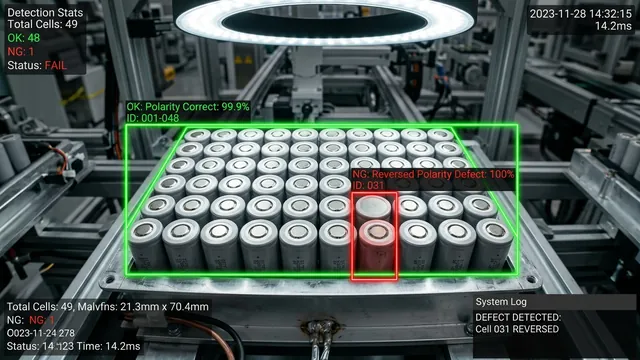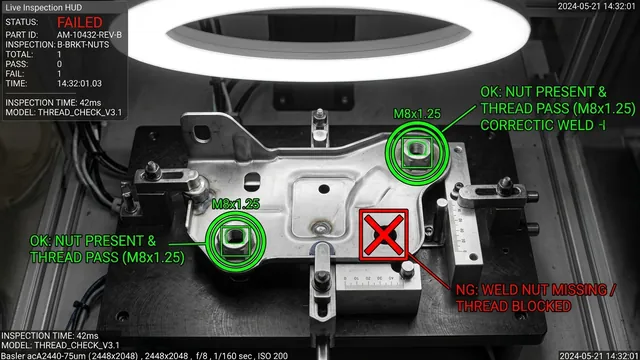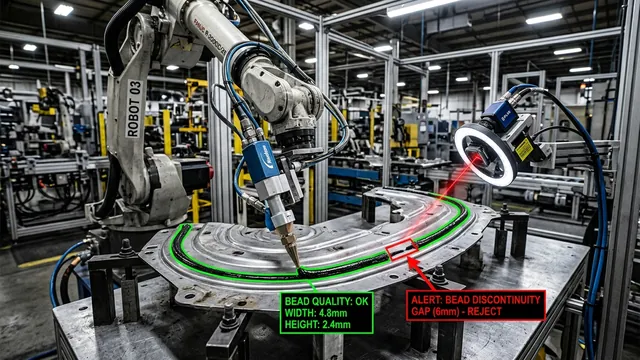

In pharmaceutical and biopharmaceutical manufacturing, automated visual inspection is not merely a quality assurance safeguard—it is a critical patient safety prerequisite governed by rigorous global pharmacopeias, including USP <790>, USP <1790>, and Ph. Eur. 5.1.4. An undetected sub-visible glass delamination flake in an injectable parenteral vial, a chipped or foreign tablet sealed into a high-speed blister pack, or an illegible expiration date on an oncology medication can lead to embolisms, therapeutic failure, nationwide product quarantines, and devastating regulatory injunctions.
Key Takeaways
- Swirl-and-Stop Kinematics for Particulates: High-speed parenteral liquid vial inspection spins vials up to 4,000 RPM and arrests rotation instantaneously, utilizing temporal difference imaging and optical flow to distinguish moving foreign particles from static container scratches and bubbles.
- 360-Degree Lyophilized Cake Inspection: Multi-camera vision arrays inspect freeze-dried cakes for meltback, collapse, micro-cracks, and shrinkage across top, side, and bottom container surfaces.
- Blister Pack Defect Classification: Deep learning segmentation inspects formed aluminum and thermoformed PVC blisters at up to 600 blisters per minute, catching crushed tablets, pinholes, foreign cross-contaminants, and channel leaks.
- Regulatory Compliance Architecture: Every automated inspection decision must satisfy FDA 21 CFR Part 11 and EU GMP Annex 11, incorporating SHA-256 encrypted audit trails, time-synchronized cryptographic image logging, and GAMP 5 validation documentation.
- Telecentric Optics & Darkfield Illumination: Eliminating perspective distortion and edge refraction through bi-telecentric lenses and collimated laser backlighting allows sub-10-micron dimensional metrology on vial crimp seals and stopper heights.
Summary Overview: Inspection Paradigms in Pharmaceutical Packaging
| Inspection Metric | Manual Visual Inspection (MVI) | Legacy Rule-Based Machine Vision | AI Deep Learning Computer Vision |
|---|---|---|---|
| Inspection Speed Throughput | 5 - 15 containers/min (Fatigue limited) | 200 - 400 containers/min | 600+ containers/min with Edge AI |
| Particulate Detection Threshold | > 50 μm (Statistically inconsistent) | > 25 μm (High false reject on bubbles) | > 5 μm (Deterministic AI classification) |
| Lyophilized Cake Defect Grading | Subjective, operator-dependent | Fails on normal surface shrinkage fissures | Semantic segmentation isolates true meltback |
| Lot/Expiry OCR Validation | Sample checks only (Batch testing) | Brittle on curved vials or inkjet bleed | 100% In-Line OCV with Deep Transformer OCR |
| Validation & Audit Trail | Paper logbooks (Human error prone) | Basic pass/fail counts | 21 CFR Part 11 compliant hashed logs & images |
| False Rejection Rate (FRR) | Variable (5% - 12%) | 3.5% - 8.0% (Costly drug product scrap) | < 0.3% while maintaining zero escapes |
For decades, pharmaceutical fill-finish and packaging facilities relied heavily on human Manual Visual Inspection (MVI) booths, where human operators visually scanned vials against black-and-white contrasting backgrounds for five seconds each. Clinical studies published by the Parenteral Drug Association (PDA) prove that human inspector detection probability drops steeply after just 20 minutes of continuous inspection due to ophthalmic fatigue, saccadic eye movement errors, and cognitive saturation. Furthermore, as sterile packaging lines accelerate to 400 to 600 vials per minute, 100% human visual inspection becomes physically impossible.
While early automated inspection machines (AIM) introduced basic photo-diode arrays and rule-based edge detection, they suffered from crippling false rejection rates. These legacy systems routinely flagged harmless micro-air-bubbles, meniscus meniscus curvature reflections, and minor cosmetic glass mold seams as lethal foreign particulates, forcing plants to discard tens of thousands of dollars worth of expensive biological drug product each shift. Today, state-of-the-art fill-finish suites are deploying edge AI-driven computer vision services that combine sub-pixel telecentric optics, multi-spectral strobe arrays, and temporal neural tracking to achieve verifiable zero-defect production. To integrate cleanroom-grade vision systems into your line, explore our enterprise manufacturing AI solutions.
Evaluating Automated Optical Inspection for Your Line?
Send us 5–10 sample images of your OK/NG parts or share your cycle-time and lighting constraints. Our Computer Vision architects will benchmark detection feasibility within 48 hours—or join a 20-minute technical scoping session.
Parenteral Liquid Vial Inspection: The Swirl-and-Stop Methodology
Inspecting liquid injectables for extrinsic contaminants (such as glass slivers, metal fibers, hair, rubber stopper coring fragments) and intrinsic particulates (protein aggregates and precipitates) is an intricate optical challenge. The contaminant is submerged inside a reflective, refractive cylindrical glass container with a dynamic fluid meniscus.
1. High-Speed Kinematics and Fluid Dynamics
To differentiate particulate matter from scratches on the exterior glass vial wall, automated inspection machines execute a mechanical sequence known as Swirl-and-Stop:
- The glass vial is secured in a precision rotary starwheel spindle and accelerated to high rotational speeds (typically 2,500 to 4,000 RPM) for 150 milliseconds.
- The high angular velocity forces the liquid contents and any suspended particulates into a forced vortex. Centrifugal and drag forces suspend heavy foreign bodies away from the vial bottom.
- The mechanical spindle is arrested instantaneously by an electromagnetic brake, bringing the glass container to a dead stop within 15 milliseconds.
- Due to angular momentum, the liquid within the vial continues to spin rapidly, carrying any suspended particulate matter in a continuous rotational vortex while the glass container remains completely stationary.
2. Temporal Differencing and Trajectory Optical Flow
During the post-stop phase, high-frame-rate global shutter CMOS cameras acquire a burst of 12 to 24 consecutive images under structured darkfield illumination over a 60-millisecond inspection window.
Our vision software pipeline applies a temporal frame differencing algorithm:
ΔI(x, y, t) = |I(x, y, t) - I(x, y, t - Δt)|
Because the glass vial wall, container scratches, ambient dust on the outer glass surface, and the machine background are completely stationary, their pixel intensity values subtract to zero in the difference image. Conversely, particulate matter carried by the rotating fluid generates high-contrast positive and negative pixel dipole pairs that move across the temporal sequence along predictable elliptical trajectories.
3. Discriminating Micro-Bubbles from Solid Particulates
A primary cause of false scrap in legacy inspection machines is micro-air-bubbles generated during high-speed rotational agitation. Both bubbles and heavy particulates move. To prevent discarding flawless vials, our deep neural models evaluate two distinct physical behaviors:
- Buoyancy vs. Gravity Vectors: Bubbles possess positive buoyancy and ascend along a helical path toward the fluid meniscus. Dense contaminants (glass fragments, stainless steel burrs, rubber corings) possess negative or neutral buoyancy and slowly settle toward the vial bottom or remain in the lower fluid vortex.
- Optical Refractive Core Signatures: Under collimated darkfield backlighting, air bubbles act as divergent spherical microlenses, exhibiting a bright central point of light surrounded by a sharp, concentric dark ring. Solid irregular foreign particulates (like glass delamination flakes or fibrous cotton lint) scatter light diffusely across irregular crystalline facets without spherical symmetry.
"In parenteral drug manufacturing, false rejects are not just an operational cost—they waste lifesaving therapies. Deep learning gives us the spatial intelligence to distinguish an ascending 15-micron air bubble from a lethal glass flake in six milliseconds."
Lyophilized Cake Cosmetic and Structural Inspection
Freeze-dried (lyophilized) biologic drugs are packaged as solid porous cakes inside sealed glass vials. Unlike liquid formulations, lyophilized cakes cannot be swirled. Inspection requires high-resolution multi-camera geometric mapping across 360 degrees of container rotation.
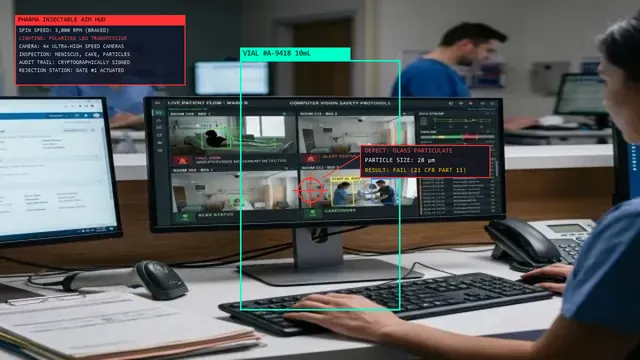
Pharmaceutical Automated Inspection Specifications
| Inspection Station | Optical & Motion Methodology | Regulatory Standard |
|---|---|---|
| Liquid Particle Tracking | Spin-and-Brake (3,000 RPM braked to 0 RPM) | USP <790> / <1790> sub-visible particulate detection. |
| Stopper & Crimp Seating | 360-degree lateral telecentric rotation view | Detects missing stoppers, wrinkled crimp skirts, and unsealed vials. |
| Lyophilized Cake Integrity | Top-down diffuse ring + bottom-up darkfield | Identifies melt-back, collapse, cake shrinkage, and splash-up defects. |
| Data Integrity & Audit Trail | Cryptographically signed inspection logs | Strict compliance with FDA 21 CFR Part 11 and EU Annex 11. |
Our inspection algorithms employ deep semantic instance segmentation combined with unsupervised anomaly detection (e.g., PatchCore backbones). Natural, benign shrinkage fissures that occur during the cryogenic sublimation process are classified as acceptable, while critical structural defects—such as eutectic meltback, basal collapse, and splatter onto the rubber stopper neck—are isolated and rejected with 100% repeatability.
High-Speed Blister Pack Integrity and Tablet Verification
In oral solid dosage packaging, thermoformed PVC/PVDC and cold-formed aluminum blister packaging lines run at up to 600 blister cards per minute. An automated vision cell mounted directly over the blister webbing before the lidding foil heat-sealing station performs comprehensive micro-defect inspection.
1. Tablet Presence, Integrity, and Foreign Contamination
The vision station inspects every individual formed pocket for four concurrent defect classes:
- Empty Pockets: Identifying missing capsules or tablets caused by feeder bowl jams.
- Physical Degradation: Chipped edges, bifurcated tablets, surface capping, laminations, and cracked gelatin capsule shells.
- Cross-Contamination: Detecting tablets of an incorrect active ingredient, wrong color, incorrect embossing imprint, or wrong physical dimensions accidentally introduced from an adjacent packaging line.
- Extraneous Dust & Loose Powder: Measuring tablet abrasion dust within the pocket that could prevent proper heat-sealing of the lidding foil.
2. Pinhole Perforation and Seal Grid Embossing
For cold-formed aluminum-aluminum (Alu-Alu) blister packs, the mechanical stamping pins that form deep pockets can stretch the ductile aluminum foil past its yield point, creating microscopic pinholes as small as 10 to 25 microns. If sealed, ambient humidity penetrates the pocket, degrading moisture-sensitive active pharmaceutical ingredients (APIs).
Our inspection systems utilize high-intensity collimated short-wavelength LED backlight panels situated below the web, while a high-sensitivity line-scan sensor monitors the top. Any light transmission through the opaque aluminum substrate indicates a structural breach, immediately flagging the blister pocket. Simultaneously, top-down coaxial lighting verifies the cross-hatched knurled embossing pattern of the heat-sealed flange, ensuring that temperature, pressure, and dwell time have created a continuous hermetic micro-weld across all perimeter channels.
Regulatory Compliance: FDA 21 CFR Part 11 and EU GMP Annex 11
Installing computer vision in regulated pharmaceutical environments requires full adherence to strict data integrity and computerized system validation mandates. A vision system that makes brilliant classification decisions is un-deployable if its software architecture cannot pass an FDA cGMP audit.
Our pharmaceutical vision architecture is designed from the silicon up to guarantee compliance with FDA 21 CFR Part 11, EU GMP Annex 11, and GAMP 5 (Good Automated Manufacturing Practice) lifecycles:
- Cryptographically Hashed Audit Trails: Every operator interaction, recipe modification, lighting calibration shift, and threshold parameter adjustment is committed to an append-only SQLite database. Each log record is hashed using SHA-256 and chained to the previous entry, providing mathematical proof against retrospective modification or tampering.
- Role-Based Access Control (RBAC): The system enforces strict multi-tier user authorization (Operator, Quality Technician, Supervisor, System Administrator) linked to active enterprise directory services (LDAP / Active Directory) with mandatory password expiration and dual-signature verification for recipe deployment.
- Non-Repudiation Image Archiving: Every rejected vial or blister pack generates an inspection package containing the raw uncompressed TIFF/PNG image, detected bounding coordinates, neural confidence scores, timestamp synchronized to an NTP grandmaster clock, and the active batch recipe version.
- GAMP 5 Validation Documentation: Every vision cell includes full validation execution packages: User Requirements Specification (URS), Functional Specification (FS), Installation Qualification (IQ), Operational Qualification (OQ), and Performance Qualification (PQ) protocols with test scripts and traceability matrices.
Deep Learning Optical Character Recognition (OCR) and OCV
Every pharmaceutical package must display a clear, accurate Lot Number, Manufacturing Date, Expiration Date, and 2D GS1 DataMatrix barcode. Failure to verify these text elements leads to massive recalls.
Traditional OCR tools in legacy machine vision rely on rigid font grids (correlation template matching). If an industrial thermal inkjet (TIJ) or continuous inkjet (CIJ) print head suffers from a partially clogged nozzle, slight ink splatter, or print distortion over curved vial glass, legacy OCR fails and halts the production line. Our vision systems deploy modern transformer-based deep learning OCR and Optical Character Verification (OCV) models. Pre-trained on pharmaceutical fonts and fine-tuned for high-speed industrial printing, the model evaluates character syntax, stroke continuity, and semantic validity, reliably reading printed strings even on curved, frosted, or high-gloss transparent surfaces with 99.999% reading confidence.
To discover more about our embedded architectures and edge compute deployments, visit our edge AI development company overview. To evaluate the cost benefits of modernizing your visual inspection systems, try our Computer Vision ROI Estimator, or contact our life-sciences engineering group to arrange a feasibility study on your product containers.
Frequently Asked Questions
How does swirl-and-stop vision distinguish between particulate contaminants and air bubbles in liquid vials?
The system spins the vial up to 4,000 RPM and stops it abruptly. The fluid continues to spin while the vial wall remains static. Consecutive high-speed frames are captured. Air bubbles exhibit positive buoyancy and rise toward the surface with a distinctive spherical bright-centered optical profile. In contrast, heavy particulates like glass shards, metal fibers, or rubber corings settle toward the bottom or follow chaotic trajectories with multi-faceted diffuse scattering.
What regulatory frameworks govern automated pharmaceutical computer vision inspection?
Automated vision systems in pharma must comply with FDA 21 CFR Part 11 and EU GMP Annex 11 for electronic records, signatures, and audit trails. The inspection quality standards are defined by USP <790> and USP <1790> for visible particulates in injectables, along with Ph. Eur. 5.1.4. Software development and commissioning must strictly follow GAMP 5 validation lifecycles.
Can computer vision inspect lyophilized (freeze-dried) cakes without damaging the container?
Yes. Non-destructive optical inspection uses multi-camera arrays positioned around the top, sidewall, and bottom of the vial. High-speed line-scan and area cameras capture 360-degree views of the rotating cake. Deep learning segmentation models evaluate the surface texture and volume to detect critical defects such as meltback, structural collapse, puffing, and glass delamination lamellae.
How small of a particulate can modern pharmaceutical vision systems reliably detect?
With bi-telecentric lenses, sub-pixel edge detection, and structured laser darkfield illumination, automated vision systems routinely detect moving particulates as small as 5 to 10 microns in clear parenteral solutions. This far exceeds the human visual inspection limit of approximately 50 microns established in USP <790>.
How does the system ensure data integrity and prevent tampering with inspection logs?
The inspection software implements cryptographically hashed append-only audit trails using SHA-256 signatures for every event, reject decision, and parameter modification. Inspection images and telemetry logs are timestamped using high-precision NTP servers, stored on encrypted local media, and transferred securely to validated MES/LIMS servers with full user role-based access control.