
In high-speed Consumer Packaged Goods (CPG), Fast-Moving Consumer Goods (FMCG), and discrete furniture manufacturing, product completeness is a non-negotiable metric of brand reputation and customer satisfaction. A package of instant noodles missing its chili oil seasoning sachet, a child's juice pouch devoid of its puncture straw, an unsealed promotional collectible card in a breakfast cereal box, or a flat-pack furniture carton omitting its hex wrench and fastener hardware bag results in immediate consumer frustration, social media backlash, retail vendor fines, and expensive return logistics.
Key Takeaways
- Beyond Checkweighers: Modern ultra-lightweight promotional cards and 3-gram liquid flavor pouches fall within the standard tare weight variance of the outer cardboard package, rendering mechanical inline checkweighers incapable of verifying presence.
- Overcoming Severe Optical Glare: High-barrier metallized mylar foil pouches and poly-wrap create specular reflections that blind standard threshold vision. Cross-polarized coaxial lighting and diffuse dark-field illumination decouple glare from true geometric boundaries.
- Sub-Surface SWIR Penetration: Short-Wave Infrared (SWIR, 1050 nm to 1550 nm) imaging penetrates translucent polymers and unbleached kraft paperboard, revealing enclosed liquids and metallic foil sachets without ionizing radiation.
- Instance Segmentation over Bounding Boxes: Crinkled sachets and randomly folded plastic bags change contours unpredictably. Deep learning instance segmentation models (such as YOLOv8-seg and fine-tuned MobileSAM) extract pixel-precise boundaries to verify both presence and package integrity.
- Edge Determinism: Deploying optimized ONNX/TensorRT segmentation models on industrial edge PCs guarantees complete visual packaging verification in under 8 milliseconds at line speeds up to 120 packages per minute.
Summary Overview: Packaging Verification Technologies Compared
| Verification Modality | Inline Checkweighers | Rule-Based Machine Vision | Industrial X-Ray Systems | AI Deep Learning Vision (Visible + SWIR) |
|---|---|---|---|---|
| Lightweight Enclosure Detection (< 5g) | Fails (masked by product tare weight variance) | Marginal (fails on crumpled foil/reflections) | Good for metals; poor for thin plastics/paper | 100% Reliable across all materials |
| Resistance to Crinkling & Rotation | N/A (Weight only) | Very Poor (Template matching breaks on folds) | Moderate (Requires density gradient calibration) | Invariant to rotation, scale, and 3D folding |
| Throughput Capability | Up to 300 ppm (dynamic settling limits) | Up to 600 ppm | 150 - 300 ppm (radiation shielding constraints) | 600+ ppm with Edge TensorRT acceleration |
| Capital Expenditure (CapEx) & Safety | Low to Moderate / Safe | Moderate / Safe | Very High / Ionizing radiation audits required | Moderate / Non-ionizing optical safety (Class 1) |
| Secondary Defect Inspection | None | Basic 1D Barcode readability | Gross dense foreign bodies only | Seal breach, tear detection, barcode, orientation |
Historically, packaging lines relied on physical checkweighers positioned downstream of the case packer to catch missing enclosures. However, modern high-speed packaging physics expose the fatal flaw of gravimetric verification. In an instant noodle bowl weighing 85 grams, the noodle cake naturally exhibits a manufacturing batch weight variance of ±4.5 grams due to ambient flour humidity, oil absorption during frying, and atmospheric drying fluctuations. A dehydrated vegetable sachet weighs approximately 2.8 grams, while a seasoning powder packet weighs 4.0 grams. Because the tare variance of the primary noodle cake exceeds the net weight of the missing component, a checkweigher cannot mathematically isolate whether an 83-gram bowl contains a light noodle cake with a sachet, or a heavy noodle cake missing its sachet entirely.
As a result, consumer goods manufacturers are integrating advanced optical packaging verification cells powered by deep learning computer vision directly into their secondary packaging lines. Whether inspecting an open cup before lid heat-sealing or peering through sealed cardboard via non-ionizing Short-Wave Infrared illumination, automated vision delivers deterministic, 100% in-line verification. Engineering managers looking to implement high-reliability visual inspection can leverage our turnkey computer vision services to design custom optical cells that integrate seamlessly into existing conveyor controls.
Evaluating Automated Optical Inspection for Your Line?
Send us 5–10 sample images of your OK/NG parts or share your cycle-time and lighting constraints. Our Computer Vision architects will benchmark detection feasibility within 48 hours—or join a 20-minute technical scoping session.
The Optical Challenges of Enclosed Items and Accessories
Verifying the presence, correct variant, and spatial placement of auxiliary components on continuous packaging lines presents unique physical and optical hurdles that defeat standard industrial cameras and conventional rule-based algorithms.
1. High-Specular Reflectivity from Metallized Foil
Flavor sachets, pharmaceutical desiccant packets, and promotional cards are typically sealed in aluminum-laminated barrier films (BOPP/Aluminum/PE) to maintain barrier protection against moisture and oxygen. Under standard overhead factory lighting or directional LED spotlights, these metallized films act as curved specular mirrors. Hot spots of saturated white pixels blind camera sensors, completely obliterating registration marks, brand logos, and edge boundaries. If the sachet is slightly wrinkled, the specular reflection shifts unpredictably across the frame, causing threshold-based machine vision tools (such as Keyence or Cognex pattern matching) to report false negative reject errors.
2. Severe Deformation, Crinkling, and Variable 3D Topography
Unlike rigid plastic bottles or metal cans, seasoning sachets, condiment packets, and polybagged hardware kits are flexible non-rigid bodies. When dropped from a pick-and-place feeder chute into an open carton or noodle cup, they land in arbitrary three-dimensional configurations: folded in half, twisted diagonally, curled against the inner sidewall, or partially buried beneath an adjacent flavor pouch. Rigid geometric vision algorithms that search for fixed bounding dimensions or static template contours fail catastrophically because no two inserted sachets ever exhibit the same pixel aspect ratio or boundary geometry.
3. Translucent Substrates and Low Contrast Backdrops
In the beverage and dairy sector, straw presence detection on the exterior of aseptic beverage cartons (e.g., Tetra Pak or SIG Combibloc packs) presents extreme contrast challenges. The applicator machine bonds a clear, transparent polypropylene straw sleeve to a high-gloss, multicoloured, highly printed carton exterior. In flat-pack furniture kit manufacturing, small polybags containing transparent nylon dowels or metallic silver screws are fed onto galvanized steel vibrating conveyor belts or pale cardboard tray inserts. The optical contrast between the target item and the background is frequently near-zero, rendering intensity-threshold edge detectors useless.
Advanced Optical Engineering: Polarized and Multi-Spectral Illumination
Solving these optical ambiguities requires tailoring the physics of photon delivery before images ever reach the software pipeline. Industrial packaging inspection relies on three specialized illumination paradigms:
Cross-Polarized Diffuse Illumination
To eliminate blinding glare from crinkled metallized foil sachets, packaging vision cells utilize cross-polarization techniques. A linear polarizing filter (sheet polarizer) is mounted over high-intensity LED light panels, aligning the emitted photon electric field along a single vibration plane. A second polarizing filter (the analyzer), rotated at exactly 90 degrees relative to the emitter filter, is threaded onto the camera lens.
When polarized light reflects specularly off the metallic foil surface, its polarization state is preserved, meaning the photons remain oriented along the original axis. Upon striking the orthogonal camera analyzer filter, these specular photons are completely extinguished. Conversely, photons that penetrate the surface ink layer and scatter diffusely undergo random depolarization. Approximately 50% of this depolarized light passes through the analyzer filter into the camera sensor. The resulting image exhibits zero blinding hot spots, high chromatic contrast, and razor-sharp edge contours regardless of pouch crinkling.
Short-Wave Infrared (SWIR) Transmission Vision
When packaging verification must occur after cartons, folding boxes, or opaque polymer pouches have already been closed and glued, visible light cameras cannot inspect the interior. Rather than installing expensive, heavily shielded X-ray inspection tunnels with ionizing radiation regulatory liabilities, engineers deploy Short-Wave Infrared (SWIR) machine vision.
Operating in the 1050 nm to 1700 nm spectral band using Indium Gallium Arsenide (InGaAs) sensors, SWIR wavelengths exhibit deep penetration through unbleached kraft paperboard, high-density polyethylene (HDPE), and thin polypropylene films. Hydrocarbon-based liquids (such as oil sachets or liquid flavor packets), moisture-rich powders, and metallic foil linings exhibit strong characteristic absorption or sharp reflection bands in the SWIR spectrum. Backlighting a closed cardboard carton with a high-power 1450 nm LED array allows the InGaAs camera to "see through" the cardboard shell, casting a distinct dark silhouette of the enclosed liquid sachet onto the sensor.
"Optical physics must solve the contrast problem before software can solve the classification problem. By pairing cross-polarized illumination with SWIR wavelength penetration, we eliminate 95% of the optical noise that derails standard factory automation cameras."
Deep Learning Instance Segmentation Architecture
While classical machine vision relies on pixel count thresholds and edge tools, complex packaging verification demands deep learning architectures capable of high-level semantic generalization. The modern standard utilizes real-time deep instance segmentation networks.
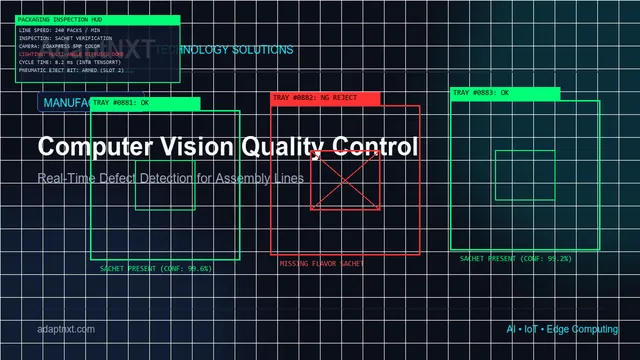
Packaging Line Inspection Operational Specifications
| Inspection Variable | Configured Metric | System Action |
|---|---|---|
| Line Conveyor Speed | 240 packages / minute (continuous motion) | Strobe flash frozen at 60 µs; zero package motion smearing. |
| Optical Illumination | Multi-Angle Diffused Dome with Cross-Polarization | Eliminates foil wrapper glint and reflection artifacts. |
| Classification Inference | 8.2 ms end-to-end cycle time on Jetson Orin Nano | Validates both presence and correct flavor variant code. |
| Rejection Mechanism | Pneumatic pusher actuated within 35 mm of vision trigger | Defective carton diverted to QA inspection bin without line halt. |
Why Instance Segmentation Surpasses Bounding-Box Detection
Standard object detection networks (such as standard YOLOv8 or Faster R-CNN) output rectangular bounding boxes ([xmin, ymin, xmax, ymax]). In packaging verification, rectangular boxes are fatally insufficient. Consider a cup of instant noodles containing two overlapping sachets: a rectangular box around one sachet overlaps 70% of the second sachet. If the sachet is partially folded, the bounding box area includes empty background space or portions of the noodle cake, making it impossible to calculate the actual visible surface area of the pouch.
In contrast, Instance Segmentation (YOLOv8-seg / MobileSAM) generates a pixel-level binary mask for every individual object instance. The network architecture splits processing into two parallel heads: a detection head that predicts bounding boxes and mask coefficients, and a prototype mask head that outputs 32 high-resolution feature maps covering the entire image. By calculating the linear combination of the prototype masks weighted by the predicted coefficients and passing the result through a sigmoid activation function, the model produces exact polygon contours of each sachet in under 4 milliseconds.
Classifying Multiple Sachet Variants in a Single Frame
Modern packaging lines frequently require the insertion of multiple distinct accessories within the same package. For instance, a premium instant noodle product requires:
- One dehydrated vegetable flake sachet (green printed foil).
- One soup seasoning powder sachet (silver metallized foil).
- One concentrated chili oil liquid pouch (transparent polymer with dark red fluid).
- One foldable plastic fork (injection-molded white polypropylene).
Our deep learning segmentation model is trained to recognize each item as an independent semantic class. If the machine vision system detects the soup base and the fork, but the liquid chili pouch is absent, the system flags a specific defect code: DEFECT_MISSING_LIQUID_SACHET. This granular diagnostic classification is instantly relayed to the upstream robotic feeding station, notifying plant technicians of a jammed feeder magazine before hundreds of defective units are packaged.
Detecting Pinched Sachets in Seal Flanges
A catastrophic failure mode on form-fill-seal (FFS) flow wrapping and cup lidding lines occurs when a flexible sachet or accessory is inserted incorrectly, protruding into the perimeter flange where the outer packaging is heat-sealed. When the heated sealing jaws clamp down, they crush the sachet, rupturing oil or powder across the seal boundary. The package loses hermetic seal integrity, leading to product spoilage, rancidity, and oil leaks that contaminate entire shipping cartons.
Our vision architecture incorporates an automated Flange Exclusion Zone Inspection routine:
- The vision pipeline dynamically identifies the inner perimeter boundary of the cup lip or carton flap using sub-pixel edge detection.
- A safety buffer zone (e.g., 5.0 mm inward from the seal seam) is algorithmically defined in camera coordinates.
- The segmentation masks of all enclosed items are checked for spatial intersection with this exclusion zone polygon.
- If any pixel of an enclosed sachet mask transgresses into the seal margin, an immediate high-priority reject trigger is fired, and the packaging line's lidding station is temporarily paused to prevent sealing jaw contamination.
High-Speed Rejection and PLC Industrial Handshake
To operate seamlessly on lines packaging up to 120 units per minute, the vision inspection station must interface deterministically with the plant's automation architecture. Through our production-tested manufacturing AI solutions, vision controllers communicate directly with Siemens, Rockwell Automation, and Beckhoff PLCs via real-time industrial fieldbuses.
When an incomplete package is identified:
- The vision processor assigns a unique tracking index to the defective unit based on the line's rotary encoder pulse count.
- The defect classification code (Missing Sachet, Wrong Flavor Variant, or Flange Pinch Violation) is written into an industrial FIFO tracking queue in PLC register memory over EtherNet/IP or PROFINET.
- As the defective package reaches the downstream rejection station—typically an air-blast nozzle for lightweight cartons or a high-speed servo-pneumatic pusher arm—the PLC high-speed output card triggers the rejection mechanism with sub-millisecond repeatability, safely diverting the unit into a rework bin without slowing line throughput.
Edge AI Hardware Deployment and Thermal Durability
Packaging plants in the food and consumer goods sectors are harsh physical environments subject to flour dust, sugar particulate, high humidity, and daily chemical washdowns. Installing delicate consumer-grade computing hardware on these lines leads to catastrophic hardware failure.
Our packaging inspection systems are deployed on fanless, IP65/IP67-rated industrial edge computing hardware (such as the NVIDIA Jetson AGX Orin Industrial or ruggedized x86 industrial PCs featuring NVIDIA RTX embedded GPUs). Encased in 316 stainless steel enclosures with M12 industrial circular connectors for camera GigE Vision links and 24V power, these units operate in ambient temperatures from -20°C to +70°C without active airflow. Learn more about our rugged edge architecture capabilities on our edge AI development company overview.
To calculate potential labor and scrap savings from automating packaging completeness checks, try our interactive Computer Vision ROI Estimator. Ready to integrate zero-defect packaging verification on your lines? Contact our vision engineering team today to discuss your package specifications.
Frequently Asked Questions
Why can't inline checkweighers reliably detect missing seasoning sachets?
Inline checkweighers measure total package weight. In many food and FMCG items, the baseline weight of the primary product (such as noodles, cereal, or chips) varies naturally by plus or minus 5 grams due to moisture absorption and manufacturing tolerances. Because a seasoning sachet or accessory item often weighs only 2 to 4 grams, its absence falls completely within the product's natural tare weight variance, making gravimetric detection mathematically impossible.
How does computer vision handle severe glare from metallic foil pouches?
We utilize cross-polarized illumination. A linear polarizing filter is placed over high-intensity LED light panels, and an orthogonal analyzer filter is mounted to the camera lens. Direct specular reflections preserve polarization and are completely blocked by the lens filter, while diffuse light scattered by the packaging inks passes through freely. This eliminates blinding white hot spots and reveals crisp brand graphics and contour edges.
Can computer vision detect sachets inside sealed cardboard cartons or opaque containers?
Yes, by utilizing Short-Wave Infrared (SWIR) imaging in the 1050 nm to 1700 nm spectrum. SWIR wavelengths penetrate unbleached kraft paperboard, high-density polyethylene, and thin plastic films. Liquid oil pouches and metallic barrier foils absorb or reflect SWIR light strongly, allowing InGaAs infrared cameras to cast distinct silhouette images of enclosed items through the closed outer packaging without requiring ionizing X-rays.
What happens if a sachet lands partially crumpled or folded?
Unlike traditional rule-based vision systems that fail when an item deviates from a rigid geometric template, our systems deploy deep learning instance segmentation models (such as YOLOv8-seg). These neural networks are trained on thousands of variations of folded, twisted, rotated, and partially occluded sachets. The AI generates a pixel-precise polygon mask, accurately identifying the item and verifying presence regardless of physical distortion.
Can the vision system prevent packaging machines from heat-sealing over a sachet?
Yes. The system performs Flange Exclusion Zone Inspection. By defining a virtual boundary around the package seal lip or flap in software, the vision model checks whether any portion of the sachet segmentation mask crosses into the sealing zone. If an item is resting on the cup rim, the system triggers an emergency divert or pauses the heat-sealing jaws before packaging material is contaminated.