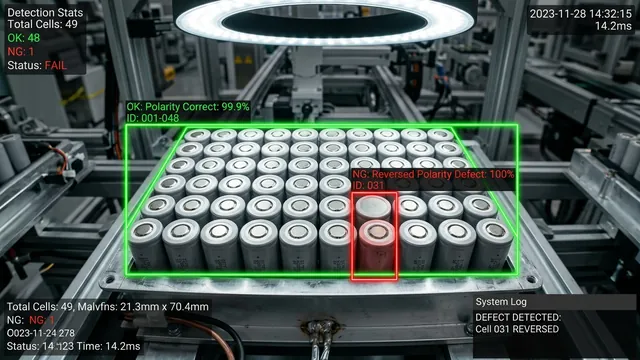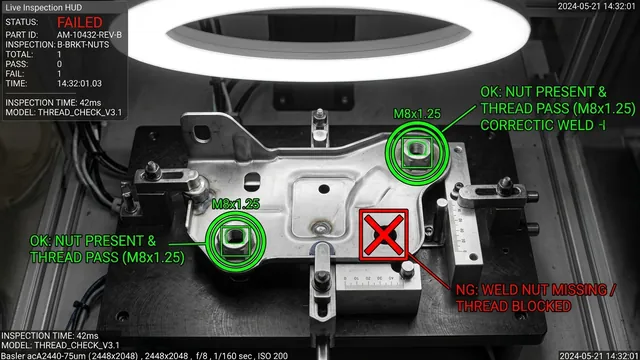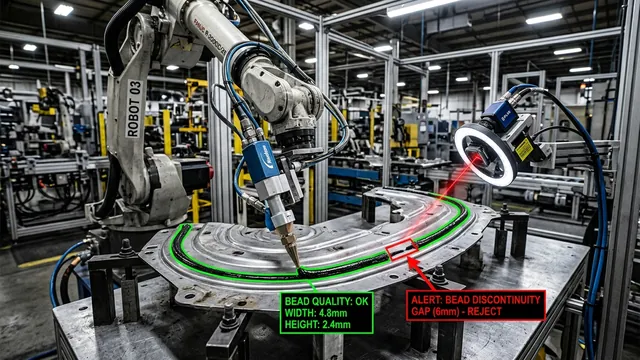

For more than three decades, the industrial automation sector has relied on proprietary "smart cameras" from dominant machine vision vendors like Cognex (In-Sight series) and Keyence (IV, IV3, and IV4 series). These all-in-one vision sensors packaged an image sensor, a dedicated microprocessor or FPGA, integrated LED illumination, and proprietary vision software into a rugged, IP67-rated enclosure. For automation engineers tasked with basic presence/absence detection, single-point barcode reading, or dimensional gauging on discrete manufacturing lines, smart cameras offered rapid, turnkey deployment without requiring software engineering expertise.
However, the explosion of modern deep learning, high-density edge computing, and complex defect inspection requirements has exposed severe architectural and economic constraints inherent to proprietary smart camera ecosystems. Today, manufacturing CTOs and systems integration leaders face a pivotal architectural crossroads: should they continue purchasing $4,000–$9,000 proprietary smart cameras for every single inspection point, or transition to a modular, open-architecture Custom Edge AI vision stack based on industrial GigE Vision cameras, NVIDIA Jetson Orin compute engines, and state-of-the-art neural networks like YOLOv10 and RT-DETR?
Evaluating Automated Optical Inspection for Your Line?
Send us 5–10 sample images of your OK/NG parts or share your cycle-time and lighting constraints. Our Computer Vision architects will benchmark detection feasibility within 48 hours—or join a 20-minute technical scoping session.
Key Takeaways
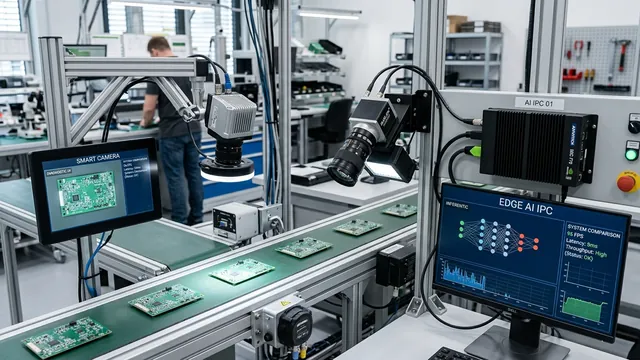
- The Architectural Divide: Proprietary smart cameras bundle optics, lighting, compute, and firmware into a single closed appliance. Custom Edge AI decouples the vision stack into modular industrial cameras (GigE/USB3), centralized edge GPU compute (NVIDIA Jetson), and open-source Linux/PyTorch/TensorRT neural runtimes.
- Multi-Camera Scaling Economics: On production lines requiring multi-angle inspection (4 to 8 viewpoints), smart cameras scale linearly at $4,000–$8,000 per camera head ($16,000–$64,000 total). A centralized Edge AI controller processes all 8 camera feeds simultaneously on a single Jetson AGX Orin or Orin NX, slashing per-station hardware bills of materials (BOM) by 60% to 75%.
- Neural Network Sovereignty: Proprietary smart camera AI tools are "black boxes" with locked model heads, limited classification labels, and restricted image capture buffers. Custom Edge AI allows arbitrary neural architectures (multi-task segmentation, pose estimation, custom transformers), domain-specific loss functions, and active learning MLOps pipelines.
- Enterprise Telemetry & MLOps: Smart cameras struggle with high-bandwidth image streaming to cloud data lakes. Custom Edge AI systems natively stream telemetry, bounding box metadata, and raw image samples over MQTT, Kafka, and S3 APIs, enabling continuous model retraining and Over-The-Air (OTA) weight updates.
Deconstructing the Two Architectures
To make an informed engineering choice, one must evaluate the physical, computational, and software topologies of both paradigms.
1. The Proprietary Smart Camera Architecture
A smart camera is an integrated edge appliance. The housing contains an image sensor (often 1.3 MP to 5 MP), a fixed or liquid-tunable lens, an integrated LED ring illuminator, a low-power digital signal processor (DSP) or FPGA, and proprietary firmware (e.g., Cognex In-Sight OS or Keyence IV-Navigator). Configuration is conducted over a closed Windows GUI utility (such as Cognex In-Sight Explorer or Keyence Vision Creator).
While newer iterations (such as the Cognex In-Sight 2800/3800 or Keyence IV4) market "embedded AI" or "edge learning," these algorithms are heavily constrained. They typically consist of pre-trained shallow classifiers or feature-extractor backbones with fixed classification heads. The engineer has no access to the underlying neural network weights, cannot export the model to ONNX, cannot modify layer hyperparameters, and cannot retrain on an external GPU cluster.
2. The Modular Custom Edge AI Vision Architecture
In contrast, a Custom Edge AI vision architecture decouples the physical sensing layer from the computation layer:
- Imaging Layer: Commercial off-the-shelf (COTS) industrial GigE Vision or USB3 Vision cameras (e.g., Basler ace 2, FLIR Blackfly S, Lucid Vision Helios, The Imaging Source). Sensors feature high-performance Sony Pregius global shutter CMOS chips ranging from 2 MP to 24+ MP, paired with standard C-mount precision lenses (telecentric, fixed focal length, or polarized).
- Illumination Layer: Application-specific illumination (diffuse dome, low-angle darkfield, coaxial, or high-intensity bar lights) driven by dedicated strobe controllers with microsecond timing.
- Compute Layer: Ruggedized, fanless industrial edge PCs housing NVIDIA Jetson system-on-modules (Orin Nano, Orin NX, or AGX Orin) providing 20 to 275 TOPS of INT8/FP16 compute power, operating within a -20°C to +70°C thermal envelope.
- Software Stack: Standard Ubuntu LTS Linux, NVIDIA JetPack, containerized Docker microservices, GenICam camera drivers, OpenCV, and TensorRT-optimized neural networks (YOLOv10, RT-DETR, Segment Anything, or custom transformer backbones).
Adopting this modular paradigm is at the core of our edge AI development practice at AdaptNXT, delivering vendor independence and unlimited algorithmic runway to enterprise manufacturers.
Detailed Engineering Comparison: 10 Core Architectural Dimensions
The table below provides an exhaustive technical benchmark comparing proprietary smart vision sensors against custom edge AI systems across hardware, algorithmic, and financial parameters:
| Engineering Dimension | Proprietary Smart Cameras (Keyence / Cognex) | Custom Edge AI (NVIDIA Jetson / TensorRT / YOLO) |
|---|---|---|
| Compute Performance & Hardware Acceleration | Embedded DSP / Low-tier FPGA (typically 1 – 5 TOPS equivalent). Heavily limited memory bandwidth. | Dedicated Ampere/Blackwell Tensor Cores (20 to 275 TOPS). High-bandwidth unified LPDDR5 memory (up to 64GB). |
| Sensor Resolution & Lens Modularity | Fixed internal sensor (usually 0.4 MP – 5 MP). Integrated autofocus/liquid lens with optical aberrations at periphery. | Full modularity: Any C-mount/F-mount lens (telecentric, macro, wide-angle). Sensors from 1.3 MP to 45+ MP. |
| Multi-Camera Scaling & Synchronization | 1 smart camera = 1 viewpoint. Inspecting 6 angles requires 6 discrete $5,000 smart units and complex cross-wiring. | 1 edge controller ingests 4 to 8 synchronized GigE/PoE cameras. Hardware PTP (IEEE 1588) sub-microsecond sync. |
| Model Architecture & Algorithmic Freedom | Closed "black-box" toolsets. Only vendor-provided classification or OCR tools; no custom loss functions or multi-head models. | Unlimited: Deploy YOLOv10, RT-DETR, Mask R-CNN, TrOCR, custom UNet, or 3D point cloud models via ONNX/TensorRT. |
| Inference Latency on High-Resolution Images | 100 – 350 ms for complex inspections; frequently requires downsampling to 640x480 to maintain cycle time. | 10 – 35 ms in FP16/INT8 precision at full 4K resolution on Jetson Orin NX / AGX Orin. |
| Software Licensing & Vendor Lock-In | Proprietary Windows software suites, USB hardware dongles, annual maintenance fees, locked feature tiers. | Open-source Linux/ROS2 stack, zero recurring licensing fees, zero vendor lock-in. Full ownership of source code. |
| Continuous Retraining & MLOps Lifecycle | Manual retraining on an engineer's laptop. Edge devices cannot buffer raw images due to minimal flash storage (1–4GB). | Automated active learning: Edge buffers borderline samples to NVMe SSD, pushes to S3; retraining occurs in cloud/on-prem GPU. |
| Telemetry, ERP & MES Integration | Primarily discrete 24V I/O or industrial fieldbus (EtherNet/IP, PROFINET). Cloud/REST streaming requires external gateways. | Native fieldbus (OPC UA, Modbus TCP, EtherNet/IP) plus native IT protocols: MQTT, Kafka, gRPC, REST, and SQL logging. |
| Field Maintainability & Hardware Obsolescence | When an internal sensor or light fails, the entire $6,000 smart unit must be replaced. End-of-life cycles force complete station re-engineering. | Modular maintenance: If a lens scratches or a camera fails, replace a $400 COTS camera without replacing the compute node. |
| Per-Unit Hardware Cost (5-Camera Station) | $25,000 – $40,000 (5 smart cameras + mounting + vendor software licenses). | $8,000 – $14,000 (1 Jetson AGX Orin industrial PC + 5 GigE cameras + PoE switch + C-mount lenses). |
The Multi-Camera Scaling Bottleneck
The single greatest operational and financial flaw of proprietary smart cameras becomes painfully apparent the moment an assembly station requires more than one camera viewpoint. In modern automotive, electronics, and pharmaceutical packaging lines, components are rarely planar. Inspecting a precision machined gearbox, a complex wire harness connector, or a blister pack requires simultaneous views from top, bottom, and multiple orthogonal sides.
The Multi-Camera Math Problem
If an inspection station requires 6 camera angles, a smart camera approach forces you to deploy 6 individual smart cameras. You are paying for 6 duplicate microprocessors, 6 separate power supplies, 6 proprietary network interfaces, and 6 software configuration files that must be manually synchronized. With Custom Edge AI, a single Jetson AGX Orin industrial edge computer ingests all 6 GigE cameras over standard Power-over-Ethernet (PoE) wiring, executing a unified neural pipeline in a single synchronized memory space.
Hardware Synchronization via PTP (IEEE 1588)
When multiple smart cameras inspect a moving part on a conveyor, coordinating their acquisition triggers is notoriously difficult. Variations in internal firmware task scheduling cause microsecond-level timing jitter. One smart camera may fire 15 ms later than another, causing motion blur or imaging the part at a shifted mechanical coordinate.
In a custom Edge AI system, industrial GigE Vision cameras support the Precision Time Protocol (IEEE 1588 PTP). The edge controller acts as a grandmaster clock, synchronizing the internal clocks of all connected cameras across the Ethernet fabric to within sub-microsecond accuracy (< 1 $\mu ext{s}$). All 6 cameras expose their global shutter sensors at the exact same physical instant, freezing high-speed motion across every perspective with absolute geometric alignment.
Neural Network Adaptability: Escaping the "Black Box"
Modern manufacturing defects are nuanced. They are not simple high-contrast scratches that can be caught by counting pixels above a grayscale threshold. Consider inspecting an electric vehicle battery module: the system must verify laser weld bead uniformity, check for micro-porosity craters, verify busbar terminal torque marks, and decode 2D Data Matrix codes stamped on reflective aluminum—all in a single 2-second station cycle.
Proprietary smart cameras fail completely on this type of multi-faceted inspection because their software toolsets are monolithic. You are limited to the vendor's pre-packaged "Locate," "Pattern," "Blob," or "Edge Learning" tools.
Custom Multi-Task Learning (MTL) Heads
With an open Custom Edge AI architecture, our engineers at AdaptNXT design custom deep neural networks with multi-task prediction heads sharing a unified convolutional or transformer backbone:
- Shared Backbone (e.g., CSPDarknet or Swin Transformer): Extracts rich spatial feature representations from the 12MP input image once in GPU memory.
- Head A (Object Detection): Outputs bounding boxes and class IDs for components, fasteners, and labels via an anchor-free YOLOv10 detection head.
- Head B (Semantic Segmentation): Predicts pixel-level defect masks for adhesive beads or thermal paste coverage via a lightweight UNet decoder.
- Head C (Pose & Keypoint Estimation): Detects sub-millimeter terminal pin centroids and angular orientations for robotic pick-and-place guidance.
- Head D (OCR Sequence Decoding): Passes text regions through a CRNN or TrOCR decoder to extract traceability serial numbers.
Because the shared backbone executes only once in GPU memory, the entire multi-task inspection runs in less than 35 milliseconds on an NVIDIA Jetson Orin NX. Achieving this level of multi-modal, synchronized analysis on a proprietary smart camera is technically impossible.
Discover how we deploy multi-task deep learning architectures across high-volume factory lines in our manufacturing AI solutions.
Total Cost of Ownership (TCO): 5-Year Financial Breakdown
Automation investments must be justified over their entire operating lifecycle. While smart cameras may appear slightly simpler to install on Day 1 for a single inspection point, their Total Cost of Ownership (TCO) escalates dramatically across multi-station facilities over 3 to 5 years.
Scenario: 4 Production Stations (4 Inspection Angles per Station = 16 Viewpoints)
Consider an automotive tier-1 supplier outfitting 4 assembly cells, each requiring 4 camera viewpoints (16 cameras total):
Proprietary Smart Camera Architecture (Keyence / Cognex)
- Hardware CAPEX (16 Smart Cameras @ $6,000 avg): $96,000
- Proprietary Software Licenses & Programming Dongles: $8,500
- Integration & PLC Gateway Modules: $12,000
- Annual Maintenance & Vendor Support Contracts (5 Years): $24,000
- Component Replacement Cost (Projected 3 unit failures over 5 yrs @ $6,000): $18,000
- Total 5-Year TCO: $158,500
AdaptNXT Custom Edge AI Architecture (NVIDIA Jetson / GigE Vision)
- Hardware CAPEX (4 Rugged Jetson AGX Orin Edge PCs @ $3,200): $12,800
- Cameras (16 Industrial GigE Sony Pregius Cameras @ $650): $10,400
- Optics (16 Precision C-Mount Lenses @ $350): $5,600
- Industrial PoE Switches & Cabling: $2,800
- Software Licensing (Open-source Linux/Docker/TensorRT stack): $0
- Integration & Engineering Calibration: $22,000
- Annual Maintenance & Retraining Pipeline (5 Years): $15,000
- Component Replacement Cost (Projected 3 camera replacements @ $650): $1,950
- Total 5-Year TCO: $70,550 (55.5% Direct Savings)
Beyond the immediate $87,950 capital expenditure savings, the custom edge AI system eliminates the catastrophic risk of vendor obsolescence. If a machine vision camera vendor discontinues a smart camera model three years into production, the plant is forced to re-engineer mounting brackets, re-write PLC ladder logic, and buy expensive legacy spares. In a custom architecture, any standard GigE Vision camera from any manufacturer can be swapped into the fixture in 10 minutes without touching a single line of application code.
Industrial Enclosures and Ruggedization
A frequent objection from traditional controls engineers is that smart cameras are physically rugged (IP67 aluminum housings), whereas commercial computer hardware is perceived as fragile. In modern industrial automation, this distinction is obsolete.
Production-grade Custom Edge AI systems are deployed in fanless, solid-state industrial PCs engineered specifically for extreme manufacturing environments:
- Thermal Management: Heavy-duty extruded aluminum chassis acting as passive heat sinks, operating continuously from -25°C to +70°C without mechanical cooling fans that clog with metal dust or airborne oil mist.
- Shock & Vibration Tolerance: Fully compliant with IEC 60068-2-27 (50G shock) and MIL-STD-810H vibration standards, allowing mounting directly onto gantry robots or stamping press frames.
- IP67 / IP69K Camera Enclosures: Standard industrial cameras are housed in stainless steel or anodized aluminum protective IP67/IP69K enclosures with sapphire or tempered glass windows, fully rated for high-pressure chemical washdowns in food, beverage, and pharmaceutical facilities.
- Isolated Power Supplies: 9V to 36V wide-range DC input with 2.5 kV isolation surge protection, shielding sensitive GPU computing from high-voltage motor spikes and inductive load kickback on the factory grid.
The Decision Framework: When to Choose Which Architecture
While Custom Edge AI offers overwhelming technological and financial advantages for complex applications, proprietary smart cameras still maintain a valid niche in manufacturing plants. Engineering teams should use the following pragmatic decision framework:
The Architectural Decision Matrix
Choose Proprietary Smart Cameras (Keyence / Cognex) When:
- The inspection is strictly a single-camera station performing simple presence/absence or 1D/2D barcode reading.
- The facility has zero software engineering or Linux capabilities and relies entirely on maintenance technicians using graphical drag-and-drop teach pendants.
- Product lifecycle is short, and cycle times are relaxed (> 500 ms).
- Budget allows high per-unit CAPEX and ongoing vendor licensing costs.
Choose Custom Edge AI (NVIDIA Jetson / YOLO / GigE) When:
- The application requires multi-camera inspection (2 to 16+ synchronized views) per station.
- Defect modes are complex, low-contrast, or variable (surface flaws, cracks, weld quality, organic materials, complex assemblies).
- Cycle times demand sub-50ms inference on high-resolution (5MP to 24MP) image feeds.
- The enterprise mandates direct integration with cloud data lakes, MQTT/Kafka message brokers, and automated MLOps continuous retraining loops.
- Long-term Total Cost of Ownership (TCO) and freedom from proprietary vendor lock-in are primary strategic priorities.
For a deeper dive into our complete computer vision methodology and edge deployments, explore our comprehensive computer vision engineering services.
Future-Proofing Your Plant with Open Vision Architectures
The manufacturing plants of the next decade cannot afford to be trapped inside walled gardens. As generative vision models, multi-modal foundation models, and autonomous robotics converge on the factory floor, the agility to deploy new neural architectures, ingest multi-camera feeds, and stream real-time operational telemetry is a decisive competitive differentiator.
Proprietary smart cameras served an admirable role in the early days of automated inspection. Today, Custom Edge AI architectures powered by NVIDIA Jetson compute and open deep learning frameworks deliver higher accuracy, lower latency, infinite customizability, and more than 50% capital cost savings. If you are planning an automation retrofit or building next-generation inspection machinery, consult with our senior computer vision architects to design an open, high-performance edge vision platform tailored to your factory.
Frequently Asked Questions (FAQ)
Are custom edge AI systems harder to maintain than smart cameras?
Not when architected properly. Modern custom edge AI systems are deployed using containerized Docker microservices with Over-The-Air (OTA) update capabilities. If a camera hardware failure occurs, a replacement COTS industrial camera can be swapped in minutes without software recalibration. Operators interact with intuitive web-based touchscreen HMIs that provide clearer diagnostic visuals than traditional smart camera monitor pendants.
Can an NVIDIA Jetson handle harsh factory floor temperatures and vibration?
Yes. Commercial carrier boards and fanless industrial enclosures designed for NVIDIA Jetson modules (such as those from Advantech, AAEON, and Neousys) are rated for -25°C to +70°C operating temperatures, 50G shock resistance, and MIL-STD-810H vibration tolerance, making them every bit as rugged as traditional IP67 smart cameras.
How do custom edge vision systems communicate with existing factory PLCs?
Custom edge AI systems interface natively with industrial PLCs (Siemens, Rockwell, Mitsubishi, Beckhoff) using standard industrial protocols including Modbus TCP, EtherNet/IP, PROFINET, and OPC UA, as well as discrete opto-isolated 24V digital I/O lines for microsecond-level hardware trigger handshakes.
Why is a multi-camera Custom Edge AI setup significantly cheaper than multiple smart cameras?
In a multi-camera station (e.g., 4 to 8 angles), a smart camera approach requires purchasing 4 to 8 complete compute units, power supplies, and proprietary software licenses ($4,000 to $8,000 each). A custom Edge AI architecture uses a single centralized Jetson edge PC to process 4 to 8 economical GigE Vision cameras ($400 to $800 each), slashing hardware BOM costs by over 60%.