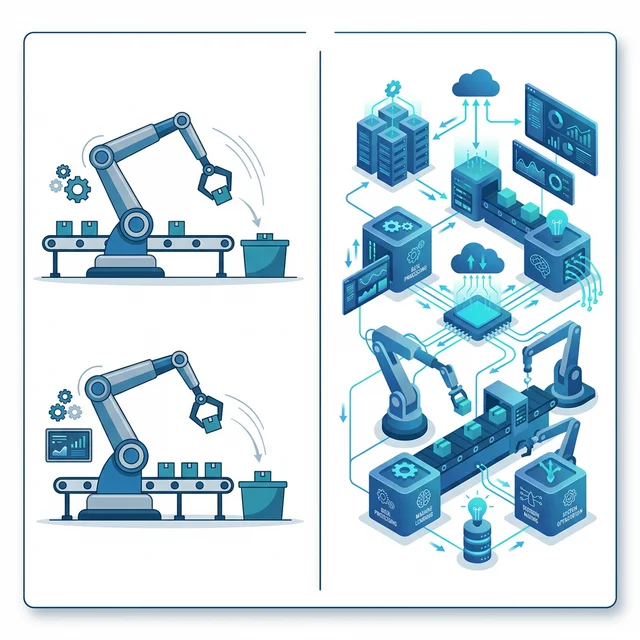

Economic downturns have a remarkable way of separating operationally excellent businesses from those coasting on favorable conditions. When revenue growth slows, businesses that reduce cost-to-serve while maintaining quality win.
Architectural Challenges in Automation
Scaling automation requires a robust architecture. Monolithic bots fail under load.
State Management
Bots often lose state during long-running transactions.
Need an Expert Opinion?
Stop guessing. Speak directly with a senior AdaptNXT engineer about your architecture, timeline, and feasibility.
Error Handling
Without robust error handling, a single failure cascades.
Security and Credentials
Hardcoding credentials is a massive risk. Use secure vaults.
Solutions to Scaling Automation
- Use idempotent operations and queue-based processing.
- Implement circuit breakers for external API calls.
- Use HashiCorp Vault or AWS Secrets Manager.
- Use distributed tracing for bot observability.
- Implement auto-scaling worker nodes.
Technical Comparison: Queues vs Webhooks
- Queues (SQS, RabbitMQ): Pros: Durable, rate-limiting. Cons: Overhead.
- Webhooks: Pros: Low latency. Cons: Missed events if endpoint is down.
"Automation architecture must assume failure is constant."
Code Implementation
Here is an example of an idempotent API call in Python:
def process_order(order_id, idempotency_key):
# Ensure idempotency
pass
Deep Dive into Automation Architecture
To truly scale automation across an enterprise, engineers must adopt a microservices mindset. Rather than building massive scripts that handle every edge case, small, single-purpose workers should communicate via message buses. This decouples the processing logic from the state management. When an API goes down, the worker can simply NACK the message, leaving it in the queue for a retry without losing any data. Furthermore, using technologies like Kubernetes for container orchestration allows the automation platform to scale dynamically based on queue depth.
Monitoring and CI/CD
Treat automation scripts as production code. Use static analysis, unit testing, and integration testing. When deploying, use canary releases to ensure new bot versions don't corrupt data.
Observability in automation means tracking not just system metrics (CPU, RAM) but business metrics (orders processed, invoices matched). Tools like Datadog or New Relic can ingest custom metrics from bot workers to alert on anomalies, such as an unexpected drop in successful transactions.
Frequently Asked Questions
Is automation only for large enterprises with big budgets?
No, automation has become highly accessible to small and medium-sized businesses thanks to cloud-based software and low-code/no-code platforms. SMBs can often see a faster ROI because they are more agile in adopting new workflows.
Will automation replace my current workforce?
While automation handles repetitive and manual tasks, it typically augments rather than replaces a workforce. Employees are freed up to focus on higher-value activities such as strategy, customer relationship building, and complex problem-solving.
How do I choose which process to automate first?
Start with processes that are high-volume, highly repetitive, and rule-based. Invoice processing, data entry, and basic customer inquiries are excellent starting points because they are easy to map out and provide immediate measurable returns.