
By an industry veteran in tech.
If you were asked to build a doghouse, you wouldn't need much of a plan. Some wood, a few nails, and a hammer would get the job done. But if you were asked to build a 100-story skyscraper, you wouldn't dare swing a hammer without consulting a highly detailed, multi-layered architectural blueprint.
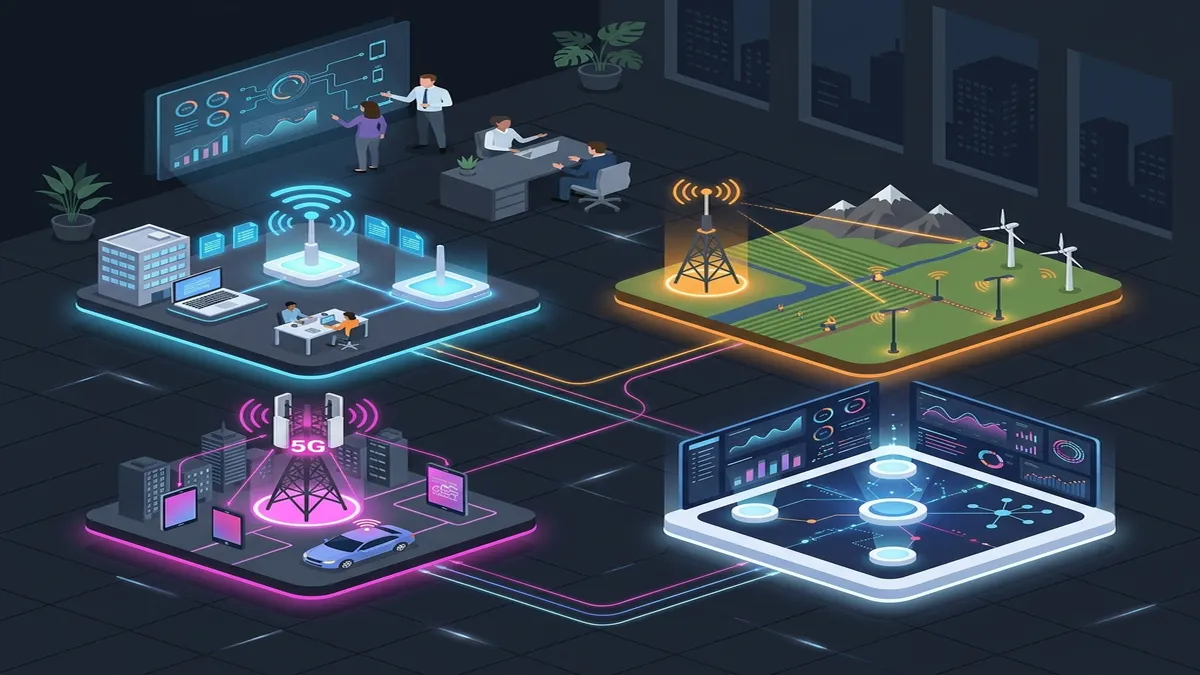
The Internet of Things (IoT) works on the same principle.
Need an Architect's Assessment?
Speak directly with a senior AdaptNXT solutions architect about your system constraints, timeline, and production feasibility.
Connecting your smartphone to a smart lightbulb is the doghouse. But connecting 10,000 sensors in an oil refinery, analyzing their data in real-time, and automating emergency shutoff valves across the globe? That’s the skyscraper.
To manage this immense complexity, the industry created a standardized blueprint. In 2014, the IoT World Forum (IoTWF) introduced the 7-Layer IoT Reference Model. It breaks down the massive undertaking of an enterprise IoT system into seven manageable, distinct layers. Let’s walk through the floors of this digital skyscraper.
Key Takeaways
- The IoTWF Reference Model provides a standardized, 7-layer framework to design, deploy, and manage complex enterprise IoT systems at scale.
- Edge Computing (Layer 3) is critical for reducing latency by processing time-sensitive data locally before sending it to the cloud.
- Successful IoT is not just about sensors; it requires robust data abstraction (Layer 5) and integration into human business processes (Layer 7).
Summary of the 7 IoT Layers
| Layer | Name | Core Function |
|---|---|---|
| 1 | Physical Devices and Controllers | Data generation from sensors and actuators |
| 2 | Connectivity | Secure data transportation (Wi-Fi, 5G, LoRaWAN) |
| 3 | Edge (Fog) Computing | Local processing for time-sensitive data |
| 4 | Data Accumulation | Secure storage and holding area (databases) |
| 5 | Data Abstraction | Formatting and structuring raw data |
| 6 | Application | Business intelligence, dashboards, and algorithms |
| 7 | Collaboration and Processes | Human integration and automated business logic |
-
Physical Devices and Controllers (The Ground Floor)
This is where the digital world meets the physical world. This layer consists of all the "things" in the Internet of Things. It includes the sensors collecting data (temperature, motion, pressure, humidity, optical scanners) and the actuators performing actions (motors, automated valves, robotic arms, switches). This layer generates the raw data that feeds the entire system.
Concrete Use Case: In a smart agriculture deployment, this layer includes soil moisture sensors embedded in the ground and the automated irrigation valves attached to the water supply.
-
Connectivity (The Elevators and Wiring)
Data on a sensor is useless if it can't go anywhere. Layer 2 encompasses the communication networks—Wi-Fi, Bluetooth Low Energy (BLE), 5G, Ethernet, and specialized low-power wide-area networks (LPWAN) like LoRaWAN or NB-IoT. This layer’s sole purpose is the reliable, secure transportation of data from the devices up to the higher layers for processing.
Concrete Use Case: A logistics company uses LTE-M (a cellular IoT connectivity standard) to ensure their fleet's GPS trackers maintain a reliable connection while crossing long stretches of highway where standard Wi-Fi is unavailable.
-
Edge (Fog) Computing (The Local Managers)
Historically, all data went straight to the cloud (Layer 4). But what if a self-driving car needs to brake immediately? It can't wait for data to travel to a cloud server in another state and back.
Layer 3 solves this. "Edge" or "Fog" computing means putting small computers (edge gateways) right next to the sensors (at the "edge" of the network). These local managers process critical, time-sensitive data instantly, only sending summarized data up to the cloud. This saves massive amounts of bandwidth and reduces latency to near zero.
Concrete Use Case: In an oil refinery, an edge gateway monitors pipeline pressure sensors. If pressure spikes dangerously, the edge gateway instantly triggers an actuator to shut the valve (Layer 1) within milliseconds, avoiding a catastrophe without waiting for a cloud response.
-
Data Accumulation (The Vault)
As data moves past the edge and into the cloud or central data centers, it hits Layer 4. Think of this as a massive vault. IoT systems generate tidal waves of data (often petabytes per day). This layer captures this data in motion and stores it securely in databases (like Time Series Databases or Data Lakes), acting as a holding area before the data is organized.
Concrete Use Case: A smart city grid collects millions of wattage readings from residential smart meters every hour. This data is dumped into a massive AWS S3 data lake (Layer 4) for secure, long-term storage.
-
Data Abstraction (The Translators)
Raw data sitting in a vault isn't very useful to a business executive. Layer 5 acts as a translator and organizer. It takes the messy, raw data streams from thousands of different devices, formats it, aggregates it, and structures it into a uniform language (via APIs and middleware) that business applications can easily understand and query.
Concrete Use Case: A retail chain uses sensors from three different manufacturers for foot-traffic counting. Layer 5 abstracts the different proprietary data formats into a single, unified JSON format so the corporate dashboard can read it seamlessly.
-
Application (The Executive Suite)
This is where the data finally turns into value. Layer 6 houses the software applications that analyze the structured data to provide business intelligence. It’s the dashboard that a factory manager looks at to see machine health; it’s the AI algorithm that predicts when a tractor engine is going to fail; it’s the mobile app you use to view your home security cameras.
Concrete Use Case: A predictive maintenance AI software (Layer 6) analyzes historical vibration data from factory motors. It alerts the maintenance crew that a specific motor has a 90% probability of failing within the next 48 hours based on anomalous vibration patterns.
-
Collaboration and Processes (The Boardroom)
Technology is only as good as the people who use it. The final layer involves humans and business systems. It’s where the insights generated by Layer 6 are integrated into the actual workflows. For example, if the application (Layer 6) predicts a machine will fail, Layer 7 is the automated process that orders a replacement part via the ERP system, schedules a technician, and alters the factory floor schedule.
Concrete Use Case: Following the predictive maintenance alert, Layer 7 integration automatically generates a work order in Salesforce Field Service, checks SAP for spare part inventory, and pushes a notification to the floor manager's smartphone to approve the downtime.
Why the Architecture Matters
Understanding these seven layers is crucial because it reveals that IoT is not a single technology; it is a stack of technologies working in concert.
By breaking the system down into these seven layers, companies can build highly scalable, secure, and efficient systems that bridge the gap between the physical sensors on the factory floor and the strategic decisions made in the boardroom.
Frequently Asked Questions (FAQ)
What is the IoT World Forum Reference Model?
The IoT World Forum (IoTWF) Reference Model is a standardized 7-layer architecture created in 2014 to simplify the complexity of enterprise IoT systems. It breaks down data flow from physical sensors at the edge to business applications in the cloud.
What is the difference between Layer 3 (Edge) and Layer 4 (Cloud)?
Layer 3 (Edge or Fog Computing) processes time-sensitive data locally near the sensors to reduce latency and bandwidth. Layer 4 (Data Accumulation) acts as a centralized vault in the cloud or data center where massive volumes of data are stored for long-term analysis.
Why is Layer 7 (Collaboration and Processes) important in IoT?
Layer 7 is where human interaction and automated business logic occur. It ensures that the insights generated by IoT data actually trigger meaningful business actions, such as ordering a replacement part before a machine fails.
Ready to transform your business? contact our team to learn more.