
Introduction to Retail Loss Prevention with AI
The retail industry has long grappled with the pervasive challenge of shrinkage—a multifaceted issue encompassing shoplifting, employee theft, administrative errors, and vendor fraud. Traditional methods of combating these losses, which predominantly rely on human surveillance, static security cameras, and electronic article surveillance (EAS) tags, often fall short in an increasingly sophisticated retail environment. Enter Computer Vision, a subset of artificial intelligence that empowers machines to interpret and understand the visual world. By integrating computer vision into retail operations, businesses are moving from reactive loss prevention strategies to proactive, predictive, and highly efficient safety protocols, leveraging proven methodologies from industrial computer vision security systems to protect high-traffic environments.
In this comprehensive guide, we will explore the technical underpinnings of computer vision for retail safety, including advanced object detection, complex behavior analysis, model training methodologies, deployment architectures (Edge vs. Cloud), and the critical aspect of privacy compliance.
Key Takeaways
- Proactive Threat Detection: Computer vision enables real-time identification of suspicious behaviors, preventing loss before it occurs.
- Advanced Behavioral Analysis: Utilizing spatio-temporal modeling and pose estimation to understand complex human actions like "stashing."
- Optimized Deployments: Edge computing architectures are essential for minimizing latency and ensuring real-time alerts.
- Seamless Integration: Modern AI solutions must integrate with existing Video Management Systems (VMS) via robust APIs.
- Privacy-First Architecture: Implementing dynamic blurring and strictly analyzing metadata to comply with stringent regulations like GDPR and CCPA.
Summary Overview
| Technology Component | Primary Function | Key Advantage |
|---|---|---|
| Object Detection (YOLO, Faster R-CNN) | Identifying specific items and tracking their movement across the store. | High accuracy in recognizing concealed or substituted products. |
| Action Recognition (3D CNNs) | Analyzing temporal sequences to identify suspicious actions over time. | Differentiates between benign actions (reaching for phone) and theft (concealing item). |
| Edge Inference Nodes | Processing video feeds locally rather than sending streams to the cloud. | Ultra-low latency, reduced bandwidth costs, and enhanced data privacy. |
| VMS Integration Bridges | Connecting AI insights with existing security infrastructure. | Leverages sunk costs in camera hardware; unified dashboard for security teams. |
The Technical Foundation: Object Detection and Tracking
At the core of any retail computer vision system lies robust object detection and tracking. Unlike static image analysis, retail environments are highly dynamic, characterized by occlusions, varying lighting conditions, and dense crowds. To address these challenges, modern systems heavily utilize deep learning architectures such as YOLO (You Only Look Once) and Faster R-CNN.
Need an Expert Opinion?
Stop guessing. Speak directly with a senior AdaptNXT engineer about your architecture, timeline, and feasibility.
State-of-the-Art Object Detection
Models like YOLOv8 or advanced Transformer-based detectors (e.g., DETR) are deployed to identify thousands of SKUs in real-time. These models are not just looking for "people"; they are trained to recognize specific products, shopping carts, personal bags, and even the structural elements of the store (shelves, point-of-sale terminals).
"The true power of computer vision in retail isn't just seeing what's there; it's understanding the context of the physical space in real-time."
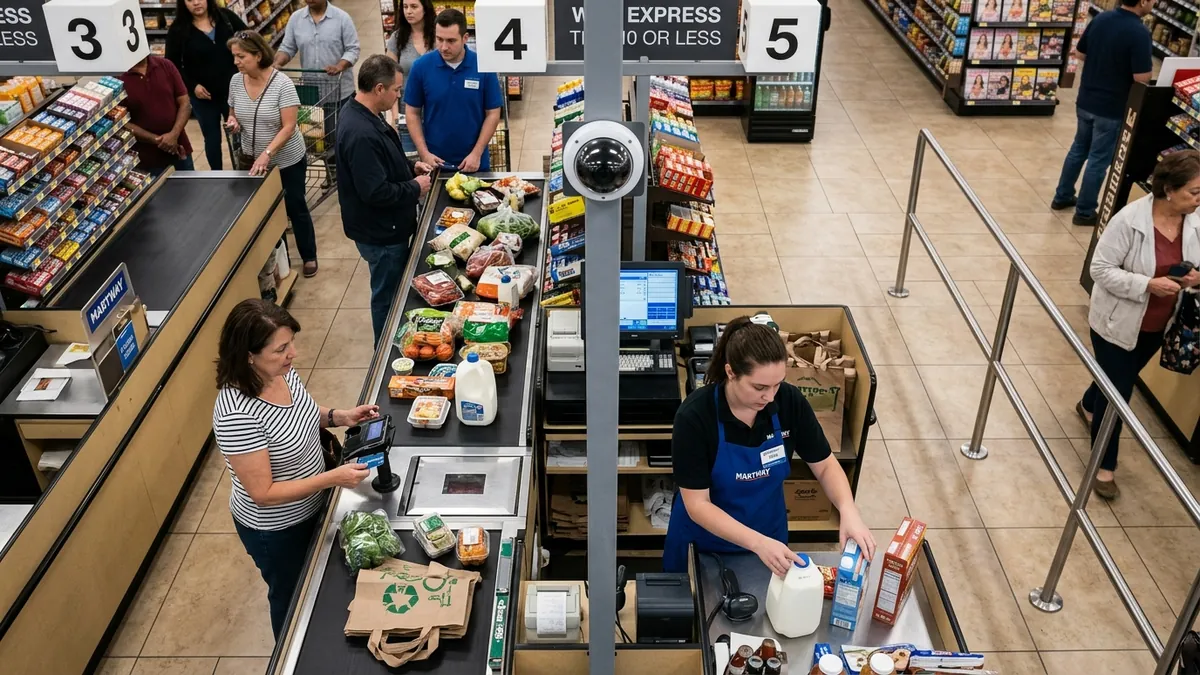
For loss prevention, the system must accurately differentiate between a customer placing an item in their cart (normal behavior) versus placing it into a personal backpack or an un-scanned area at self-checkout. This requires instance segmentation (like Mask R-CNN) to understand the precise boundaries of objects, especially when they overlap.
Multi-Object Tracking (MOT)
Detection alone is insufficient. The system must track objects across frames to understand their trajectory. Algorithms like DeepSORT (Simple Online and Realtime Tracking with a Deep Association Metric) or ByteTrack are utilized to assign unique IDs to individuals and items, maintaining these associations even when the object briefly leaves the camera's field of view or is occluded by another shopper or aisle display. Re-identification (ReID) models extract feature embeddings to match identities across multiple, non-overlapping camera feeds throughout the store.
Advanced Behavior Analysis and Action Recognition
Shoplifting is rarely a single, static event; it is a sequence of actions occurring over time. Therefore, analyzing static frames is inadequate. The system must perform complex behavior analysis, which brings us to the realm of Action Recognition.
Spatio-Temporal Modeling
To detect theft, models must process both spatial (what is happening in the frame) and temporal (how it changes over time) features. 3D Convolutional Neural Networks (3D CNNs) like I3D or SlowFast networks are employed to process video clips (e.g., 30-frame segments) rather than single images. This allows the model to understand the fluid motion of "concealment"—the nuanced difference between a customer scratching their stomach and slipping a high-value cosmetic item into their jacket.
Pose Estimation and Skeleton Tracking
Another layer of behavioral analysis involves Human Pose Estimation (e.g., using models like OpenPose or MediaPipe). By mapping the keypoints of a person's body (wrists, elbows, shoulders), the system can analyze kinematics. If a customer's hand rapidly moves from a high-value shelf directly into a personal bag, the specific trajectory and speed of those keypoints can trigger a probabilistic alert for suspicious behavior. This skeletal data is highly advantageous because it requires less compute than full-pixel analysis and naturally anonymizes the subject. To see how pose kinematics detect physical anomalies and threat indicators in real-time, explore our interactive security aggression detection demo.
Model Training for Shoplifting Detection
Developing highly accurate models for loss prevention is incredibly challenging due to the "long-tail" nature of retail theft. While normal shopping behavior provides millions of examples, actual theft events are relatively rare and highly varied.
Dataset Acquisition and Synthetic Data
Training requires vast amounts of annotated video data. Since acquiring real footage of shoplifting is difficult and fraught with privacy issues, AI developers often rely on staged scenarios (actors performing theft in mock stores). Furthermore, synthetic data generation using game engines like Unreal Engine is becoming a critical tool. By simulating retail environments, developers can automatically generate perfectly annotated datasets with infinite variations in lighting, clothing, and store layouts, drastically accelerating the training of robust models.
"Synthetic data bridges the gap between the scarcity of real-world anomaly data and the voracious data requirements of deep learning models."
Addressing False Positives
A loss prevention system is only as good as its false-positive rate. If the system constantly flags benign behavior, store personnel will experience "alert fatigue" and ignore the system entirely. Training involves rigorous hard-negative mining—feeding the model thousands of edge-case videos (e.g., customers putting items back on shelves, comparing products closely, or checking their phones) to refine the decision boundary. Confidence thresholds must be dynamically tuned based on the store's specific environment.
Edge vs. Cloud Architecture for Real-Time Inference
The architectural decision between processing video on the Edge versus in the Cloud is a pivotal consideration for retail computer vision.
The Case for Edge Computing
In retail loss prevention, latency is the enemy. An alert generated 30 seconds after a theft occurs is practically useless. This necessitates Edge AI architectures. Processing video locally on dedicated inference appliances (equipped with GPUs or specialized NPUs like NVIDIA Jetson or Hailo AI processors) ensures ultra-low latency, typically analyzing frames in milliseconds.
Furthermore, streaming dozens of high-definition camera feeds to the cloud requires immense bandwidth, which is cost-prohibitive for most retail locations. Edge processing ensures that only metadata (e.g., "Alert: Suspicious behavior at Aisle 4") and a short, low-res video clip are transmitted to the central server, saving massive amounts of bandwidth.
Cloud for Aggregation and Retraining
While inference happens at the edge, the cloud remains crucial for centralized management, cross-store analytics, and model retraining. An optimized architecture utilizes a hybrid approach: the heavy lifting (video processing) stays local, while aggregated data flows to the cloud to identify macro-trends (e.g., organized retail crime rings hitting multiple locations) and to distribute updated, smarter neural network weights back to the edge nodes.
Integration with Video Management Systems (VMS)
A standalone AI system is a headache for IT and security teams. To be effective, computer vision solutions must integrate seamlessly with the retailer's existing physical security infrastructure, specifically their Video Management System (VMS) like Milestone, Genetec, or ExacqVision.
RTSP Streams and API Bridges
The integration process typically involves ingesting RTSP (Real-Time Streaming Protocol) feeds from existing IP cameras. The AI appliance acts as a passive listener, avoiding any interference with the primary recording function of the VMS. When an event is detected, the AI system pushes an alert (often via JSON payloads over RESTful APIs or Webhooks) back into the VMS. This allows security personnel to view the AI-generated alerts within the exact same software interface they are already trained to use, creating a frictionless user experience.
Privacy Compliance, Ethics, and the Future
Deploying AI surveillance in public spaces brings immense ethical and legal responsibilities. Retailers must navigate complex regulatory landscapes, including the GDPR in Europe and various state-level privacy laws in the US (like CCPA and BIPA).
Privacy by Design
Modern computer vision systems must be engineered with "Privacy by Design." This means the system does not process or store biometric data (like facial recognition) unless explicitly authorized and legally permissible. Instead, systems focus on behavior analysis and skeletal tracking, which do not identify the individual.
"Effective security should never come at the cost of consumer privacy. True innovation lies in anonymized intelligence."
Techniques like dynamic blurring are employed at the edge; if a video clip must be saved for evidence, all faces in the frame are automatically obfuscated before the footage is written to disk or sent to the cloud. By ensuring that the AI analyzes actions rather than identities, retailers can leverage powerful loss prevention tools while maintaining consumer trust and legal compliance.
Conclusion
Computer vision is fundamentally transforming retail safety and loss prevention. By combining advanced object detection, temporal behavior analysis, and edge-optimized architectures, retailers can finally move beyond reactive security measures. As these technologies mature, they will not only drastically reduce shrinkage but also provide invaluable operational insights, creating safer, more efficient, and more profitable retail environments.
Frequently Asked Questions (FAQ)
How does computer vision detect shoplifting?
Computer vision detects shoplifting by using AI models to analyze video feeds in real-time. It tracks objects and uses action recognition algorithms (like 3D CNNs) to identify suspicious spatio-temporal patterns, such as a high-value item being rapidly concealed into a personal bag or pocket, rather than placed in a shopping cart.
Does retail computer vision use facial recognition?
Most modern retail loss prevention systems avoid facial recognition due to strict privacy laws (like GDPR and CCPA). Instead, they rely on behavioral analysis, pose estimation, and skeletal tracking to detect the *action* of theft without identifying the *individual* performing it.
Why is edge computing preferred over cloud for loss prevention?
Edge computing is preferred because it processes video data locally on site. This drastically reduces latency, allowing for real-time alerts (within milliseconds). It also saves significant bandwidth costs since continuous high-definition video streams don't need to be uploaded to the cloud.
Can AI integrate with my existing security cameras?
Yes, modern computer vision solutions are designed to ingest standard RTSP streams from existing IP cameras. They integrate seamlessly with major Video Management Systems (VMS) via API bridges, meaning retailers do not need to replace their current camera hardware to utilize AI.