

Generative AI Development Company
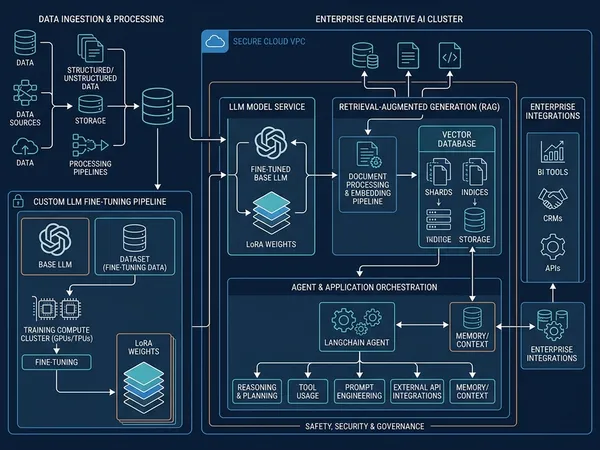
Build production-hardened Generative AI solutions tailored for the enterprise—from LoRA fine-tuning and hybrid RAG with Pinecone to LangChain agentic workflows and private VPC hosting via vLLM and Ollama.
Enterprise Generative AI Capabilities
Four foundational engineering pillars to deploy reliable, deterministic, and isolated LLM systems at enterprise scale.
Custom LLM Fine-Tuning
We employ parameter-efficient fine-tuning (LoRA/QLoRA) on models like Llama 3 and Mistral to adapt them to your specific enterprise vernacular and tasks.
LoRA & QLoRA Fine-TuningAdvanced RAG Systems
Eliminate hallucinations by grounding LLMs in your internal knowledge bases using vector databases like Pinecone, Milvus, Qdrant, and Weaviate.
Pinecone / Milvus Vector DBsAgentic Workflows
Move beyond simple chat. We build autonomous AI agents using LangChain and LlamaIndex that can plan, call APIs, query SQL databases, and execute tasks.
LangChain & LlamaIndexPrivate LLM Hosting
Guarantee 100% data security by hosting open-source LLMs entirely within your private cloud infrastructure using high-throughput engines like vLLM and Ollama.
vLLM & Ollama DeploymentZero-Compromise Private LLM Deployments
For enterprises handling sensitive PII, PHI, or proprietary financial data, sending payloads to public APIs is often a non-starter. We engineer fully isolated Generative AI pipelines inside your controlled perimeter.
On-Premises & VPC Hosting
Deploy high-performance open-source models (Llama 3, Mixtral, DeepSeek) directly within your own AWS VPC or on-premise hardware using vLLM.
Enterprise Guardrails
Implement NeMo Guardrails to enforce strict output formatting, prevent prompt injection, and ensure compliance with internal governance policies.
Generative AI Adaptation: RAG vs. Fine-Tuning vs. Prompt Engineering
Select the optimal technique for domain adaptation, factual accuracy, hallucination prevention, and training budget.
| Dimension | Prompt Engineering & In-Context | Retrieval-Augmented Generation (RAG) | Domain Fine-Tuning (LoRA / QLoRA) |
|---|---|---|---|
| Primary Objective | Guiding model behavior, output tone, and formatting via system instructions and few-shot examples. | Grounding the LLM with real-time, external enterprise documents to eliminate hallucinations. | Teaching specialized domain terminology, niche task syntax, or unique writing styles permanently. |
| Dynamic Knowledge Access | Extremely limited; strictly bounded by maximum LLM context window size and prompt tokens. | Real-time dynamic updates; newly ingested documents are searchable instantly without model retraining. | Static snapshot; model knowledge is frozen at training time and requires periodic re-fine-tuning. |
| Hallucination Risk | Moderate to high; model relies on pre-trained parametric memory when instructions are underspecified. | Very low; responses are strictly anchored to retrieved chunk citations with traceable source attribution. | Moderate; improves domain fluency and style but can still generate plausible-sounding false statements. |
| Engineering Effort & Cost | Lowest effort; testable in minutes via API playgrounds with zero additional infrastructure costs. | Moderate effort; requires document chunking, embedding models, vector databases, and hybrid rerankers. | High compute and data effort; requires curated training pairs, GPU clusters, and rigorous benchmark evals. |
| Model Weight Mutation | No weights modified; operates strictly at inference runtime via context window memory. | No weights modified; combines frozen foundation model with external semantic retrieval indices. | Modifies low-rank adapter weights (LoRA/QLoRA) or full parameter matrices for persistent behavioral changes. |
| Recommended Use Case | Rapid prototyping, tone conditioning, summary extraction, and lightweight classification tasks. | Enterprise knowledge bases, policy/legal compliance search, customer support bots, and internal wikis. | Proprietary code synthesis, structured medical reporting, domain dialect translation, and format enforcement. |
Not Sure Which AI Architecture Fits Your Budget?
Use our interactive LLM Selector and AI Chatbot Cost Calculator to get a tailored architecture estimate based on your specific security, token volume, and deployment requirements.
Proven Enterprise AI & Automation Deployments
From high-concurrency customer support to predictive maintenance, see how our engineering teams deliver production-grade AI solutions.
AI-Powered Predictive Maintenance for Manufacturing
Engineered custom ML sensor models on factory assembly lines, predicting motor vibration anomalies 72 hours before failure.
WhatsApp Automation for Multi-Channel Retail Support
Automated tier-1 ticket resolution with seamless live-agent escalation, reducing customer response latency from 4 hours to sub-minute.
"AdaptNXT people know our language, know our business, and understand our domain. They provide the development acumen and 24x7 implementation support around the globe."
Generative AI Technical Questions
Answers on RAG versus LoRA fine-tuning, private VPC hosting, evaluation pipelines, and enterprise data security.
Need a custom LLM architecture review?
Speak directly with our AI systems architects to evaluate vector retrieval and fine-tuning trade-offs.
Book a 20-minute scoping callTalk Directly to an AI Solutions Architect
Book a zero-pitch, 20-minute engineering session to evaluate your dataset readiness, scope vector database options (Pinecone/Milvus), map LLM architectures (RAG/Agentic), or calculate model training costs.
Book a 20-Min Technical Strategy Call
Discuss your architecture, feasibility, hardware sizing, or custom software requirements directly with a senior engineer.
You're on Our Calendar!
We have registered your session. A calendar invite (.ics) and meeting details have been emailed to .
20 Mins • Google Meet / Conference