The Operational Challenge
Railway networks rely on continuous geometric accuracy of tracks to guarantee safe train operations. Over time, heavy freight loads, repeated high-speed train movements, environmental factors, and shifting ballast alter the track geometry. Critical parameters like track gauge (distance between rails), cant (cross-level height difference), and track twist (change in cross-level over a distance) must be monitored continuously to prevent derailment hazards.
Traditionally, railway operators relied on slow, manual inspections using manual gauges or dedicated, extremely expensive inspection trains. Manual inspection is labor-intensive, prone to human error, and poses safety risks to the inspection crews. Dedicated inspection trains, on the other hand, are scarce, high-cost assets that cannot be run frequently enough to catch early geometric deviations.
To bridge this gap, our partner needed a portable, digitised, and continuous track geometry measurement solution. The engineering challenge lay in creating a track-scanning trolley that could capture and process multiple sensor inputs simultaneously, performing precise geometric calculations in real-time at the edge, even in remote railway corridors and tunnels lacking network connectivity.
Our Engineering Solution
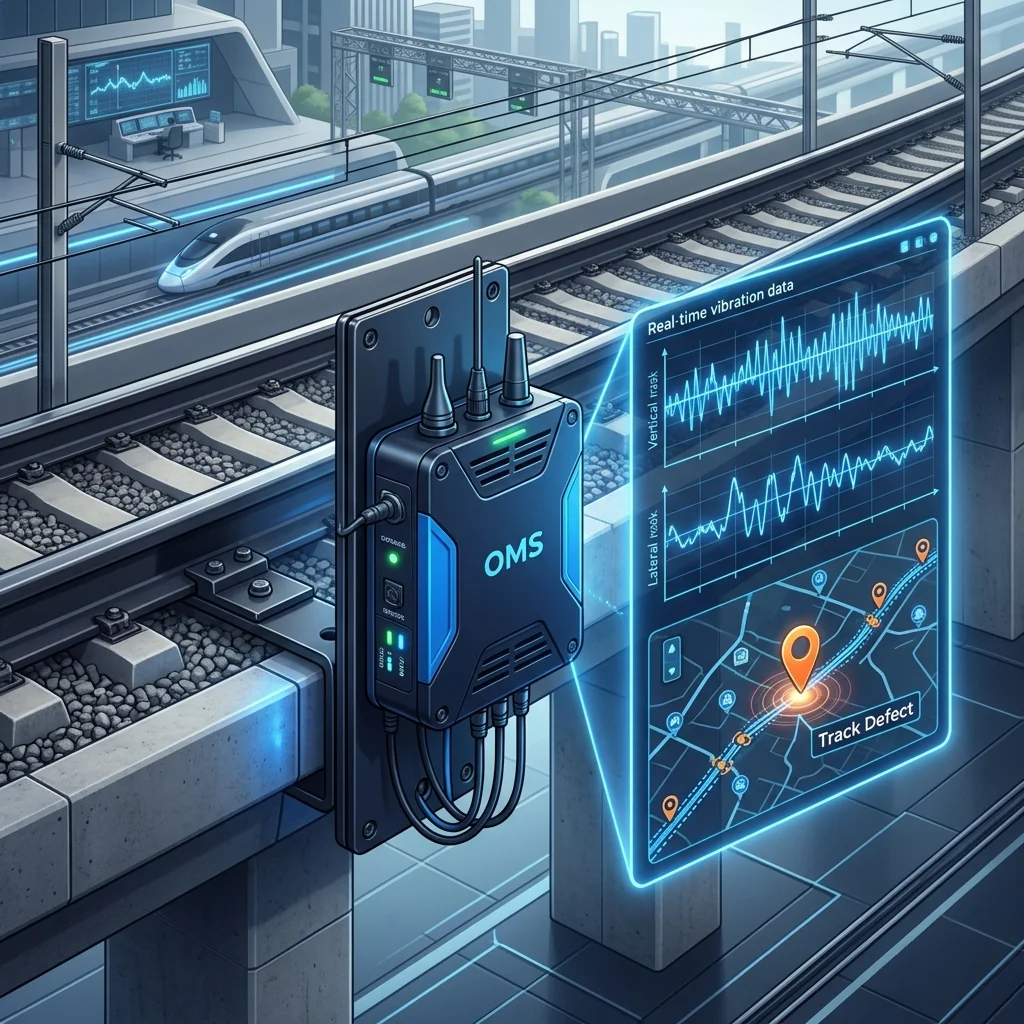
AdaptNXT, in collaboration with the railway partner, designed and developed the complete Industrial IoT and Edge AI architecture for the Portable Track Geometry Measurement System (PTGMS). The system integrates a portable mechanical trolley with high-fidelity telemetry, edge processing, and a rugged field application:
- Precision Sensor Integration: Deployed and calibrated laser displacement sensors for millimeter-level gauge tracking, MEMS-based inclinometers for precise cant measurement, and high-resolution rotary encoders for distance and chainage tracking.
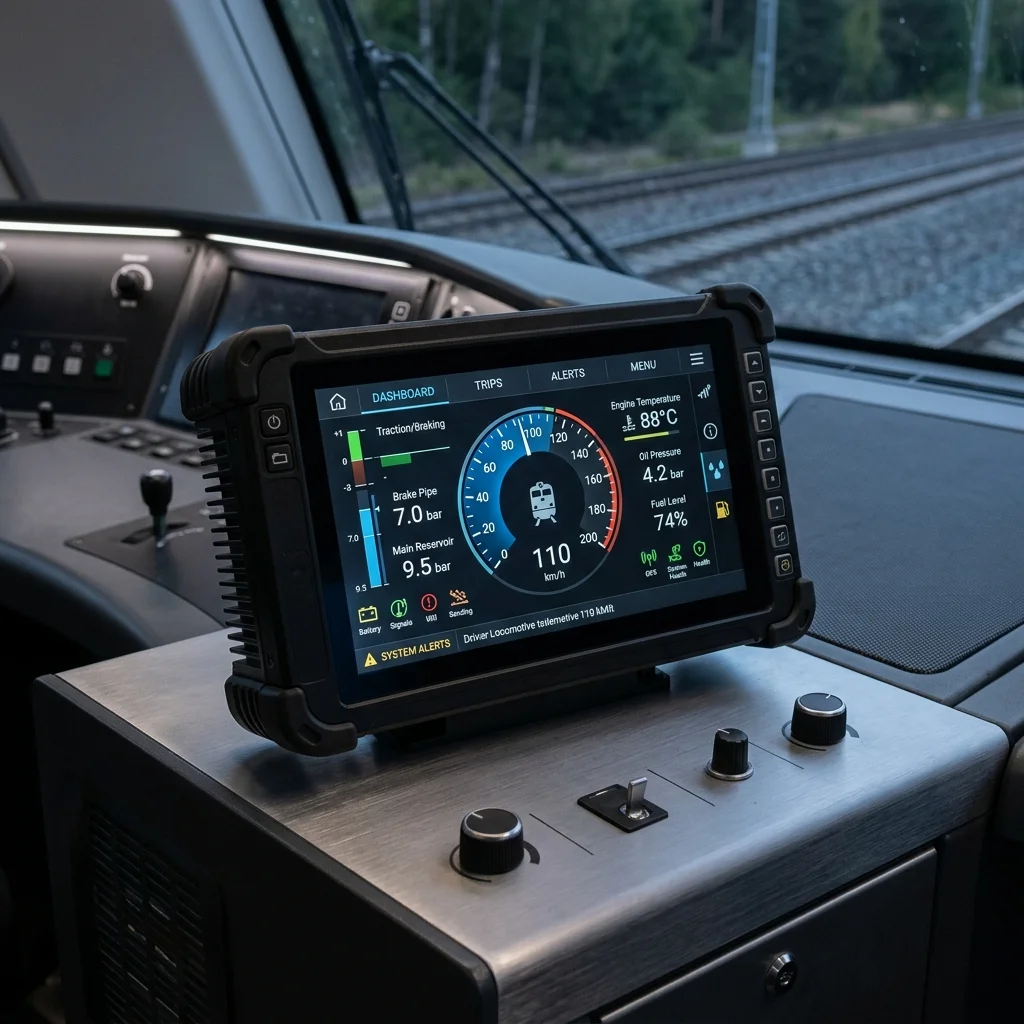
- Low-Power Wireless Field Communication: Integrated Bluetooth Low Energy (BLE) communication between the trolley's data acquisition system and the operator's tablet, eliminating fragile cables and minimizing power draw for long field shifts.
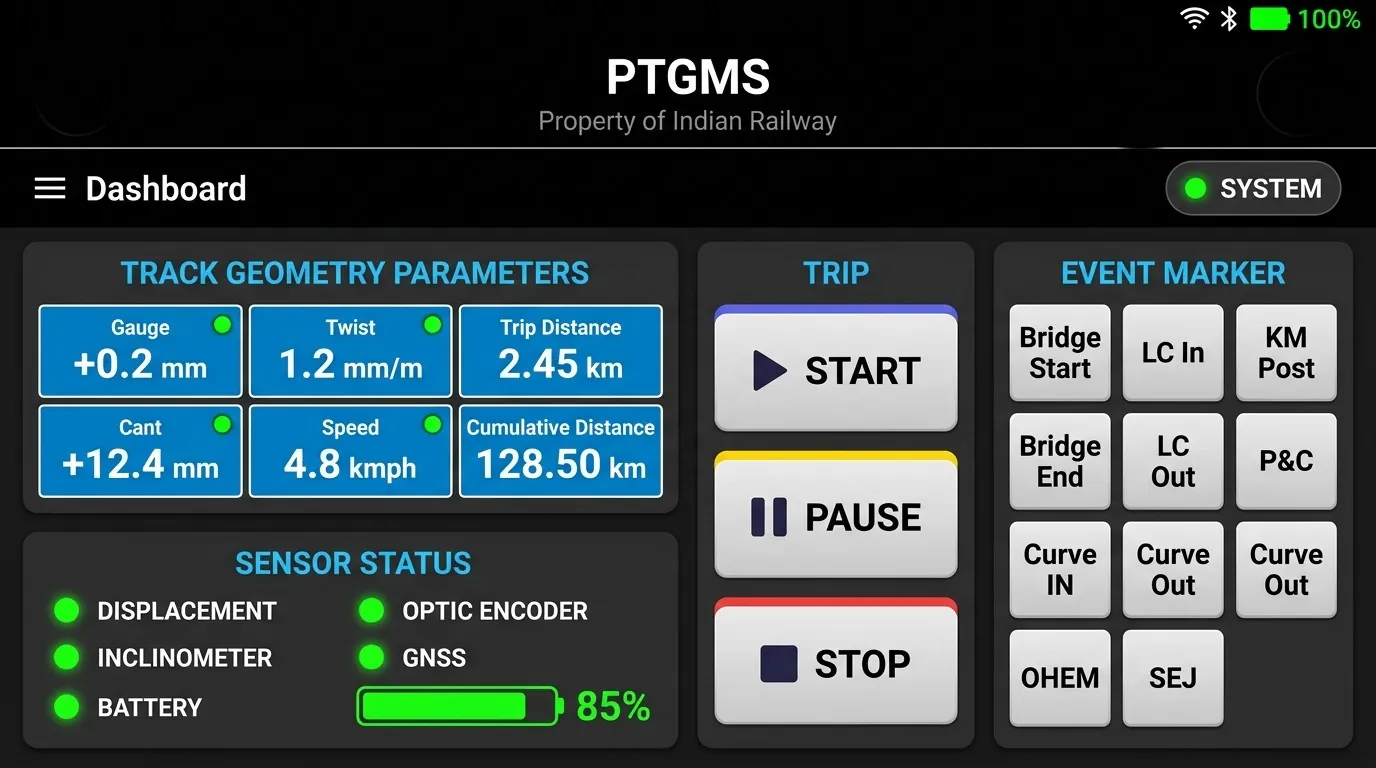
- On-Device Spatial Edge Processing: Developed custom edge algorithms on the Android field application that combine speed, distance, and cant measurements. The processing engine maps incoming sensor data spatially rather than temporally, ensuring calculations remain tied to the physical track location even as operators change speed or stop.
- Offline-First Architecture: Built a robust, local SQLite database storage engine on the tablet to handle continuous telemetry capture. The application operates entirely offline, resolving data loss issues in tunnels, cuttings, and deep valleys.
- Designed for Rugged Field Usability: Crafted a high-contrast Android application interface tailored for harsh outdoor conditions and strong sunlight. The UI includes large, gloved-finger-friendly buttons, instant telemetry plots, and fast, single-tap entry for landmark markers (bridges, switches, crossings) to build rich context into the inspection datasets.
- Tabular and Graphical Analysis: Programmed a built-in analysis suite on the tablet allowing inspectors to review run logs in both tabular formats and graphical plots, validating measurements against configured limits immediately after completing a run.
Technical Architecture & Stack
| Layer / Component | Technology / Framework / Role |
|---|---|
| Trolley Sensors | Laser displacement sensors, MEMS inclinometers, rotary encoders, GNSS receivers |
| Field Communication | Bluetooth Low Energy (BLE) wireless transmission |
| Field Tablet Application | Custom Android (Java/Kotlin), local SQLite database, spatial edge-processing algorithms |
| Data Analytics | On-device tabular & graphical plotting engine, route chainage synchronization |
Verified Business Impact
The deployment of the Portable Track Geometry Measurement System (PTGMS) has introduced unprecedented speed, precision, and safety to railway operations:
- Millimeter-Level Measurement Precision achieved consistently across all primary geometry parameters (gauge, cant, twist), replacing subjective manual checks with digital telemetry.
- 100% Autonomous Offline Capability, ensuring inspection teams capture and analyze track data across remote rail corridors, tunnels, and deep cuttings with zero dependency on cellular networks.
- Zero-Latency Edge Anomaly Detection, enabling immediate identification of track defects and immediate warning alerts right on the field tablet before the inspection run is completed.
- Rich Digital Data Trails for all inspection runs, replacing paper logs and enabling long-term historical deterioration analysis to support predictive maintenance schedules.