
By an industry veteran in tech.
Key Takeaways:
- Implementing this technology requires careful architectural planning and technical expertise.
- Focus on security, scalability, and robust edge/cloud infrastructure.
- Automation and AI are shifting from rule-based to dynamic, intelligent systems.
The "Internet of Things" (IoT) is a catchy phrase, but it is fundamentally inaccurate. A more accurate, albeit boring, name would be the "Internet of Sensors."
Need an Architect's Assessment?
Speak directly with a senior AdaptNXT solutions architect about your system constraints, timeline, and production feasibility.
Without sensors, there is no IoT. The cloud algorithms, the fancy dashboards, the AI predictive models—they are all completely useless if they don't have raw data feeding into them. Sensors are the crucial bridge between the messy, physical world we live in and the clean, digital world of data processing.
If you are planning to deploy any type of connected ecosystem—whether it’s a smart greenhouse, a fleet of connected delivery trucks, or a fully automated factory—understanding the fundamentals of IoT sensor monitoring is your mandatory first step.
What is an IoT Sensor?
At its core, a sensor is a piece of hardware that detects changes in a physical environment (like heat, light, motion, or pressure) and converts that physical phenomenon into a measurable electrical signal.
An IoT Sensor takes that electrical signal, digitizes it, and pairs it with a communication module (like a Wi-Fi or Bluetooth chip) so that the data can be transmitted over a network to a central processing hub.
The Most Common Types of IoT Sensors
The variety of sensors on the market is staggering, but the vast majority of commercial and industrial IoT applications rely on a core set of sensor types:
- Temperature & Humidity Sensors: The most ubiquitous. Used in cold-chain logistics (tracking vaccines or frozen food), smart HVAC systems, and agricultural monitoring.
- Proximity & Motion Sensors: Using infrared (PIR) or ultrasonic waves to detect movement or the presence of an object. Essential for smart lighting, security systems, and retail foot-traffic tracking.
- Optical Sensors (Cameras): Capturing light and video. When paired with Computer Vision AI, these are the most powerful sensors available, capable of complex quality inspection and security monitoring.
- Vibration Accelerometers: The backbone of industrial predictive maintenance. They measure the microscopic vibrations of heavy machinery to detect bearing wear or misalignment before a catastrophic failure occurs.
- Pressure & Flow Sensors: Critical for manufacturing, oil & gas, and water management to ensure liquids and gases are moving through pipes at safe and optimal rates.
The Three Challenges of Sensor Monitoring
Deploying a single sensor on your desk is easy. Deploying 5,000 sensors across a sprawling, multi-acre facility introduces severe engineering challenges.
1. Power Management
You cannot run a power cable to a sensor buried in a farm field or attached to the wheel of a moving train. Millions of IoT sensors must rely on batteries. Engineers must carefully balance the frequency of data transmission with battery life. (A sensor that transmits data every second will die in a week; a sensor that transmits once a day can last for ten years).
2. Connectivity and Range
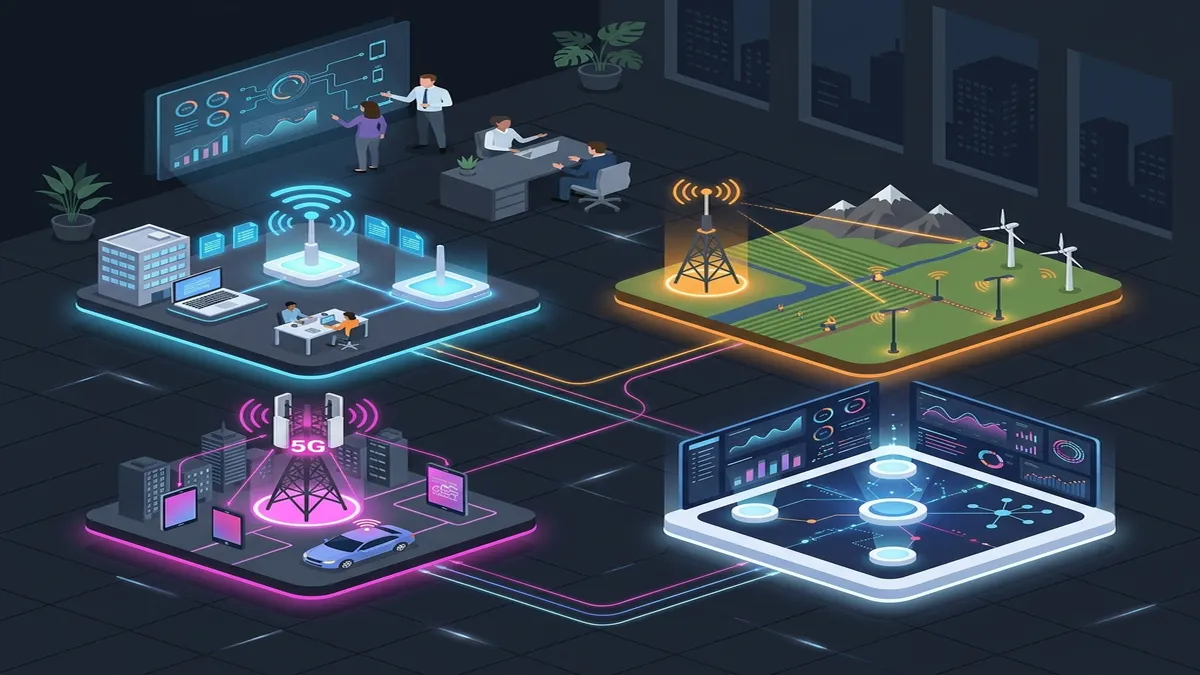
Sensors must send their data to a gateway. If a sensor is located deep inside a concrete basement or miles out in a rural area, standard Wi-Fi is useless. This has led to the rise of specialized LPWAN (Low-Power Wide-Area Network) protocols like LoRaWAN and NB-IoT, which can transmit small packets of data over several miles, even penetrating concrete, while sipping microscopic amounts of battery power.
3. Data Overload (The Noise Problem)
If you have 1,000 sensors transmitting data every 5 seconds, you will instantly overwhelm your network bandwidth and incur massive cloud storage costs. The solution is Edge Computing. Modern IoT sensors are becoming "smart"—they possess tiny microprocessors that filter the data locally. Instead of constantly shouting "I am at 72 degrees," the smart sensor remains silent until the temperature breaches a set threshold, only transmitting the critical anomaly.
The Foundation of Automation
As we move toward a future of autonomous systems and AI-driven business intelligence, remember that the entire architectural pyramid rests on the tiny shoulders of IoT sensors. Selecting the right sensor, ensuring reliable connectivity, and managing its power lifecycle is the unglamorous, but absolutely vital, foundation of the connected world.
Summary Comparison
| Aspect | Traditional Approach | Modern Architecture |
|---|---|---|
| Technology | Legacy Systems | AI & IoT Integrated |
| Scalability | Limited | High (Cloud/Edge) |
Frequently Asked Questions (FAQ)
What is the main benefit of this technology?
It provides significant improvements in efficiency, accuracy, and operational scalability compared to legacy methods.
How difficult is it to integrate?
Integration requires technical expertise, particularly in system architecture and security, but modern APIs have simplified the process.
Is it secure?
Yes, provided that best practices like end-to-end encryption and compliance standards are rigorously followed. For more details, contact our team.