
Key Takeaways
- Decoupled Architecture: Prevent data loss during unavoidable network partitions by splitting edge gateway software into entirely independent ingestion and forwarding threads.
- Embedded Databases: Utilize robust, lightweight databases like SQLite (configured in WAL mode) or LSM-tree stores like BadgerDB to securely buffer high-frequency telemetry locally.
- Ring-Buffering Safety: Implement strict FIFO ring-buffer limits to prevent a prolonged internet outage from consuming all flash storage and crashing the gateway OS.
- Cloud Spike Mitigation: Configure algorithmic backpressure and rate-limiting on the forwarding thread to prevent DDoSing your own cloud broker when edge connectivity is suddenly restored.
In a cloud-only IoT tutorial, network connections are pristine, latency is non-existent, and data flows continuously. In the real world—especially on factory floors, underground mining sites, or remote solar grids—network partitions are a daily, inescapable occurrence. Heavy machinery EMI (Electromagnetic Interference), cellular signal drops in rural areas, and localized IT firewall maintenance will regularly cut your edge gateway off from the internet.
If your edge gateway is designed naively—simply trying to write telemetry directly to a remote MQTT broker or REST API without a robust offline fallback—you will suffer immediate, unrecoverable data gaps. In mission-critical industrial environments, these data gaps break predictive maintenance models, skew regulatory compliance reports, and ruin financial audit trails.
To solve this, industrial data engineers implement a Store-and-Forward architecture. This deep-dive guide walks you through the core software design principles, concurrency strategies, and embedded database choices required for building a highly resilient, zero-data-loss edge buffering system.
Need an Expert Opinion?
Stop guessing. Speak directly with a senior AdaptNXT engineer about your architecture, timeline, and feasibility.
The Architecture: Decoupling Ingestion from Egress
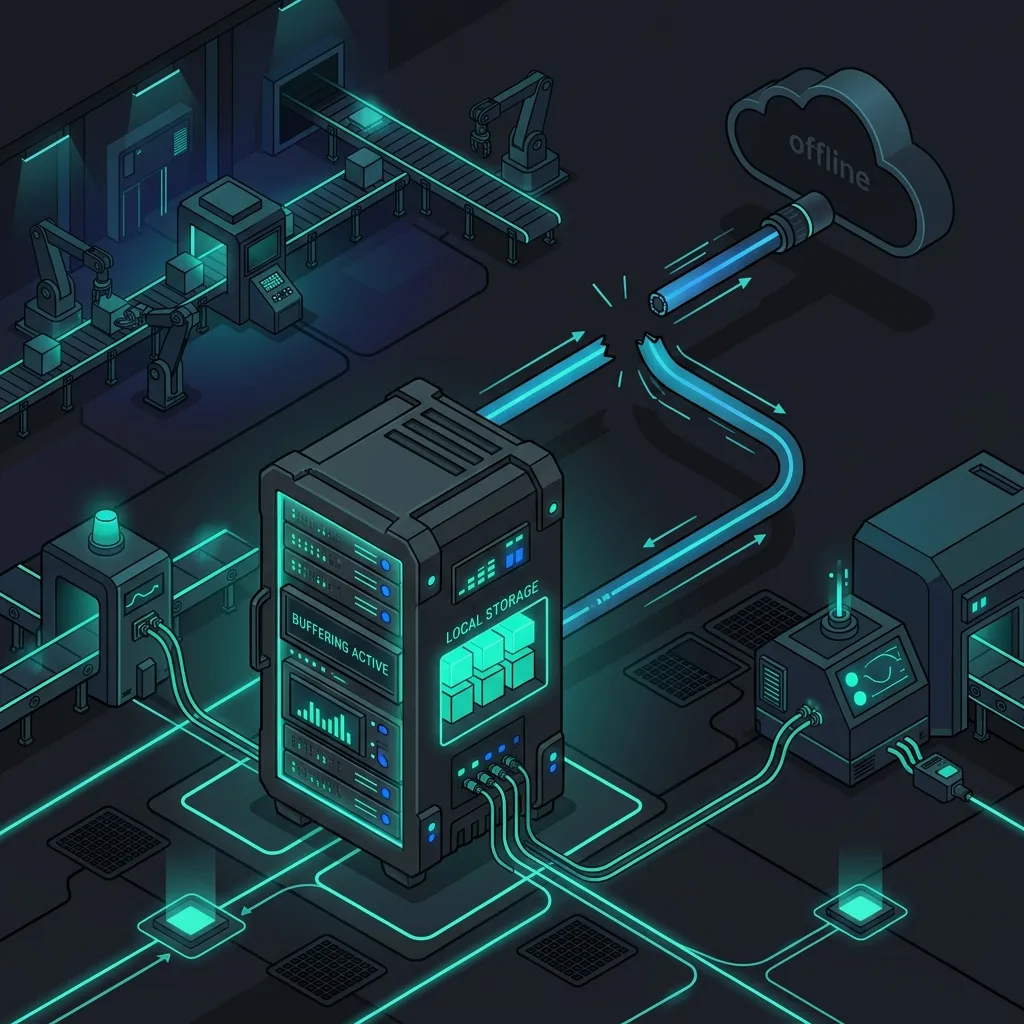
The foundational rule of a resilient gateway is that it must never block or drop local sensor data ingestion due to a wide-area network failure. We achieve this by splitting the gateway software into two decoupled processes running asynchronously, communicating only via a local disk-based buffer:
-
The Ingestion Thread (The "Store"):
This dedicated thread listens to local machine interfaces (via protocols like Modbus TCP, OPC-UA, or CAN Bus) and immediately writes the incoming telemetry payloads directly into a local embedded database. This operation must be lightning-fast, highly optimized, and run completely offline, oblivious to the state of the internet connection.
-
The Forwarding Thread (The "Forward"):
This independent egress thread continuously monitors external network availability. When an active connection to the cloud is verified, it queries the local embedded database in controlled chunks (e.g., 500 records at a time), transmits the data to the cloud MQTT broker or HTTPS ingestion endpoint, waits for the cryptographic ACK (acknowledgment), and only then deletes the successfully transmitted entries from the local database.
Choosing the Right Embedded Database for the Edge
An edge gateway typically operates on highly constrained hardware (ARM processors, SD cards, eMMC flash memory) and must survive sudden, ungraceful power cutoffs. Traditional client-server databases like PostgreSQL or MySQL are far too heavy and memory-intensive for this. Instead, we use specialized embedded databases.
1. SQLite (Relational / WAL Mode)
SQLite is the most robust, battle-tested general-purpose choice for edge storage. Because it stores all data in a single file, it is extremely easy to manage, backup, and inspect. However, out of the box, SQLite locks the entire database during a write. To use SQLite for high-frequency sensor writes on flash storage, you must explicitly enable Write-Ahead Logging (WAL) mode in your connection string:
PRAGMA journal_mode=WAL;
PRAGMA synchronous=NORMAL;
WAL mode allows concurrent reads (the forwarding thread) and writes (the ingestion thread). It significantly increases write throughput and protects against database corruption if the gateway loses power mid-write.
2. BadgerDB or RocksDB (Key-Value LSM Tree)
If you are dealing with very high-frequency sensor data—for example, sampling triaxial vibration data at 10,000 times per second—even SQLite's optimized write overhead might prove too slow for your edge CPU. In these extreme edge-AI scenarios, we turn to Key-Value databases built on Log-Structured Merge-trees (LSM).
Databases like BadgerDB (written in pure Go) or RocksDB (C++) are explicitly optimized for write-heavy workloads. They append incoming data to sequential log files in memory before flushing to disk, minimizing disk head movement (or flash block erase cycles) and maximizing write speed.
Summary Comparison: Edge Database Engines
| Feature | SQLite (WAL Mode) | BadgerDB / RocksDB |
|---|---|---|
| Data Model | Relational (SQL, Tables, Rows) | Key-Value (LSM Tree) |
| Query Complexity | High (Supports complex filtering) | Low (Exact key lookups only) |
| Write Throughput | Moderate to High | Extremely High |
| Best Use Case | Standard telemetry (1-100Hz), complex states | High-frequency vibration/acoustic data (1kHz+) |
Production Checklist: Crucial Store-and-Forward Edge Cases
Designing a theoretical store-and-forward pipeline is easy. Making it survive years in a dusty, vibrating factory involves solving three major edge-case behaviors.
-
Database Cap and Ring-Buffering (FIFO)
What happens if the internet goes down not for 5 minutes, but for a week? The gateway will continue storing data until it completely fills up the physical disk, which will immediately crash the Linux operating system. You must enforce a hard database size limit (e.g., 2GB). When that threshold is reached, your ingestion thread must adopt a ring-buffer (First-In, First-Out) policy: automatically deleting the oldest historical records to make room for the newest ones, while firing a critical local alarm.
-
Backpressure and Cloud Ingestion Spike Mitigation
If a gateway goes offline for 12 hours, it accumulates a backlog of millions of telemetry points. Once the network is restored, if the gateway tries to push all 12 hours of data at maximum speed, it will likely overload your cloud ingestion server or trigger AWS/Azure DDoS protection rules, getting itself temporarily banned. Your forwarding script must implement algorithmic rate-limiting (backpressure control)—syncing historical data in controlled batch sizes, with deliberate micro-delays between each batch to allow the cloud to process the surge.
-
De-duplication and Out-of-Order Ingestion
Network drops happen mid-transmission. If the gateway forwards a batch of data, but the cellular network drops a millisecond before receiving the cloud MQTT broker's acknowledgment (PUBACK), the gateway will assume the transmission failed. When it reconnects, it will send that same batch again. The cloud application must be architected to handle these duplicate payloads gracefully (usually via unique message IDs). Furthermore, the cloud time-series database must support out-of-order ingestion, as the delayed "forwarded" historical data will arrive simultaneously alongside the latest real-time telemetry.
Conclusion
A properly engineered Store-and-Forward buffer is the primary differentiator between a fragile toy IoT demo and a production-grade industrial solution. By rigorously decoupling data collection from cloud egress using an embedded WAL-mode SQLite database or a high-speed LSM-tree KV store, you ensure that physical events on the factory floor are captured reliably—no matter the chaotic state of the network connection.
AdaptNXT builds resilient edge gateway software, custom Yocto Linux images, and high-throughput data synchronization engines for challenging industrial environments. Speak with our embedded engineers about designing a bulletproof data pipeline for your remote assets.
Frequently Asked Questions
What is a Store-and-Forward architecture in IIoT?
Store-and-forward is a software design pattern where an edge gateway saves incoming sensor data to a local database (store) before attempting to send it to the cloud (forward). This ensures zero data loss if the internet connection drops, as the gateway will simply buffer the data locally and transmit it when the connection is restored.
Why should I use SQLite in WAL mode for edge computing?
By default, SQLite locks the entire database when writing, which blocks reads. WAL (Write-Ahead Logging) mode allows simultaneous reading and writing. This is crucial for a store-and-forward gateway, as the ingestion thread can write new sensor data at the exact same time the forwarding thread is reading old data to send to the cloud.
What happens if the gateway disk fills up during a long network outage?
If the disk fills up, the OS will crash. To prevent this, resilient gateways use a ring-buffer (FIFO - First-In, First-Out) strategy. Once a predefined storage limit is reached (e.g., 80% capacity), the gateway automatically deletes the oldest saved records to make room for the newest incoming sensor data.