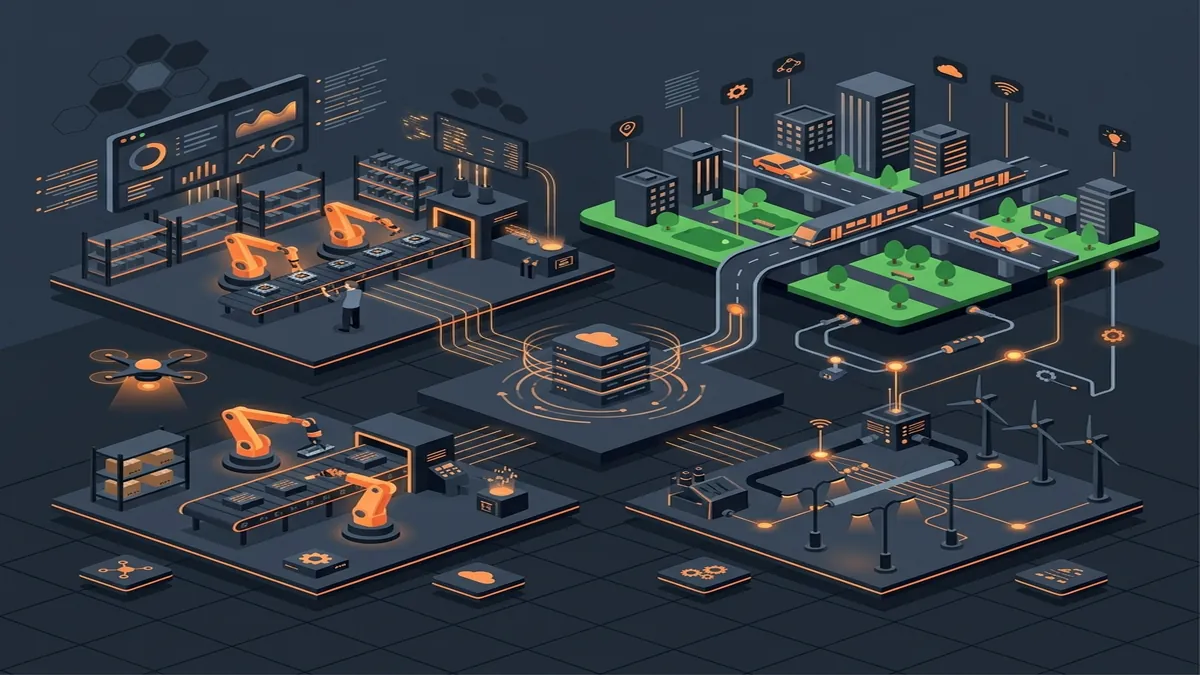

In the rapidly evolving landscape of enterprise technology, two distinct fields—Artificial Intelligence (AI) and the Internet of Things (IoT)—are colliding to create a massive paradigm shift. This convergence is giving birth to a new ecosystem where machines don't just collect data; they analyze, learn, and make autonomous decisions on the edge. This is the era of AIoT.
In this comprehensive 2026 guide, we will explore exactly what AIoT means, the underlying architecture driving it, the most lucrative AIoT applications in the market today, and the top IoT and AI projects your enterprise can start building immediately. We will also deep-dive into the hardware requirements, edge processing models, and networking protocols necessary to build a secure, enterprise-grade AIoT infrastructure.
Based on our hands-on engineering experience deploying AIoT systems for global manufacturing clients, this guide moves beyond theory and dives into practical, scalable architectures.
Key Takeaways
- Understand the architectural shift from cloud-centric IoT to Edge AI processing.
- Identify high-ROI AIoT applications like predictive maintenance and quality control.
- Learn how to retrofit legacy equipment with non-invasive IoT sensors.
Summary Overview
| Concept | Impact |
|---|---|
| Edge Computing | Drastically reduces latency and cloud bandwidth costs. |
| Predictive Maintenance | Eliminates unplanned downtime by anticipating mechanical failures weeks in advance. |
| Legacy Retrofitting | Digitizes older factories at a fraction of the cost of buying new smart machinery. |
What is AIoT? (The AIoT Full Form)
The AIoT full form is the Artificial Intelligence of Things. It represents the combination of AI technologies (such as machine learning, computer vision, natural language processing, and predictive analytics) with IoT infrastructure (sensors, edge devices, gateways, and interconnected networks).
To understand AIoT, you have to look at the limitations of traditional IoT. Historically, IoT networks were entirely focused on data telemetry. Sensors would collect temperature, vibration, humidity, or video data, and stream it all back to a central cloud server. A human operator, or a rigid, rule-based algorithm living on a distant server, would then review that data to make a decision. This architecture worked fine for slow-moving data, like checking the temperature of a greenhouse every hour. However, it completely falls apart in high-speed industrial environments.
AI in IoT fundamentally changes this pipeline. Instead of just passing data to the cloud, AI algorithms are embedded directly into the network—often right at the edge, on the device itself. The device can now process its own sensor data locally, detect anomalies in real-time, and trigger mechanical responses without ever needing to contact a centralized cloud server. This drastically reduces latency, cuts bandwidth costs, and ensures operational continuity even if the internet connection drops.
The Evolution from Cloud IoT to Edge AIoT
In the early days of IoT, the paradigm was simple: dumb sensors and a smart cloud. However, as the volume of data exploded, enterprises quickly realized the hidden costs of cloud-centric IoT:
- Latency: Sending a video feed of a manufacturing line to the cloud, processing it for defects, and sending a stop command back takes hundreds of milliseconds. In high-speed manufacturing, the defective product has already moved past the robotic arm by the time the command arrives.
- Bandwidth Costs: Streaming 4K video from 50 factory cameras to AWS 24/7 will generate astronomical egress and ingest bandwidth bills.
- Data Privacy and Security: Transmitting sensitive patient data (in Healthcare IoT) or proprietary manufacturing processes across the public internet introduces severe security vulnerabilities and compliance risks (like HIPAA or GDPR violations).
AIoT solves these problems through Edge AI. By shifting the neural networks and machine learning models from the cloud directly onto the local edge devices, the data never has to leave the facility. The AI analyzes the data locally, and only transmits the lightweight metadata or inference result (e.g., "Defect detected on assembly line #4 at 10:04 AM") to the cloud for historical logging.
The Architecture: How AI and IoT Converge at the Edge
Deploying a successful AIoT network requires a robust, multi-layered architecture. Modern AIoT deployments lean heavily into distributed computing, ensuring that processing happens exactly where it is most efficient.
- The Perception Layer (Sensors & Actuators): This is the physical hardware collecting telemetry from the real world. Examples include thermal cameras, vibration sensors on factory motors, acoustic microphones, or biometric scanners. Actuators are the components that execute physical commands, like a robotic arm or a shut-off valve.
- The Edge AI Layer (Microcontrollers & Gateways): This is where the magic happens. Hardware like NVIDIA Jetson Orin Nanos, Coral Edge TPUs, or specialized ARM Cortex microcontrollers run quantized machine learning models locally. Models like YOLOv8 (for object detection) or TinyML anomaly detection algorithms are compressed and optimized to run on low-power devices, processing raw sensor data in single-digit milliseconds.
- The Network Layer (MQTT/LoRaWAN): Instead of sending gigabytes of raw video feed to the cloud, the Edge AI layer only transmits the inference result. This lightweight JSON payload is sent via efficient, publish-subscribe protocols like MQTT, or long-range low-power networks like LoRaWAN and 5G.
- The Cloud/Central AI Layer: The cloud is not dead; it just has a new job. The cloud is utilized for heavy, asynchronous tasks like aggregating historical data across multiple global factories, performing federated learning (updating and retraining the AI models across the fleet), and orchestrating Enterprise AI integrations like ERP syncing.
Choosing the Right Hardware for AIoT
The success of an AIoT project heavily depends on selecting the right hardware for the Edge AI layer. You must balance computational power (TOPS - Tera Operations Per Second), power consumption, and thermal constraints.
For heavy computer vision tasks (like running multiple video streams simultaneously), GPUs are required. The NVIDIA Jetson family is the gold standard here. For lighter tasks, like vibration analysis or simple acoustic anomaly detection, microcontroller units (MCUs) running TinyML frameworks (like TensorFlow Lite for Microcontrollers) are ideal because they can run for years on a single battery.
Top AIoT Applications Disrupting Industries in 2026
The practical applications of AI in IoT are practically limitless, but several key sectors are seeing massive ROI today.
1. Predictive Maintenance in Smart Manufacturing
In heavy industry, unplanned downtime can cost millions of dollars an hour. Traditional maintenance is either reactive (fixing a machine when it breaks) or preventative (replacing parts on a rigid schedule, regardless of their actual condition, which wastes perfectly good components). AIoT enables true predictive maintenance. IoT vibration and acoustic sensors continuously monitor motors, pumps, and compressors. AI models analyze the frequency signatures locally to detect microscopic anomalies that indicate a bearing is going to fail three weeks before it actually breaks. This allows operators to schedule maintenance precisely when needed, eliminating both unplanned downtime and wasted parts. Learn more about our Industrial IoT Platform services.
2. Intelligent Video Analytics & Quality Control
Factories are rapidly replacing inconsistent human visual inspection with AIoT camera systems. High-speed industrial cameras capture images of products moving on a conveyor belt. Edge AI models instantly detect scratches, dimensional misalignments, or missing components. Because the processing happens locally, the system can automatically trigger a pneumatic robotic arm to discard the defective item without ever slowing down the production line.
3. Smart Grid and Energy Optimization
Commercial real estate and large enterprise campuses are deploying AIoT to slash energy costs and reduce carbon footprints. IoT thermostats, occupancy sensors, and smart meters feed real-time data into a localized AI that predicts building usage patterns. By combining this data with external factors like weather forecasts and real-time grid pricing, the system optimizes HVAC and lighting autonomously, radically reducing energy waste.
4. Healthcare (IoMT - Internet of Medical Things)
In hospitals, AIoT is transforming patient monitoring. Wearable IoT devices continuously track heart rate, blood oxygen, and ECG data. Instead of overwhelming nurses with constant raw data streams, embedded AI models analyze the telemetry in real-time to detect the early onset of conditions like sepsis or cardiac arrest, alerting medical staff only when a critical anomaly is identified.
Top 3 IoT and AI Projects to Start Today
If your enterprise is looking to invest in IoT and AI projects, here are three high-impact initiatives you can pilot within a single quarter without ripping out your existing infrastructure:
- AI-Powered Anomaly Detection on Legacy Machines: You don't need a brand-new "smart factory" to start. Retrofit legacy PLC machines with non-invasive IoT current clamps and external vibration sensors. Feed that data into a lightweight machine learning anomaly detection model (running on a local gateway) to establish a baseline of "normal" operation and trigger alerts for any deviation.
- Vision-Based Safety Compliance Monitoring: Deploy AIoT edge cameras on the factory floor configured with object detection models trained specifically to identify PPE (Personal Protective Equipment) compliance. If a worker enters a designated hazard zone without a hardhat or safety vest, the system can instantly sound a local alarm or even temporarily disable heavy machinery until the area is clear.
- RAG-Enabled Technician Copilots: Combine IoT telemetry with Large Language Models (LLMs). When a machine flags a complex error code, the technician can query an Enterprise Chatbot that uses Retrieval-Augmented Generation (RAG). The AI instantly pulls the exact repair manual, overlays the real-time sensor data, and provides a step-by-step diagnostic guide. Check out our RAG Chatbot Development guide to see how this is built.
The Challenges of Scaling AIoT
While a pilot project is easy to launch, scaling AIoT across dozens of global facilities introduces significant challenges:
- Model Drift: Machine learning models degrade over time as the physical environment changes (e.g., a machine naturally vibrates differently as it ages). Enterprises must implement MLOps pipelines to continuously monitor model accuracy and retrain them.
- Fleet Management: Updating firmware and AI models on 10,000 edge devices securely over-the-air (OTA) requires robust device management infrastructure to prevent bricking devices in the field.
- Data Silos: Bridging the gap between OT (Operational Technology on the factory floor) and IT (Information Technology in the cloud) requires overcoming legacy protocols and strict network security policies.
Conclusion
The AIoT revolution is no longer a futuristic concept; it is a baseline requirement for operational efficiency in 2026. By embedding localized intelligence into physical sensors, enterprises can transition from merely collecting data to acting on it instantaneously. The convergence of AI and IoT allows machines to see, hear, and understand their environment, leading to unprecedented levels of automation.
At AdaptNXT, we specialize in bridging the gap between physical hardware and advanced machine learning. Whether you are looking to retrofit legacy equipment with Edge AI, build a computer vision quality control pipeline, or orchestrate a massive fleet of smart devices, our engineering teams have the hands-on expertise to deliver end-to-end solutions.
Ready to explore AIoT for your business? Contact our technical team today to schedule a feasibility consultation and request your Enterprise AIoT Architecture Blueprint.
"The AIoT revolution is no longer a futuristic concept; it is a baseline requirement for operational efficiency in 2026. Enterprises that wait to deploy these architectures will find themselves mathematically unable to compete on margin."
Frequently Asked Questions
What is the difference between IoT and AIoT?
Traditional IoT focuses solely on collecting data and transmitting it to a central cloud. AIoT embeds artificial intelligence directly into the network, allowing devices to analyze their own data locally and act autonomously in real-time.
Why is edge computing important for AIoT?
Edge computing reduces latency, drastically lowers cloud bandwidth costs, and ensures critical safety systems continue to operate even if the internet connection is temporarily lost.
What are the most common AIoT applications?
The highest ROI applications today include predictive maintenance for industrial machinery, autonomous quality control using computer vision, and smart grid energy optimization for commercial real estate.