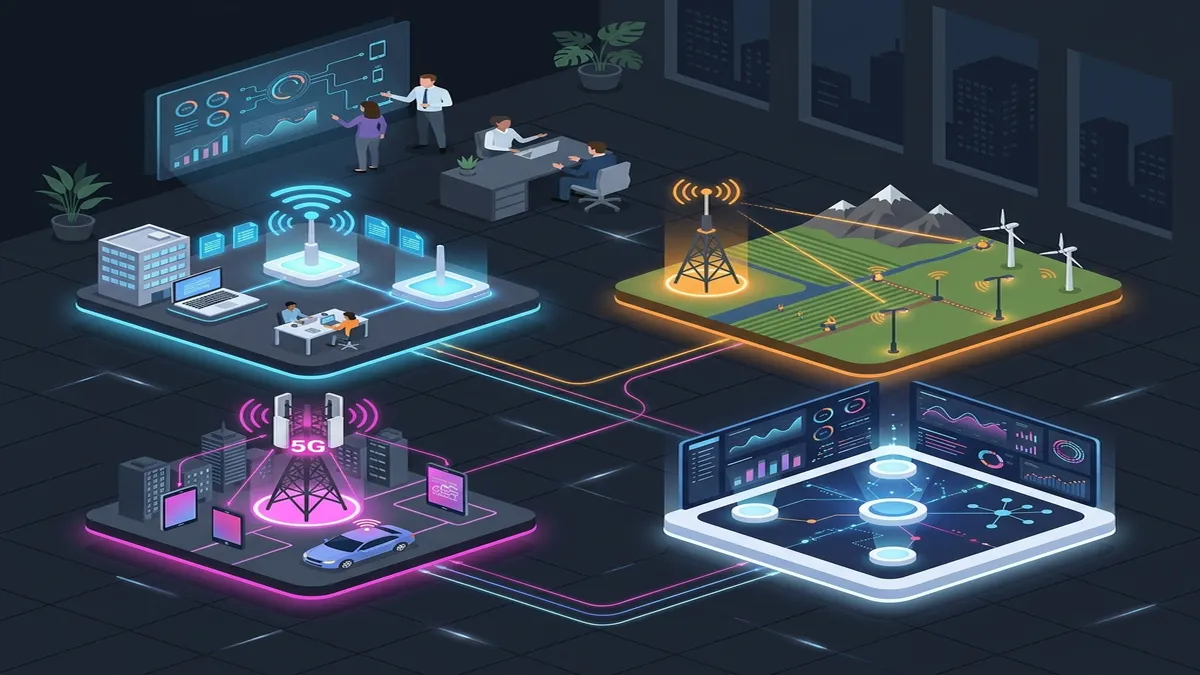

Selecting the right hardware for an IoT initiative is one of the most critical decisions a Chief Technology Officer (CTO) will make. The hardware ecosystem is vast, ranging from low-power microcontrollers to high-performance edge computing gateways. This guide provides a strategic framework for evaluating and selecting IoT hardware components, focusing on performance, connectivity, power consumption, and environmental constraints. By making informed hardware choices, CTOs can ensure the long-term viability and success of their enterprise IoT deployments.
Key Takeaways
- Evaluate processing power requirements based on edge computing needs vs. cloud dependency.
- Select connectivity protocols that match the deployment environment and bandwidth constraints.
- Account for environmental factors such as temperature, humidity, and physical durability.
Summary Overview
| Concept | Impact |
|---|---|
| Microcontrollers (MCUs) | Ideal for simple, low-power sensor nodes. |
| Edge Gateways | Essential for local data processing and protocol translation. |
| Cellular Modules | Provides reliable, wide-area connectivity for mobile assets. |
| Power Sources | Critical for remote deployments lacking grid power. |
1. Compute Architecture: MCUs vs. MPUs vs. Edge AI Gateways
The first hardware hurdle for any IoT engineering team is matching the compute tier to edge processing requirements. Deployments broadly fall into three categories:
- Low-Power Microcontrollers (MCUs): Chips like the ESP32-S3, STM32WB, and Nordic nRF52840 excel at battery-operated sensor nodes where tasks are limited to reading I2C/SPI interfaces, local threshold evaluation, and periodic radio wakeups.
- Microprocessors (MPUs) & Single-Board Gateways: Arm Cortex-A platforms (e.g., NXP i.MX8, Raspberry Pi CM4) run full Linux distributions, managing local containerization (Docker, balenaOS), multi-sensor data aggregation, and complex protocol conversion (e.g., Modbus to MQTT).
- Accelerated Edge AI Gateways: When deployments demand real-time object detection or automated optical inspection, CTOs must deploy hardware with dedicated neural accelerators (NPUs) like NVIDIA Jetson Orin or Hailo-8. Integrating these with Industrial Computer Vision & AI Security enables autonomous perimeter guarding, defect sorting, and workplace safety compliance directly at the edge without cloud video streaming latency.
2. Wireless Connectivity: BLE vs. LoRaWAN vs. Cellular
Selecting the optimal radio protocol requires balancing data throughput, transmission range, power budget, and infrastructure costs:
Need an Expert Opinion?
Stop guessing. Speak directly with a senior AdaptNXT engineer about your architecture, timeline, and feasibility.
- Bluetooth Low Energy (BLE 5.x): Ideal for dense indoor asset tracking, warehouse beacons, and local firmware provisioning via smartphone.
- LoRaWAN: Unmatched for long-range (up to 15 km line-of-sight), ultra-low-power telemetry in agriculture and smart utility metering, operating on license-free sub-GHz spectrum.
- Cellular (LTE-M, NB-IoT, 5G): Essential for geographically dispersed or high-mobility assets. When architecting long-haul freight tracking or cold-chain monitoring, combining cellular gateways with Logistics AI Solutions provides end-to-end operational visibility, automated route anomaly detection, and real-time cargo condition tracking.
3. Power Management and Environmental Ruggedization
A hardware spec is only as durable as its enclosure and power delivery subsystem. For industrial and outdoor deployments, CTOs must mandate rigorous physical protections:
Evaluate IP ratings (minimum IP67 for washdown or outdoor environments), wide operating temperature ranges (-40°C to +85°C), conformal coatings against sulfur and humidity, and battery chemistries (e.g., Lithium Thionyl Chloride $ ext{LiSOCl}_2$ for 10-year field longevity). Additionally, ensure hardware roots of trust (e.g., ATECC608 secure elements) are embedded on-board for tamper-resistant cryptographic key storage.
Architect High-Performance Edge & Logistics Hardware
Deploying connected devices at scale requires deep synergy between embedded hardware and intelligent cloud backends. Explore our Logistics & Supply Chain AI Solutions for connected asset visibility, or discover how our Industrial Computer Vision & Security Systems turn edge camera hardware into real-time hazard detection systems.
4. Strategic Lifecycle Management: OTA & Provisioning
Choosing hardware based solely on Bill-of-Materials (BOM) cost is a common pitfall. The true Total Cost of Ownership (TCO) is determined by long-term maintainability. Architecting for Over-the-Air (OTA) dual-bank firmware updates (A/B partitioning), automated zero-touch provisioning via cloud certificates, and long component availability lifecycles (7-10+ years) ensures your hardware investment remains secure and operational for years to come.
Frequently Asked Questions
What factors should CTOs consider when choosing IoT hardware?
CTOs should consider processing requirements, power consumption, connectivity options, environmental durability, and security features.
How does edge computing impact hardware selection?
Edge computing requires more powerful local hardware to process data near the source, reducing latency and reliance on continuous cloud connectivity.