
The retail industry is undergoing a structural transformation driven by the deployment of Artificial Intelligence (AI) and Computer Vision (CV). Gone are the days when in-store cameras were relegated merely to security and loss prevention. Today, these sensors act as the optical nerve center of the modern smart store, gathering high-fidelity, real-time data on customer behavior, inventory levels, and spatial utilization. However, moving from a proof-of-concept AI model to a fully integrated, scalable vision system presents immense engineering challenges. From selecting the optimal edge compute hardware and fine-tuning convolutional neural networks (CNNs) to ensuring seamless integration with existing enterprise resource planning (ERP) systems, the complexity of deploying computer vision in retail requires a rigorous, systems-level approach.
Key Takeaways
- Edge computing is critical for minimizing latency and reducing bandwidth costs in retail CV deployments.
- Advanced tracking models like YOLOv8 and DeepSORT enable robust, multi-object tracking across overlapping camera views.
- Integration pipelines must be fault-tolerant, utilizing message brokers like Kafka to stream inference data to centralized analytics platforms.
- Privacy-preserving architectures, such as on-device anonymization, are mandatory for complying with global data protection regulations.
Summary Overview
| Architecture Component | Technical Function | Retail Impact |
|---|---|---|
| Edge Inference Nodes | Executes deep learning models locally using NPUs or discrete GPUs. | Reduces latency to milliseconds; eliminates heavy cloud bandwidth. |
| Camera Topologies | Provides multi-angle, overlapping frustums for 3D spatial mapping. | Ensures seamless customer tracking across aisles without occlusion. |
| Message Brokers (Kafka/MQTT) | Asynchronously streams structured inference JSONs to central data lakes. | Guarantees data delivery even during intermittent network outages. |
1. Architectural Paradigms: Cloud vs. Edge vs. Hybrid
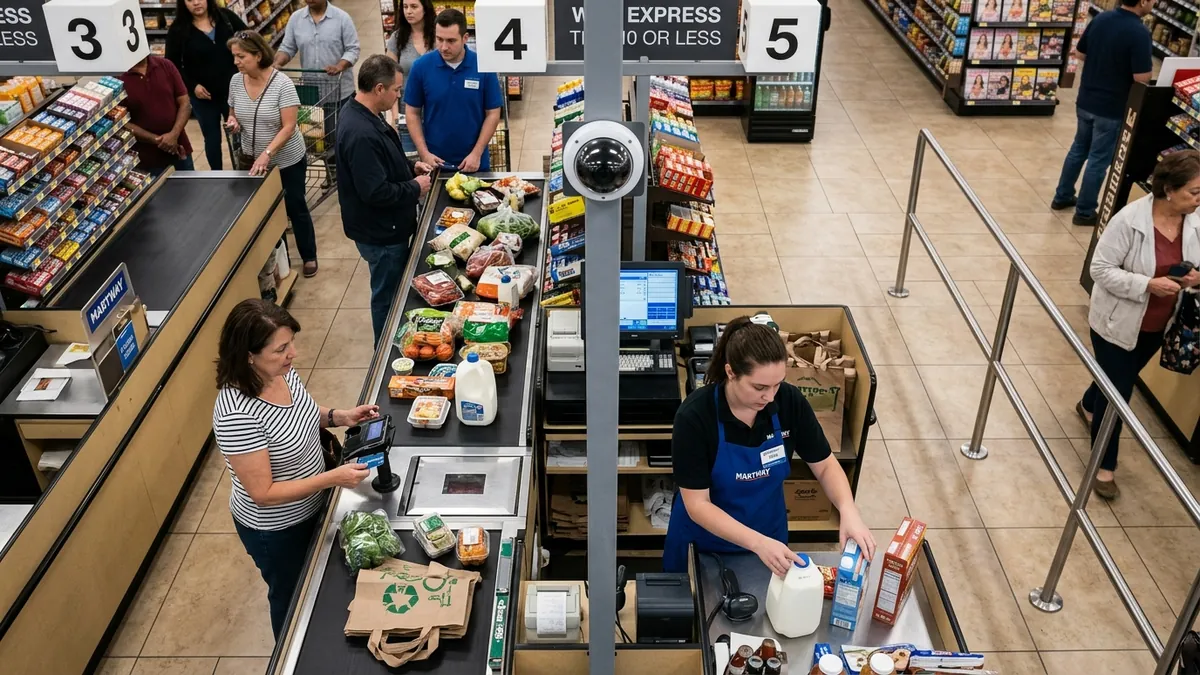
The foremost decision in integrating AI vision systems in retail is determining the inference architecture. Traditional cloud-based inference, where raw video feeds are streamed to AWS, GCP, or Azure for processing, is fundamentally flawed for large-scale retail deployments. A typical supermarket might have 100 to 300 cameras. Streaming 1080p video at 30 frames per second (fps) from 300 cameras requires astronomical outbound bandwidth and incurs prohibitive egress costs. Furthermore, the round-trip latency renders real-time applications—such as frictionless checkout or instant spill detection—impossible.
Therefore, retail vision systems mandate an Edge or Hybrid-Edge architecture. In a purely edge-based setup, inference is performed directly on the camera (smart cameras with built-in NPUs) or on a localized edge server (e.g., NVIDIA Jetson AGX Orin or industrial PCs equipped with NVIDIA T4/A2 GPUs). The hybrid approach processes heavy, real-time workloads (like object detection and tracking) at the edge, while transmitting only lightweight, structured metadata (JSON payloads detailing bounding boxes, timestamps, and classifications) to the cloud for historical aggregation and complex behavioral analytics.
Need an Expert Opinion?
Stop guessing. Speak directly with a senior AdaptNXT engineer about your architecture, timeline, and feasibility.
"In retail computer vision, transmitting pixels to the cloud is an architectural anti-pattern. The edge must distill video into structured metadata instantly; only insights, never raw frames, should cross the wide area network."
2. Hardware Considerations: Cameras and Compute
The efficacy of any deep learning model is strictly bounded by the quality of its input data. Retail environments introduce unique optical challenges: varying illumination (bright storefront windows vs. dimly lit aisles), severe occlusions (customers blocking each other), and diverse reflective surfaces.
Camera Selection: Standard RGB security cameras are often insufficient for advanced CV tasks. System integrators must specify cameras with high dynamic range (HDR) sensors to handle extreme contrast, global shutters to eliminate motion artifacts when customers move quickly, and appropriate focal lengths to maximize pixel density per target (PPM - Pixels Per Meter). For specific applications like autonomous checkout, stereoscopic or Time-of-Flight (ToF) cameras are increasingly deployed to provide depth maps, aiding in differentiating between a customer picking up an item versus merely hovering their hand over it.
Edge Compute Sizing: Sizing the edge compute node requires calculating the aggregate TOPS (Tera Operations Per Second) required. If a store has 50 cameras, and each runs a YOLOv8 model requiring 30 milliseconds per frame, a single edge node must efficiently parallelize this workload using frameworks like NVIDIA TensorRT or Intel OpenVINO. Resource orchestration at the edge is typically managed via Kubernetes (K3s for lightweight edge deployments), ensuring that if one node fails, workloads are dynamically rescheduled.
3. Advanced Deep Learning Models for Retail
Deploying AI in retail transcends basic object detection; it requires sophisticated pipelines involving detection, tracking, re-identification (ReID), and action recognition.
Object Detection and Tracking: The foundational layer typically relies on single-stage detectors like YOLOv8 or SSD due to their optimal balance of mean Average Precision (mAP) and inference speed. However, detecting a customer in a single frame is trivial compared to tracking them persistently across a massive store. This necessitates robust tracking algorithms like DeepSORT or ByteTrack. These algorithms utilize Kalman filters for trajectory prediction and deep feature extractors to associate detections across consecutive frames, even when the customer is temporarily occluded behind a shelf.
"Persistent tracking across non-overlapping camera views is the holy grail of retail analytics. It requires not just spatial heuristics, but robust, invariant feature embeddings that can recognize a shopper from aisle one to aisle twelve."
Multi-Camera Re-Identification (ReID): When a customer moves out of the field of view (FOV) of Camera A and into the FOV of Camera B, the system must assign them the same unique ID. Multi-camera ReID models are trained to extract high-dimensional feature vectors based on clothing, color histograms, and gait. By computing the cosine similarity between the feature vector of a person exiting one camera and entering another, the system stitches together a unified trajectory of the customer's entire journey through the store.
Action Recognition and Pose Estimation: For grab-and-go (frictionless) retail, the system must understand interactions with the physical environment. Pose estimation models (like OpenPose or MediaPipe) map skeletal keypoints, while action recognition networks (like SlowFast or 3D CNNs) analyze spatial-temporal volumes of video to classify actions: e.g., "picked up item," "returned item to shelf," or "placed item in pocket."
4. The Data Integration Pipeline
Generating accurate inferences at the edge is only half the battle; integrating this data into enterprise systems is where true business value is unlocked. The integration pipeline must handle high-throughput, low-latency data streams reliably.
Typically, the edge inference nodes act as publishers in a Pub/Sub architecture. As bounding boxes and events are generated, they are serialized into JSON and pushed to a local message broker, such as an edge-deployed Apache Kafka cluster or an MQTT broker. This decoupled architecture ensures that if the WAN link to the cloud drops, the local broker buffers the messages, preventing data loss.
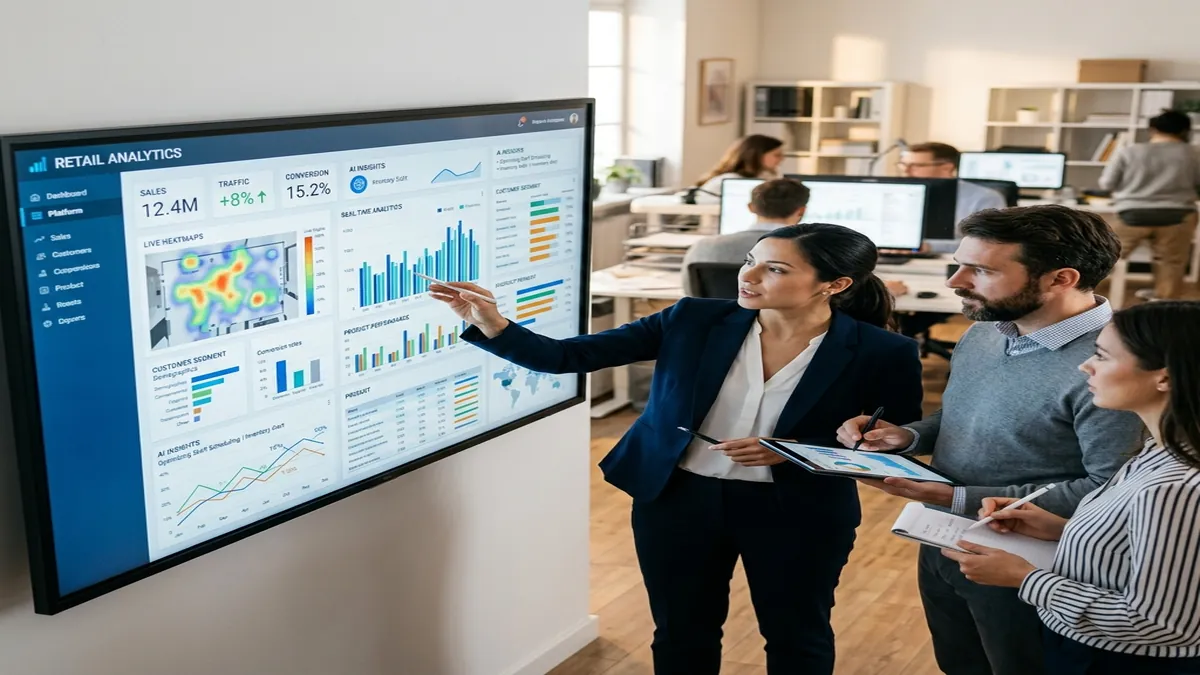
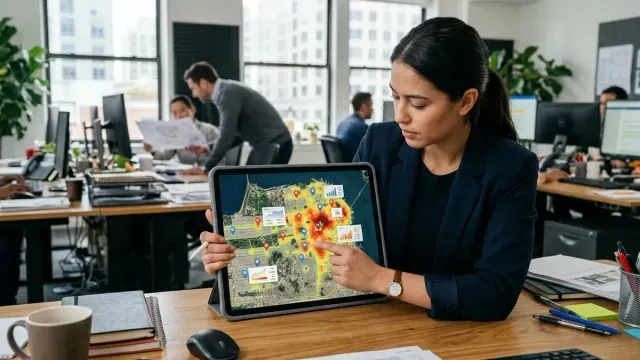
Once the data reaches the cloud, stream processing engines (like Apache Flink or Spark Streaming) aggregate the raw metadata. They transform millions of coordinate points into actionable business metrics: dwell times, heatmaps, conversion rates per aisle, and real-time inventory depletion alerts. This aggregated data is then ingested into a data warehouse (like Snowflake or BigQuery) and exposed to the retail management via GraphQL or REST APIs, eventually feeding into visualization dashboards and ERP systems like SAP or Microsoft Dynamics.
5. Navigating Privacy and Compliance
The deployment of ubiquitous camera systems inevitably raises severe privacy concerns and regulatory scrutiny (e.g., GDPR in Europe, CCPA in California). Retail AI systems must be architected with "Privacy by Design."
To comply with these regulations, vision systems must implement on-device anonymization. Before any frame is saved or any metadata is transmitted, facial detection models identify faces and apply irreversible blurring or pixelation. Furthermore, the ReID feature vectors must be ephemeral, hashed, and purged the moment the customer exits the store. The system must guarantee that it is tracking an "anonymous entity" rather than a specific individual, ensuring that no Personally Identifiable Information (PII) is ever persisted in the cloud database.
6. Real-World Case Scenarios
Frictionless Checkout: Pioneered by Amazon Go, this involves a dense ceiling array of cameras combined with shelf-weight sensors. The CV system performs continuous 3D tracking and action recognition to maintain a virtual cart for every shopper, charging their account automatically upon exit.
Real-Time Shelf Auditing: Fixed cameras or autonomous robots scan the aisles, using object detection models specifically trained on thousands of SKU variations. The system identifies out-of-stock (OOS) items or misplaced products in real-time, instantly routing a task to a store associate's mobile device to restock the specific shelf, thereby preventing lost sales.
Spill and Hazard Detection: To mitigate slip-and-fall liabilities, CV models are trained to detect anomalies on the floor, such as liquid spills or fallen merchandise. Upon detection, an automated alert is dispatched over the store's public address system or directly to the janitorial staff's wearables.
Conclusion
Integrating AI vision systems into retail environments is a multidisciplinary engineering feat. It demands a holistic approach encompassing ruggedized edge hardware, optimized neural networks, resilient messaging pipelines, and strict adherence to privacy architectures. As computer vision models become more computationally efficient and edge hardware continues to commoditize, the smart store will transition from an experimental luxury to an operational standard. Retailers who successfully navigate these integration complexities will gain an unassailable advantage in operational efficiency and customer experience.
Frequently Asked Questions
Why is edge computing preferred over cloud for retail vision systems?
Edge computing is preferred because streaming high-definition video from hundreds of in-store cameras to the cloud requires immense bandwidth and incurs high latency. Processing video locally on edge devices ensures real-time responsiveness and significantly reduces operational costs.
What is multi-camera Re-Identification (ReID)?
Multi-camera ReID is a deep learning technique used to track a single customer across multiple, non-overlapping camera views. It extracts unique feature vectors based on clothing and appearance to match the person as they move throughout the store.
How do retail vision systems address privacy concerns like GDPR?
Systems ensure privacy by implementing on-edge processing where video frames are analyzed and instantly discarded. Faces are blurred in real-time, and only anonymized metadata (like coordinates and timestamps) is sent to the cloud, ensuring no Personally Identifiable Information (PII) is stored.