
By an industry veteran in technology delivery, enterprise financial modeling, and industrial machine vision deployment.
Key Takeaways
- The Cost of Quality (COQ) Framework
- Calculating Escape-Rate Cost Savings
- Labor Re-allocation and Appraisal Savings
- The Boardroom Cash-Flow Model
- Structuring Your Pitch: Overcoming Boardroom Hesitations
Every quality director I have ever met knows the exact metric that keeps them awake at night: Defect Escape Rate.
It is one thing to throw away a defective part on your own factory floor. That is a waste of material, but it is contained. It is an entirely different disaster when that defective part escapes your facility, travels down the supply chain, and is assembled into a finished product by your customer.
Need an Expert Opinion?
Stop guessing. Speak directly with a senior AdaptNXT engineer about your architecture, timeline, and feasibility.
At that point, the cost of the defect multiplies by a factor of 100 or 1,000. You are no longer looking at the scrap value of a piece of steel. You are looking at warranty claims, product recalls, OEM late-delivery fines, and the potential loss of multi-million-dollar supply contracts. In automotive, aerospace, and medical device manufacturing, a single escaped defect can destroy a supplier's reputation overnight.
To prevent this, manufacturers traditionally deploy teams of manual inspectors. But manual visual inspection is fundamentally limited. Humans get tired. Our eyes strain. We get distracted by noise or repetitive tasks. Studies show that even the most well-trained human inspectors, working in optimal conditions, have an error rate of 10% to 20% over an 8-hour shift.
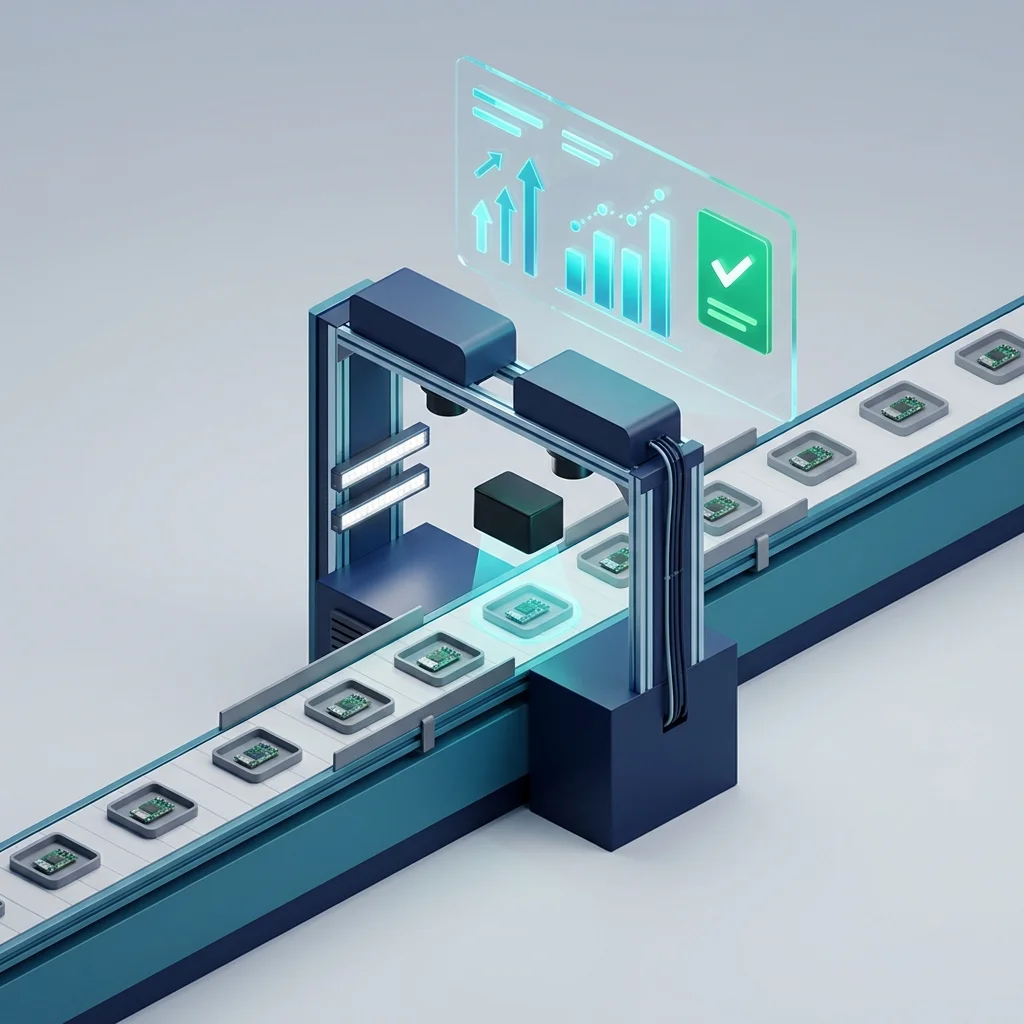
Computer Vision (CV) solves this by inspecting 100% of your products at high speeds with consistent 99.9%+ accuracy. Yet, when engineering teams try to pitch these systems, they often get rejected because they focus on deep learning frameworks and camera megapixel specs instead of talking to the CFO in the language they understand: Return on Investment (ROI).
This guide breaks down the financial math of automated inspection. We will examine the Cost of Quality (COQ) framework, calculate the savings of reducing escape rates, and build a board-ready cash-flow model that shows how a custom computer vision system can pay for itself in under six months.
The Cost of Quality (COQ) Framework
To justify a capital investment in automated quality control, we must structure our analysis using the industry-standard Cost of Quality (COQ) framework. COQ divides quality-related expenses into four distinct buckets:
Category What It Includes How Computer Vision Impacts It Internal Failures Scrap, rework, and material waste identified before shipment. Increases initially, then decreases. By catching defects immediately at the station (rather than at end-of-line), you prevent adding value to bad parts. External Failures Warranty claims, customer returns, recall campaigns, and late fines. Slashes by 90%+. By reducing the escape rate near zero, you systematically eliminate external warranty liabilities. Appraisal Costs The cost of inspecting and testing parts (primarily manual labor). Reduces dramatically. Automates the repetitive scanning loop, allowing you to reallocate skilled labor to optimization tasks. Prevention Costs Training, quality audits, and engineering changes to prevent defects. Optimizes. The digital logging of defects provides raw data for root-cause analysis, preventing future process drift. A digital twin or automated computer vision system primarily targets External Failures and Appraisal Costs. Let's look at the financial math behind both.
Calculating Escape-Rate Cost Savings
Let's model the cost of defect escapes. We will use a standard, mid-sized discrete manufacturing scenario:
- Annual Production Volume: 2,000,000 units
- Baseline Defect Generation Rate: 1.5% (30,000 defective units produced annually)
- Manual Inspection Escape Rate: 15% (Meaning 4,500 defective units are shipped to customers each year)
- Average Cost of an Escaped Defect: $150 (Includes returns processing, shipping, customer rework, and contract penalties)
Using these baselines, the current Annual External Failure Cost is:
\[ ext{Current Failure Cost} = 4,500 ext{ escaped units} imes $150 = $675,000 ext{ per year}\]
The Computer Vision Impact
By installing a calibrated camera station with a deep-learning model designed for your environment (as we detailed in our guide on Industrial Camera Calibration), we reduce the escape rate from 15% to less than 0.5%.
- New Defect Escape Volume: 30,000 defects × 0.5% = 150 escaped units per year
- New Annual External Failure Cost: 150 units × $150 = $22,500 per year
- Annual Net Savings: $$675,000 - $22,500 = \mathbf{$652,500}$
Labor Re-allocation and Appraisal Savings
A common misconception is that computer vision systems are designed to lay off workers. In today's tight industrial labor market, the reality is different. Manufacturers are struggling with severe labor shortages and high employee turnover in boring, repetitive visual inspection roles.
Deploying automated inspection allows you to reallocate labor from mind-numbing manual scanning to high-value roles like process optimization, machine setup, or preventative maintenance.
The Labor Math
Suppose you run a 3-shift operation, requiring 1 inspector per shift on a critical line. Each inspector costs an average of $60,000 per year (fully loaded with benefits, training, and overhead).
\[ ext{Annual Manual Inspection Cost} = 3 ext{ inspectors} imes $60,000 = $180,000\]By automating the line's visual inspection with a 24/7 camera system, you free up these three positions. Rather than letting them go, you move them to resolve the bottleneck in your CNC department, increasing your overall plant capacity. Even if we simply model the labor replacement, you are looking at an annual appraisal savings of $180,000.
The Boardroom Cash-Flow Model
Let's combine these savings and compare them against the implementation cost of a custom, multi-camera computer vision system deployed by AdaptNXT. We will model a comprehensive edge-based deployment with custom lighting, telecentric lenses, Jetson Orin edge hardware, database integration, and pilot calibration.
Expense Category Description One-Time Cost Recurring / Year Industrial Cameras & Optics 2x 5MP Machine Vision cameras, telecentric lenses, ring lights, and protective enclosures. $18,000 -- Edge Inference Hardware NVIDIA Jetson Orin Industrial computer for local real-time inference (YOLO). $7,000 -- Software & Integration Data ingestion pipelines, PLC integration via OPC UA, database logs, and dashboard setup. $35,000 -- AI Model Development Dataset annotation, custom neural network training (YOLO model), and lab validation. $65,000 -- Calibration & Commissioning On-site physical camera setup, lens calibration, lighting tuning, and operator training. $15,000 -- Cloud Storage & Retraining Cloud database for defect logging and periodic automated model retraining. -- $12,000 Maintenance & Support 24/7 technical support, lens cleaning routines, and firmware updates. -- $10,000 TOTAL INVESTMENT -- $140,000 $22,000
Financial Return Analysis (3-Year Horizon)
Combined Annual Savings:
Escape-rate savings ($652,500) + Labor appraisal savings ($180,000) = $832,500 per year.
Year 1 Cash Flow:
Gross Savings ($832,500) − One-Time Capital Cost ($140,000) − Recurring Support ($22,000) = +$670,500
Year 2 & 3 Cash Flow (Per Year):
Gross Savings ($832,500) − Recurring Support ($22,000) = +$810,500
Three-Year Cumulative Net Savings:
$670,500 + $810,500 + $810,500 = $2,291,500
The Payback Period:
With monthly savings of $69,375 ($832,500 / 12 months) and a total Year 1 cost footprint, the initial capital investment of $140,000 is fully recovered in approximately 2.0 months.
These metrics are undeniably strong. A technology deployment that pays for itself in just two months and saves the company over $2.2 million over three years is no longer an optional innovation project — it is a critical operational upgrade that directly impacts profitability.
Structuring Your Pitch: Overcoming Boardroom Hesitations
Even with outstanding cash-flow projections, executive boards often hesitate to approve AI projects due to perceived technology risks. To ensure approval, address their concerns directly: (If your project involves monitoring human operations or safety compliance zones, worker privacy is often the primary bottleneck. Read our complete guide on Privacy-First Video Analytics to see how we ensure 100% GDPR compliance).
Concern: "What if the AI misses a new, unknown type of defect?"
The Answer: We build hybrid models. We do not just train the neural network to look for known defects (like a specific crack). We also train anomaly detection models that learn the template of a perfect part. If a part comes down the line with a weird smudge or a dent the system has never seen before, the anomaly model flags it as "abnormal" and routes it for inspection, ensuring zero escapes.
Concern: "Who maintains this when our line parameters change?"
The Answer: AdaptNXT designs automated MLOps pipelines. If your engineering team modifies the product design or introduces a new SKU, the system's edge cameras capture the new imagery, flag the changes, and queue them for automated retraining. We build self-correcting models that evolve with your production line, requiring minimal input from your on-site IT team.
Concern: "We cannot afford weeks of downtime to install this."
The Answer: We follow a strict parallel-deployment methodology. We build and validate the camera enclosures, lighting, and AI models in our lab environment first. The physical installation on your line is executed during a standard weekend maintenance window in less than 12 hours. We then run the system in "shadow mode" (monitoring without taking action) to validate its performance before connecting it to your PLC reject actuators.
The Bottom Line
Manual visual inspection is a bottleneck that leaks defects and drains your operational margin. Automating your quality control with computer vision is a high-ROI decision that pays for itself in months by eliminating warranty exposure and optimizing labor allocation.
If you are ready to construct a custom Cost of Quality audit and build a business case for automated inspection in your facility, our team can help. AdaptNXT specializes in designing, lighting, and deploying production-ready machine vision systems that deliver bottom-line value. Book a free Feasibility & ROI scoping call with our architects →
Deployment Risks
Protect your ROI by understanding the hidden technical hurdles. Read our guide on Core Challenges in Enterprise Computer Vision Projects.
Ready to streamline your operations and drive growth? Contact our team today to explore how our advanced solutions can be tailored to your business needs, or discover your potential savings with our ROI Calculator.
Summary Overview
| Concept / Strategy | Description |
|---|---|
| The Cost of Quality (COQ) Framework | An introduction to the standard framework for analyzing quality-related expenses like internal and external failures. |
| Calculating Escape-Rate Cost Savings | How to quantify the financial savings achieved by reducing the number of defective units that reach customers. |
| Labor Re-allocation and Appraisal Savings | The benefits of shifting manual inspectors to higher-value roles and reducing ongoing appraisal costs. |
| The Boardroom Cash-Flow Model | A comprehensive breakdown of initial investments versus ongoing savings to calculate the ROI of an automated system. |
| Structuring Your Pitch: Overcoming Boardroom Hesitations | Strategies for addressing executive concerns regarding AI adaptability, maintenance, and installation downtime. |
| The Bottom Line | A summary of how automated quality inspection quickly pays for itself while improving overall operational margins. |
Frequently Asked Questions (FAQ)
How does computer vision reduce the Cost of Quality?
Computer vision dramatically reduces external failure costs by minimizing defect escape rates and lowers appraisal costs by automating manual inspection.
What is the typical payback period for an automated inspection system?
A well-implemented computer vision system can often pay for its initial capital investment in as little as a few months by preventing costly defect escapes.
Can computer vision systems adapt to new types of defects?
Yes, modern systems use hybrid models that include anomaly detection to identify abnormal parts, even if they have never encountered that specific defect before.