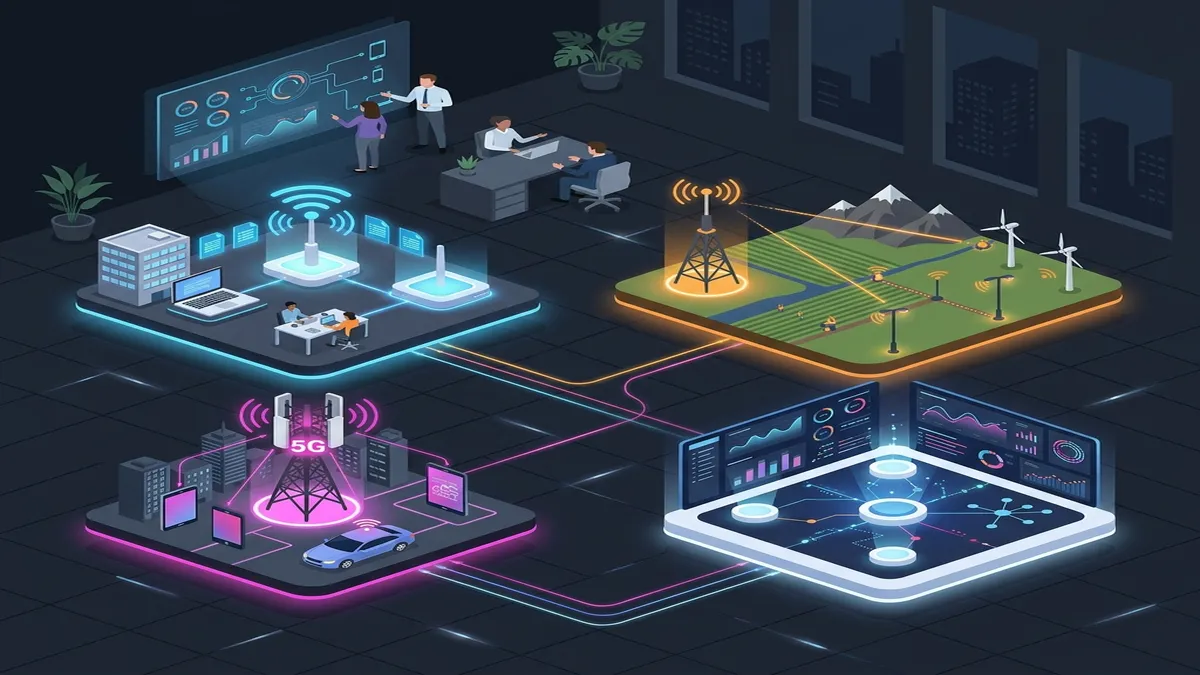

As Internet of Things (IoT) devices proliferate across industries — from smart factories to connected autonomous vehicles — the traditional computing model of sending all raw data to a centralized cloud for processing is hitting its physical limits. Edge computing offers a powerful architectural alternative by bringing computation, storage, and analytics closer to where the data is actually generated.
Key Takeaways
- Edge computing processes data locally, eliminating the latency of round-trips to centralized cloud servers.
- It drastically reduces bandwidth costs by filtering and transmitting only critical anomalies or aggregated insights.
- Edge architectures provide operational resilience, allowing systems to function safely during internet outages.
- Security and privacy are inherently improved by keeping sensitive raw data entirely on-premise.
The Latency and Bandwidth Problem
In time-critical, mission-essential applications like autonomous driving, industrial robotics, and remote robotic surgeries, even 50 milliseconds of latency can result in catastrophic failure. Cloud round-trips (sending data to an AWS/Azure server hundreds of miles away, processing it, and receiving a command back) introduce unavoidable delays dictated by the speed of light and network congestion. Furthermore, continuously streaming 4K video from hundreds of factory floor cameras to the cloud is financially ruinous in bandwidth costs alone.
How Edge Computing Works
Edge computing distributes processing power across a localized network of devices — ruggedized gateways, on-premise micro-data centers, and increasingly, directly on the IoT sensors themselves (often referred to as "TinyML").
Need an Architect's Assessment?
Speak directly with a senior AdaptNXT solutions architect about your system constraints, timeline, and production feasibility.
- Local Processing: Data is analyzed immediately at the point of collection using locally deployed machine learning models.
- Selective Syncing: Instead of streaming gigabytes of raw video or vibration data, the edge device only transmits kilobytes of relevant summaries or anomaly alerts to the cloud.
- Offline Resilience: Systems continue operating, executing logic and maintaining safety protocols, even if the primary internet connection is completely severed.
- Privacy by Design: Sensitive data (like facial recognition in a retail store or patient vitals in a hospital) stays strictly on-premise, vastly simplifying regulatory compliance.
Comparing Cloud vs. Edge Computing
| Characteristic | Cloud Computing | Edge Computing |
|---|---|---|
| Latency | High (50ms - 200ms+) | Ultra-Low (< 5ms) |
| Bandwidth Requirement | Very High (Continuous streaming) | Low (Only sends insights) |
| Compute Power | Infinite / Elastic | Constrained by local hardware |
| Offline Capability | None (Fails without internet) | High (Operates autonomously) |
Industry Applications
Manufacturing plants use edge computing to run high-speed computer vision for quality control, rejecting defective parts on an assembly line moving at 300 units per minute. Retailers deploy edge AI for in-store foot traffic analytics without streaming customer faces to the cloud. Healthcare systems process continuous patient vitals locally to trigger immediate life-saving alerts without relying on a hospital's occasionally spotty Wi-Fi network.
"Edge computing is not about replacing the cloud — it's about extending intelligence to where it matters most: the point of action."
The 5G Accelerator
The global rollout of 5G networks is heavily accelerating edge computing adoption. 5G provides the high-bandwidth, ultra-low-latency connectivity required to link localized edge networks (like a factory floor) back to central command centers. Together, 5G networks and edge compute nodes (MEC - Multi-Access Edge Computing) create a robust foundation for the next generation of industrial IoT.
Building an Edge Strategy
Organizations should aggressively evaluate their IoT workloads to determine edge suitability. The roadmap requires investing in edge-capable industrial hardware, adopting containerized application architectures (like Kubernetes on the Edge) to manage deployments, and planning for distributed, zero-trust security. AdaptNXT helps global enterprises design, deploy, and manage secure edge architectures that scale reliably across hundreds of remote locations.
Frequently Asked Questions (FAQ)
Will edge computing replace cloud computing?
No. They are highly complementary. The edge handles real-time, low-latency execution and data filtering, while the cloud handles heavy model training, historical long-term storage, and global data aggregation.
What is an edge gateway?
An edge gateway is a physical piece of hardware located on-premise that acts as a bridge between local "dumb" sensors and the internet. It often packs enough CPU/GPU power to run analytics locally before transmitting data upward.
Is edge computing secure?
It offers mixed security benefits. It improves privacy by not transmitting raw data over the internet, but physically securing hundreds of remote edge devices from tampering requires rigorous physical and software security protocols. For more details, contact our team.