
In today's fast-paced digital landscape, enterprise mobile app development is no longer just a trend; it is a critical driver for business transformation. As organizations seek to empower their mobile workforce and provide frictionless experiences for clients, the architectural foundation of these applications dictates their ultimate success or failure. Building enterprise mobile solutions is fundamentally different from creating consumer-facing apps. It requires a rigid focus on security, seamless integration with existing core business platforms, and an architecture capable of accommodating thousands of concurrent enterprise users without a hint of performance degradation.
The Foundations of Enterprise Mobile Architecture
Unlike consumer apps, enterprise solutions must handle massive amounts of sensitive data, integrate with complex internal systems, and adhere to strict compliance regulations. A well-designed architecture ensures that your application can scale horizontally and vertically without compromising performance or security. The architecture serves as the blueprint, defining how data flows between the mobile client and the enterprise backend, how offline capabilities are managed, and how business logic is executed reliably across diverse network conditions.
To establish a solid foundation, architects must adopt a multi-tiered approach. This generally involves a presentation layer (the app UI), a business logic layer (often residing on a middleware server or microservice), and a data access layer connecting to legacy databases or ERP systems. Segregating these layers ensures that changes to the UI don't mandate a rewrite of the underlying business rules, thereby drastically reducing technical debt over the application's lifecycle.
Microservices and API-First Design
Modern enterprise mobile app development relies heavily on microservices architecture. By decoupling backend services, development teams can update, scale, and maintain individual components independently. For example, the authentication module, data synchronization engine, and push notification service can all operate as distinct microservices. This API-first approach ensures that your mobile application acts as a seamless extension of your core business systems.
Adopting an API-first mindset means that before a single screen is designed, the API contracts are established. This allows frontend and backend teams to work in parallel, accelerating the development cycle. Teams looking for robust backend structures should explore advanced product engineering services to guarantee high availability and fault tolerance within their microservices ecosystem.
Deep Dive: Core Architectural Patterns
Selecting the right architectural pattern is pivotal. Here are the most prominent patterns utilized in enterprise mobile app development:
- Model-View-ViewModel (MVVM): Highly favored in native development (both iOS and Android), MVVM separates the UI from the business logic, making the code highly testable and maintainable. It facilitates two-way data binding, ensuring the UI always reflects the current underlying data state.
- Clean Architecture: Proposed by Robert C. Martin (Uncle Bob), this pattern structures the app in concentric circles. The innermost circle contains the enterprise business rules, insulated from any UI or database changes on the outer layers. This provides unparalleled maintainability for long-term enterprise projects.
- Backend-for-Frontend (BFF): In complex enterprise environments, the mobile app often requires data formatted differently than a web portal. The BFF pattern involves creating a dedicated backend service specifically tailored for the mobile app, aggregating data from multiple downstream microservices and formatting it precisely for the mobile client.
Security and Compliance Strategies
Security in enterprise mobility cannot be an afterthought; it must be woven into the fabric of the architecture. An enterprise app that leaks data is worse than having no app at all.
- End-to-End Encryption: Safeguard sensitive corporate data both in transit (using TLS 1.3) and at rest using industry-standard cryptographic protocols (like AES-256). Secure enclaves and keychains on modern mobile devices should be utilized to store encryption keys.
- Identity and Access Management (IAM): Implement robust authentication mechanisms such as biometric logins, Multi-Factor Authentication (MFA), and OAuth 2.0/OpenID Connect to ensure only authorized personnel can access critical systems. Single Sign-On (SSO) integration is mandatory for a seamless enterprise user experience.
- MDM/MAM Integration: Ensure compatibility with Mobile Device Management (MDM) and Mobile Application Management (MAM) solutions (like Microsoft Intune or VMware Workspace ONE). This allows IT administrators to enforce device policies, distribute apps securely, and execute remote wipe capabilities if a device is compromised.
- Code Obfuscation and Tamper Detection: Protect the intellectual property and internal logic of the app by implementing code obfuscation techniques and runtime application self-protection (RASP) mechanisms that detect jailbroken or rooted devices and terminate the app session immediately.
"A resilient enterprise mobile app is built on the premise that security is not a feature, but the foundational layer of its entire architecture."
Optimizing Performance for Global Workforces
When deploying an app to a global workforce, latency and offline capabilities become paramount. Field service technicians, sales representatives, and traveling executives often find themselves in low-bandwidth environments.
Implementing Robust Offline Capabilities
Implementing sophisticated caching mechanisms, local databases (like SQLite, Realm, or CoreData), and efficient data synchronization protocols ensures that employees can continue working even in areas with poor network connectivity. A robust offline-first architecture requires a sophisticated conflict resolution strategy. When a connection is re-established, the app should seamlessly sync data back to the central servers without data corruption.
To achieve this, developers often employ a strategy where the local database acts as the single source of truth for the UI. Background sync engines manage the payload delta, sending only modified records (using timestamps or version hashing) to conserve bandwidth and reduce server load.
Performance Monitoring and Analytics
Enterprise apps require deep observability. Integrating Application Performance Monitoring (APM) tools allows IT teams to track crash rates, API response times, and battery consumption in real-time. This proactive monitoring ensures that performance bottlenecks are identified and resolved before they impact workforce productivity.
Frameworks and Technology Stack Selection
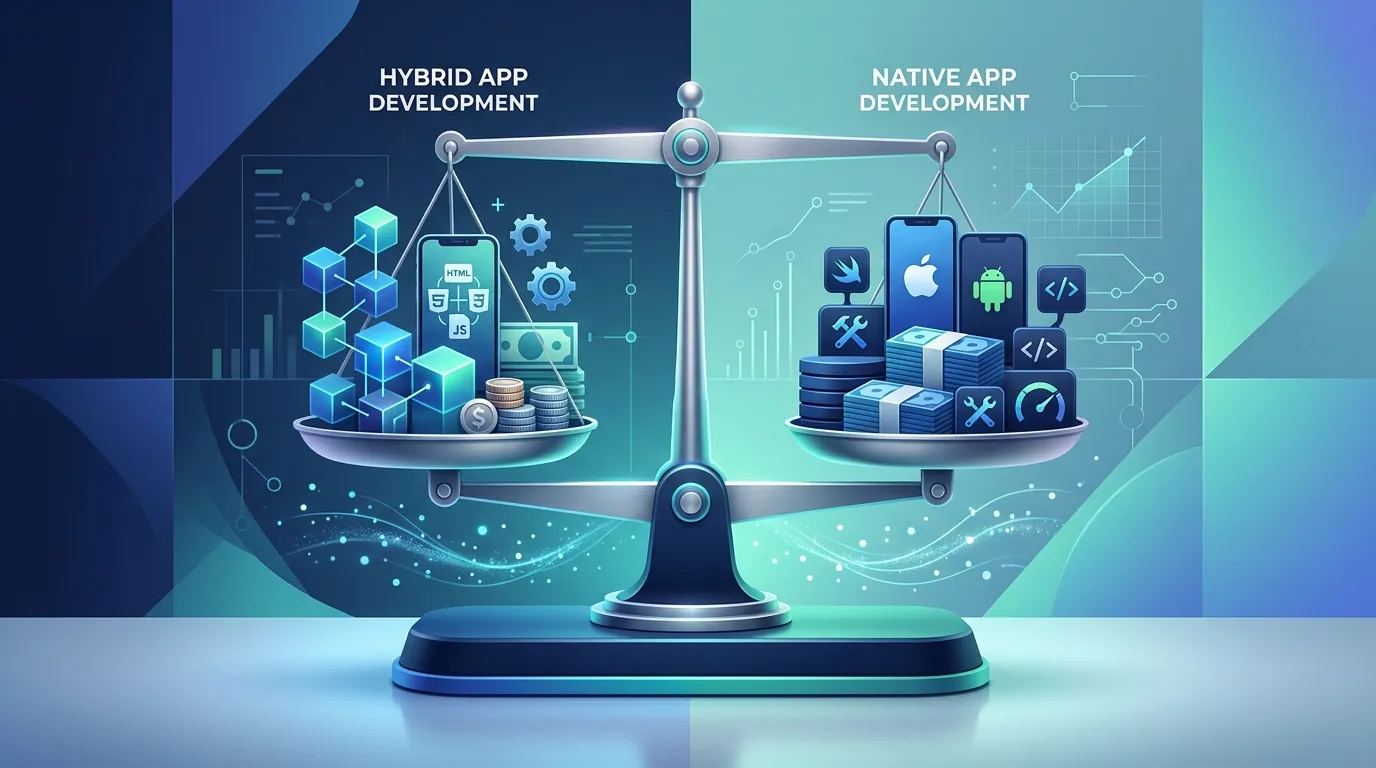
The choice between Native (Swift/Kotlin), Cross-Platform (React Native/Flutter), or Progressive Web Apps (PWAs) should be driven by the enterprise's architectural requirements. Native development offers the ultimate performance and deep OS integration, crucial for highly secure or hardware-intensive tasks. However, cross-platform frameworks have matured significantly, offering near-native performance with the benefit of a single codebase, drastically reducing time-to-market and maintenance costs for standard enterprise utility apps.
Case Study: Architecting a Global Supply Chain App
Consider a multinational manufacturing firm that needed a mobile app for its warehouse managers. The initial attempt failed due to a monolithic backend and zero offline capabilities; workers lost connectivity in the depths of the warehouse, rendering the app useless. By re-architecting the solution using a BFF pattern, implementing Couchbase Lite for robust offline synchronization, and containerizing the backend services using Kubernetes, the firm achieved 99.99% uptime. Warehouse efficiency increased by 40%, proving that architecture directly impacts operational output.
Successful enterprise mobile app development requires a holistic view of your organization's technical ecosystem. By prioritizing scalable architecture, API-first design, stringent security, and offline resilience, you can deliver powerful mobile experiences. These well-architected applications move beyond basic utility, transforming into strategic assets that drive productivity and operational excellence across the entire enterprise.