
Retrieval-Augmented Generation (RAG) is excellent for giving a chatbot facts. But when an AI needs to understand the nuance, tone, and highly specialized jargon of a specific industry—like interpreting complex medical diagnoses or drafting legally binding contract clauses—you have to modify the model's actual neural weights.
In this technical guide, our ML engineering team breaks down how to fine-tune open-weights models like Llama 3 and Mistral to build highly specialized, domain-specific AI chatbots.
RAG vs. Fine-Tuning: The Enterprise Dilemma
A common misconception in AI development is that fine-tuning is for adding "new knowledge." That is factually incorrect.
- Use RAG (Retrieval-Augmented Generation) when you want to feed the model dynamic, changing facts (e.g., current inventory levels, today's policy documents).
- Use Fine-Tuning when you want to change the model's behavior, tone, syntax, or innate understanding of a complex domain language.
For example, if you are building an AI chatbot for radiologists, RAG will fetch a patient's chart. But Fine-Tuning is what allows the LLM to inherently understand the difference between "subdural hematoma" and "epidural hematoma" without having it explicitly explained in the prompt every time.
Need an Expert Opinion?
Stop guessing. Speak directly with a senior AdaptNXT engineer about your architecture, timeline, and feasibility.
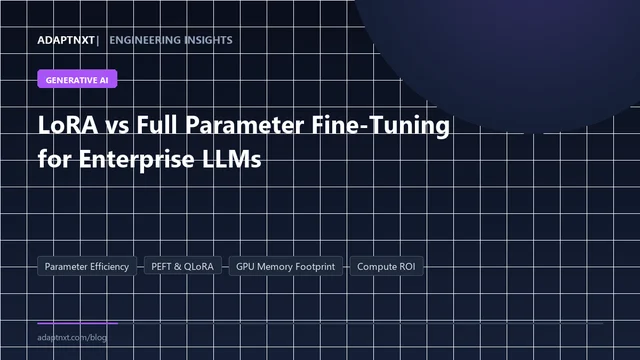
Parameter-Efficient Fine-Tuning (PEFT): LoRA and QLoRA
Historically, fine-tuning a 70 Billion parameter model required clusters of A100 GPUs costing tens of thousands of dollars. Today, we use PEFT (Parameter-Efficient Fine-Tuning).
What is LoRA (Low-Rank Adaptation)?
Instead of updating all 70 billion weights (Full Fine-Tuning), LoRA freezes the original model and injects tiny, trainable "adapter" matrices into the attention layers. This reduces the number of trainable parameters by 99%, meaning you can fine-tune a massive model on a fraction of the compute.
What is QLoRA (Quantized LoRA)?
QLoRA takes this a step further by quantizing (compressing) the base model's precision down to 4-bit before applying the LoRA adapters. This means you can effectively fine-tune a powerful Llama 3 8B model on a single consumer-grade GPU (like an RTX 4090) or a cheap AWS `g5.xlarge` instance.
The Fine-Tuning Workflow for Chatbots
Here is the exact architectural pipeline we use at AdaptNXT when deploying custom models for enterprise clients:
Step 1: Dataset Preparation (Instruction Tuning)
You need a highly curated dataset formatted as Instruction/Response pairs. The quality of this data is critical. "Garbage in, garbage out" applies heavily here. We typically aim for 1,000 to 5,000 high-quality examples formatted in JSONL:
{"system": "You are a legal AI assistant.", "instruction": "Draft a mutual NDA for...", "response": "This Mutual Non-Disclosure Agreement..."}
Step 2: Training via HuggingFace & PyTorch
Using libraries like HuggingFace's transformers, trl (Transformer Reinforcement Learning), and bitsandbytes, we load the base model (e.g., Llama-3-8B-Instruct) in 4-bit precision, apply the LoRA configuration, and train for several epochs.
Step 3: Merging & Deployment (vLLM)
Once the LoRA adapter is trained, we merge it back into the base model weights. We then deploy the newly fine-tuned model using high-throughput inference engines like vLLM or Ollama, exposing it as an OpenAI-compatible API for the chatbot frontend to consume.
When Does Fine-Tuning Make Sense?
If your enterprise operates in Finance, Healthcare, Law, or highly technical engineering domains, off-the-shelf cloud APIs (like ChatGPT) will often fail because they lack innate domain reasoning. By fine-tuning an open-source LLM, you achieve a model that speaks your industry's exact language, hosted entirely within your secure VPC.
Need a Domain-Specific LLM?
AdaptNXT provides end-to-end Machine Learning engineering. We curate datasets, execute QLoRA fine-tuning on AWS/Azure clusters, and deploy the models for your enterprise chatbot.
Consult our ML Engineers