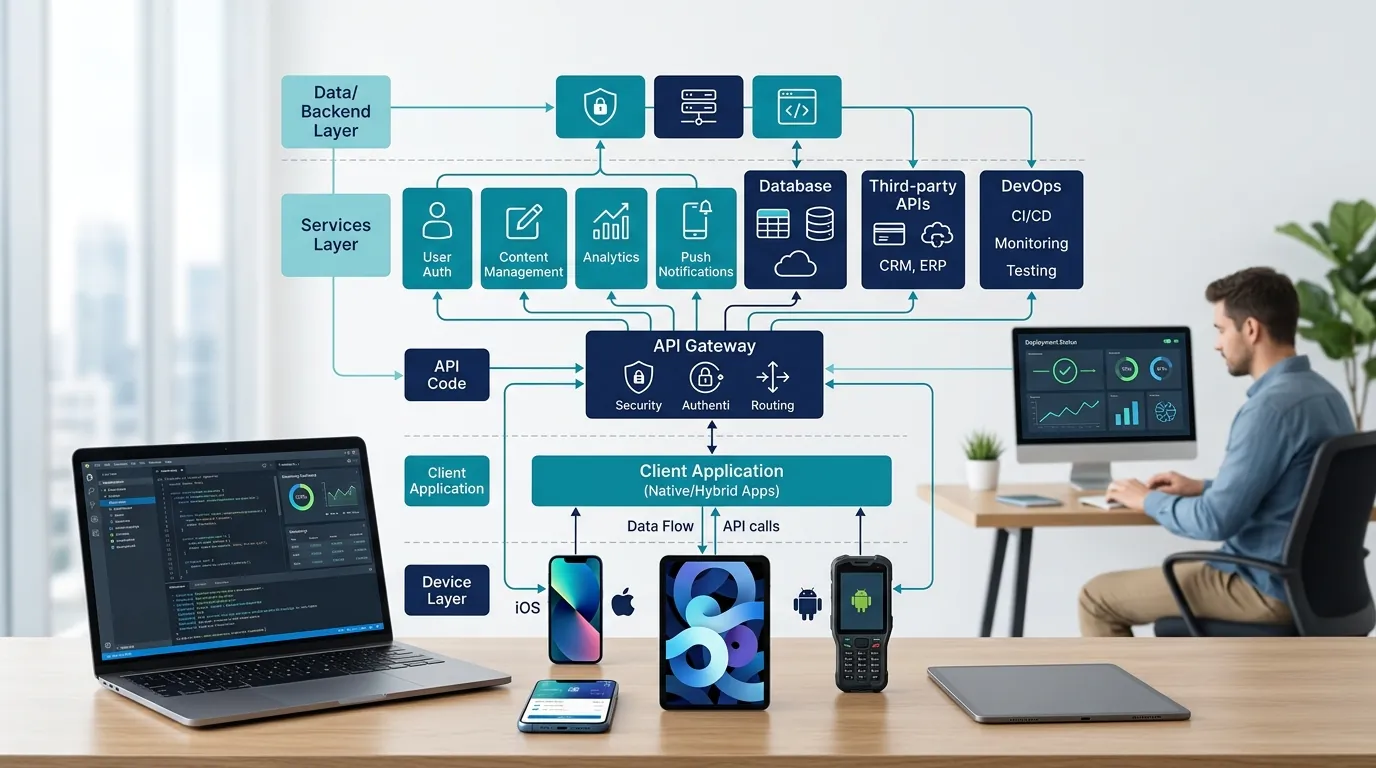

Welcome to this comprehensive technical guide on integrating HL7 and FHIR standards into custom healthcare software. As the healthcare industry accelerates its digital transformation, clinic management systems must evolve to support seamless data interoperability. This guide will provide deep technical dives, architectural frameworks, best practices, and actionable integration strategies to help your engineering teams navigate the complexities of modern health data exchange.
Key Takeaways
- Modern Paradigms: Transitioning from HL7 v2 to FHIR enables RESTful, JSON-based interoperability suitable for microservices.
- Security First: Implementing SMART on FHIR guarantees robust OAuth 2.0 and OpenID Connect authorization.
- Legacy Coexistence: Use integration engines and mapping facades to bridge older MLLP connections with modern cloud FHIR repositories.
-
The Shift from HL7 v2 to FHIR
Legacy health systems have historically relied on HL7 version 2.x, which utilizes pipe-hat delimited flat files over point-to-point MLLP (Minimum Lower Layer Protocol) connections. While functionally adequate for basic transactional messaging within closed hospital networks, it presents massive scaling limitations in modern distributed environments. The archaic nature of MLLP means it lacks native security constructs like TLS, requiring additional VPN tunneling to meet basic compliance mandates. Furthermore, processing these delimited payloads demands specialized parsing libraries, such as HAPI in Java, which often involve writing custom regular expressions to extract specific segments like PID (Patient Identification) or OBR (Observation Request). The overhead of maintaining these rigid parser implementations becomes a bottleneck when attempting to integrate cloud-native analytical workflows or mobile client applications.
Fast Healthcare Interoperability Resources (FHIR) introduces a monumental paradigm shift by exposing discrete medical concepts as predictable RESTful APIs. Instead of opaque, monolithic event streams, FHIR models clinical data as granular resources such as Patient, Observation, or MedicationRequest. This granular approach aligns perfectly with modern microservices architectures and domain-driven design principles. Engineering teams can leverage standard HTTP verbs like GET, POST, PUT, and DELETE alongside ubiquitous content types such as JSON or XML. By utilizing established web standards, the learning curve for full-stack web developers is dramatically reduced. They can query specific demographics or clinical notes using standard URL parameters, enabling composable architectures where frontend single-page applications can securely bind directly to health data endpoints without intermediary translation layers.
Furthermore, the FHIR specification provides an extensive search paradigm and built-in conformance mechanisms. Developers can construct complex queries leveraging chained parameters or reverse includes, radically reducing the number of network roundtrips required to construct a comprehensive patient dashboard. The standard also mandates the publication of CapabilityStatements, allowing client applications to dynamically discover the supported interactions of a given FHIR endpoint. This self-documenting nature, combined with the usage of implementation guides, ensures that diverse health platforms can establish semantic interoperability out of the box. As cloud providers like AWS with HealthLake and Google Cloud with their Cloud Healthcare API roll out managed FHIR repositories, offloading the operational burden of maintaining these servers has never been more accessible for clinic management platform vendors.
- Provision a managed FHIR store using a provider like Google Cloud Healthcare API or Azure Health Data Services to ensure high availability and HIPAA compliance.
- Deploy a secure API Gateway (e.g., Kong or AWS API Gateway) to route incoming traffic, enforce rate limiting, and terminate TLS connections before traffic reaches the FHIR server.
- Implement an integration engine like Mirth Connect or NextGen Connect to ingest legacy HL7 v2 feeds over MLLP, transforming the pipe-delimited messages into FHIR JSON resources via Javascript mapping steps.
- Configure the integration engine to execute HTTP POST requests to the FHIR endpoint, publishing the transformed resources into the managed clinical data repository.
- Validate the resulting data integrity by performing test queries against the FHIR API, ensuring resources like Patient and Encounter accurately reflect the original legacy messages.
-
Core Architectural Patterns for FHIR APIs
Modernizing a clinic's infrastructure requires designing an API facade that securely proxies legacy relational databases or proprietary document stores. Using an API Gateway is foundational for managing inbound requests, terminating SSL, and routing traffic to appropriate backend microservices. Behind the gateway, a specialized FHIR facade or server handles the parsing and validation of JSON/XML payloads against established implementation profiles. This facade layer acts as a crucial abstraction, translating standard FHIR search queries into the proprietary SQL or NoSQL dialects understood by the underlying legacy persistence layer. By decoupling the API contract from the database schema, engineering teams can gradually refactor internal data models without introducing breaking changes to external integrators or mobile application clients.
When architecting the data storage layer for native FHIR implementations, teams often face the choice between relational databases like PostgreSQL with JSONB columns and document databases such as MongoDB. PostgreSQL, combined with extensions like pg_trgm for text search, provides robust transactional guarantees and ACID compliance, which are non-negotiable for critical health records. Frameworks like the open-source HAPI FHIR JPA server leverage relational databases to provide fully compliant FHIR endpoints out of the box. Alternatively, serverless architectures utilizing AWS Lambda and Amazon DynamoDB can offer incredible elastic scalability for read-heavy workloads, though they require sophisticated secondary indexing strategies to support the complex search parameters defined by the FHIR specification.
Another architectural consideration is event-driven data propagation. As clinical resources are created or updated, other components of the healthcare ecosystem must be notified in real-time. Implementing the FHIR Subscriptions framework alongside a robust message broker like Apache Kafka or RabbitMQ allows the system to emit domain events asynchronously. For instance, when a new Lab Result represented as an Observation resource is persisted, the FHIR server can publish an event to a Kafka topic. Downstream consumers, such as analytics pipelines or patient notification services, can subscribe to this topic and react accordingly. This event-driven pattern prevents tight coupling between services, ensures horizontal scalability, and isolates failures, ensuring that a bottleneck in the reporting engine does not impact the core transactional performance of the clinic management system.
- Analyze the existing database schema of the clinic management software to identify the core entities that map to fundamental FHIR resources (e.g., Demographics to Patient, Appointments to Encounter).
- Develop a microservice using Node.js or Spring Boot that implements the FHIR RESTful API specification, acting as a facade over the legacy data store.
- Integrate a mapping library or write custom translation logic within the facade to convert inbound FHIR JSON payloads into SQL queries and vice versa for outgoing responses.
- Establish a robust validation layer using FHIR JSON Schema or dedicated validation engines to ensure all incoming data adheres strictly to the required regional profiles and terminologies.
- Deploy the facade behind a Web Application Firewall (WAF) and configure load balancing to distribute API traffic seamlessly across multiple container instances managed by Kubernetes.
-
Implementing the SMART on FHIR Standard
Security cannot be an afterthought in healthcare software, where unauthorized access can lead to severe regulatory penalties and compromised patient safety. SMART on FHIR provides an implementation guide that overlays OAuth 2.0 and OpenID Connect on top of the FHIR specification. This guarantees that third-party clinical applications authenticate robustly before accessing sensitive patient information. By utilizing scopes like "patient/Observation.read", authorization servers can enforce granular access controls, ensuring a mobile app only retrieves data for the authenticated patient. Implementing SMART requires deploying a hardened Identity Provider (IdP) such as Keycloak or Okta, configured to issue JSON Web Tokens (JWTs) that the FHIR resource server validates upon every API request.
-
Mapping Legacy Databases to Resource Profiles
Data normalization is an intensive engineering undertaking fraught with edge cases. Proprietary schemas used by old clinic systems must be mapped accurately to canonical FHIR resources. This often involves building custom ETL pipelines using Apache Spark or Apache Airflow that sanitize strings, format dates to ISO 8601, and resolve local medical codes to standardized terminologies. Mapping unstructured free-text fields into structured FHIR extensions requires sophisticated natural language processing techniques, potentially utilizing cloud AI services like Amazon Comprehend Medical. The mapping logic must be version-controlled and subject to rigorous automated testing to prevent regressions that could corrupt the clinical semantic meaning during the transformation process.
-
Overcoming Implementation Hurdles
Deploying such an architecture comes with specific difficulties that must be mitigated proactively by engineering leadership. One primary challenge involves handling massive patient payloads during bulk data exports. Extracting years of clinical history for population health analytics can easily overwhelm both the database and network layers. The solution relies on implementing the FHIR Bulk Data Access specification, which leverages asynchronous processing. Instead of returning massive JSON arrays synchronously, the server kicks off a background job and provides a status endpoint. Once complete, the data is dumped into NDJSON (Newline Delimited JSON) files stored securely in cloud object storage like AWS S3, allowing clients to download the data concurrently using pre-signed URLs without blocking the main API threads.
Real-time synchronization between disparate systems introduces another layer of complexity. Legacy HL7 v2 systems often expect immediate acknowledgement of message receipt, whereas modern web clients might suffer from intermittent connectivity. Utilizing FHIR Subscriptions and Webhooks allows servers to push updates actively to registered endpoints rather than relying on inefficient and heavy polling mechanisms. However, webhook delivery can fail due to network partitions or client downtime. To guarantee delivery, engineers must implement robust retry mechanisms with exponential backoff and dead-letter queues (DLQs) using cloud-native messaging services like Amazon SQS or Google Cloud Pub/Sub. This ensures that critical clinical updates, such as abnormal lab results, are never lost in transit.
Terminology mapping and semantic translation represent the most insidious hurdles in interoperability projects. A legacy clinic management system might use arbitrary local codes for diagnoses that are meaningless outside that specific database. FHIR mandates the use of standard ontologies like SNOMED CT, LOINC, or ICD-10. Hardcoding these translations in application logic creates an unmaintainable nightmare. The best practice is to deploy a dedicated terminology server, such as the open-source HAPI FHIR terminology service or Ontoserver. These specialized services provide APIs to dynamically resolve local codes to standard terminologies at runtime, centralizing the mapping logic and allowing clinical informaticists to manage code sets without requiring continuous software deployments.
- Audit existing clinical workflows to identify integration choke points, particularly focusing on how legacy systems emit state changes or process incoming laboratory results.
- Implement an asynchronous processing queue using Redis and Celery (or equivalent background task processors) to handle bulk data extraction requests without blocking synchronous API calls.
- Deploy a cloud-native terminology server within your Virtual Private Cloud (VPC) to handle dynamic code translations, populating it with the latest SNOMED CT and LOINC distribution files.
- Establish a robust dead-letter queue (DLQ) architecture using AWS SQS to capture failed webhook deliveries triggered by FHIR Subscriptions, ensuring no clinical events are permanently dropped.
- Construct comprehensive automated integration tests that mock external client behavior, specifically validating the exponential backoff and retry logic of your event-driven notification systems.
-
Technical Comparison: HL7 v2 vs. FHIR
Evaluating the differences highlights why a migration is technically sound and strategically imperative. The pros of FHIR center around its utilization of standard web protocols like HTTP and REST, support for modern serialization formats such as JSON and XML, and a significantly lower barrier to entry for full-stack developers. Unlike the obscure syntax of HL7 v2, a typical web developer can inspect a FHIR JSON payload and immediately understand its structure. This accelerates development cycles for creating patient portals or mobile health applications. Furthermore, the extensive ecosystem of open-source tooling, libraries like SMART on FHIR JavaScript client, and public sandbox environments enables rapid prototyping and seamless integration into modern continuous integration pipelines.
However, adopting FHIR is not without its challenges. The cons of FHIR include the fact that resource profiles can become extraordinarily complex when attempting to model highly specialized clinical domains. Regional implementation guides, such as US Core or UK Core, introduce mandatory constraints and extensions that require rigorous validation engines to enforce. Additionally, version backward-compatibility requires strict API management and governance. Transitioning from FHIR STU3 to R4, for instance, involved breaking changes to resource definitions, requiring engineering teams to implement complex version-aware routing and data migration scripts to prevent breaking existing integrations.
Conversely, examining the legacy standard reveals its enduring foothold. The primary pro of HL7 v2 is its absolute ubiquity in older hospital systems and laboratory networks. Basic integration points are already established in almost every healthcare facility globally, making it a reliable fallback for foundational messaging like admission, discharge, and transfer feeds. However, the cons of HL7 v2 are substantial in a modern context. It lacks native security layers, relying entirely on the transport layer for encryption. It requires specialized parsers, and data extraction is cumbersome, often requiring expensive integration engines just to route and filter messages. In an era of cloud computing and zero-trust security architectures, the limitations of HL7 v2 present significant operational liabilities.
- Configure a dual-stack integration engine like Mirth Connect to simultaneously receive legacy HL7 v2 messages via MLLP and modern FHIR resources via HTTP POST.
- Develop routing rules within the engine to filter incoming admission, discharge, and transfer (ADT) HL7 v2 messages based on facility codes or patient demographics.
- Implement Javascript transformation steps to extract patient identifiers and demographics from the PID segment of the HL7 v2 message and construct an equivalent FHIR Patient JSON object.
- Transmit the generated FHIR payload to your modern cloud-based clinical data repository while simultaneously logging the original HL7 v2 message for compliance auditing.
- Monitor the translation pipeline using application performance monitoring (APM) tools like Datadog to ensure transformation latency remains below acceptable clinical thresholds.
Standard Comparison Summary
Feature HL7 v2 FHIR (Fast Healthcare Interoperability Resources) Data Format Pipe-delimited flat files JSON, XML, RDF Protocol MLLP (TCP/IP) HTTPS (RESTful APIs) Security Lacks native application-level security Supports modern web security (SMART, OAuth 2.0, mTLS) Data Model Monolithic messaging Discrete, composable resources -
Future-Proofing Clinic Management
As governmental regulations enforce greater interoperability and patient data access, engineering teams must proactively adopt these modern standards. Building a scalable, secure, and performant FHIR API layer is an investment in the long-term viability of the healthcare software ecosystem. Legacy monolithic systems that trap data in proprietary silos are rapidly becoming obsolete, replaced by composable architectures where best-of-breed microservices interact seamlessly. By embracing FHIR natively, clinic management software vendors position themselves to easily integrate with emerging technologies like artificial intelligence diagnostic tools, population health analytics platforms, and remote patient monitoring Internet of Things (IoT) devices.
Future-proofing also demands a rigorous approach to infrastructure as code (IaC) and automated compliance auditing. When deploying FHIR infrastructure, utilizing tools like Terraform or AWS CloudFormation ensures that the environment is reproducible, secure by default, and fully documented. This is critical for maintaining HIPAA or GDPR compliance, as infrastructure changes can be tracked through version control. Furthermore, implementing continuous security scanning within the deployment pipeline ensures that the API gateway and backend FHIR servers remain patched against emerging vulnerabilities. Combining robust IaC practices with the standardized data models of FHIR creates a resilient technical foundation capable of adapting to future regulatory shifts.
Ultimately, the transition represents a cultural shift for engineering organizations as much as a technical one. Teams must move away from building isolated, custom interfaces for every new integration partner and instead focus on publishing well-documented, standardized APIs. Investing in developer portals that host OpenAPI documentation for the FHIR endpoints, providing sandbox environments for third-party integrators, and fostering a community of practice around health informatics will accelerate innovation. The goal is to transform the clinic management system from a simple record-keeping database into a dynamic, interconnected platform that actively drives clinical decision support and improves overall patient care delivery.
- Adopt an Infrastructure as Code (IaC) approach using Terraform to define the entire cloud architecture required for the FHIR server, ensuring reproducible and auditable deployments.
- Integrate automated security scanning tools like Snyk or Checkmarx into your deployment pipeline to continuously evaluate the FHIR API surface and dependencies for known vulnerabilities.
- Develop a comprehensive developer portal using tools like Backstage or ReadMe to host OpenAPI specifications, integration guides, and automated onboarding workflows for external partners.
- Establish a continuous monitoring strategy using Prometheus and Grafana to track API error rates, response latencies, and FHIR resource validation failures in real-time.
- Schedule regular disaster recovery drills that involve restoring the entire FHIR data repository from automated snapshots to guarantee data durability and business continuity.
"The transition from legacy HL7 V2 to FHIR is not just a technical upgrade; it is a fundamental reimagining of how healthcare ecosystems share and leverage clinical data to improve patient outcomes."
Frequently Asked Questions
What is the recommended authentication method for securing a FHIR API?
The industry standard for securing FHIR endpoints is the SMART on FHIR specification, which leverages OAuth 2.0 and OpenID Connect. This framework allows for granular, scope-based access control, ensuring that applications and users can only access the specific clinical resources they are explicitly authorized to view, such as a single patient's medication history.
Can legacy HL7 v2 interfaces coexist with modern FHIR implementations?
Yes, in most enterprise environments, coexistence is mandatory during transition periods. Engineering teams typically deploy integration engines like Mirth Connect or specialized cloud services to act as translation layers. These engines listen for legacy MLLP feeds, transform the pipe-delimited data into FHIR JSON resources, and forward them to the modern REST API, ensuring both legacy and modern systems remain synchronized.
How do engineering teams handle complex medical terminologies in FHIR?
Mapping proprietary clinical codes to standardized ontologies like SNOMED CT or LOINC is a major challenge. Best practices dictate deploying a dedicated, cloud-native terminology server that exposes FHIR terminology operations such as the endpoint. This abstracts the complexity of terminology resolution away from the core application logic, allowing clinical informaticists to update mappings independently of software deployments.