
By an industry veteran in technology consulting and industrial automation.
Every manufacturing executive knows the sinking feeling that accompanies the phrase: "The line is down."
It is not just a localized maintenance issue. It is a financial chain reaction. Production schedules slip. Logistics trucks sit idle on loading docks. Labor costs accumulate without output. Customer support teams start fielding angry calls. In heavy industries like automotive, oil & gas, or chemical processing, the cost of unplanned downtime is not measured in thousands of dollars — it is measured in tens of thousands of dollars per minute.
Need an Architect's Assessment?
Speak directly with a senior AdaptNXT solutions architect about your system constraints, timeline, and production feasibility.
According to industry research, unplanned downtime costs industrial manufacturers an estimated $50 billion annually, with the average cost of a single hour of downtime hovering around $260,000. Yet, when technology vendors pitch "digital transformation" or "digital twins," they often focus on the cool factor of 3D models and VR headsets rather than the hard, cold reality of the balance sheet.
As a marketer and technologist who has spent three decades on factory floors and in corporate boardrooms, I believe in talking about numbers. If you cannot prove the ROI of a digital twin in black and white, you should not build one.
This deep dive breaks down the financial math of digital twins, how they systematically eliminate downtime, and how you can construct a realistic, boardroom-ready ROI framework for your organization.
Key Takeaways
- Understand the core principles and semantic structure for better SEO.
- Implement real-time monitoring and scalable frameworks to drive ROI.
- Adopt a robust governance and compliance strategy.
Summary Overview
| Concept | Impact |
|---|---|
| Efficiency | Reduces manual effort and accelerates processing times. |
| Quality | Minimizes errors and ensures consistent output. |
| Scalability | Enables seamless growth without proportional cost increases. |
The True Cost of Downtime: The Hidden Iceberg
To calculate the return on investment of a digital twin, we must first get a precise grasp on the "I" — the cost of the problem we are solving. Most manufacturers dramatically underestimate their true cost of downtime because they only track direct, visible costs.
Think of downtime costs as an iceberg. The visible tip is easy to measure:
- Lost Capacity/Revenue: The value of the products you could have produced and sold during the outage.
- Direct Labor: The hourly wages of operators standing idle on the line.
- Direct Maintenance: The cost of emergency spare parts and external technicians called in to rush a fix.
But the massive bulk of the cost lies beneath the surface, hidden in operational overhead:
- Scrap & Rejects: The materials ruined when a machine stops mid-cycle (highly common in plastic injection molding, steel, and food processing).
- Overtime Premium: The overtime wages required to catch up on missed production schedules once the line is restored.
- Expedited Shipping Fees: Air freight or hot-shot trucking fees paid to get delayed goods to customers on time.
- Customer Penalties: Late-delivery fines (OEM contract penalties) and the long-term erosion of customer trust.
Before you pitch a digital twin, you must quantify these hidden costs. A reliable starting point is the standard Downtime Cost Formula:
\[ ext{Hourly Downtime Cost} = ext{Lost Production Revenue} + ext{Direct Idle Labor} + ext{Material Scrap} + ext{Contractual Penalties} + ext{Overtime Catch-up Cost}\]How a Digital Twin Systematically Targets Downtime
A digital twin does not magically make steel stronger or motors run forever. Instead, it systematically removes the information gaps that lead to unplanned failures. It works across three distinct phases of the machine lifecycle.
1. Prevention: Finding Anomalies Before They Become Failures
Most mechanical breakdowns do not happen instantly. They are the culmination of days or weeks of microscopic degradation. A bearing doesn't just shatter; it slowly loses lubrication, vibrates slightly differently, heats up, and then fails.
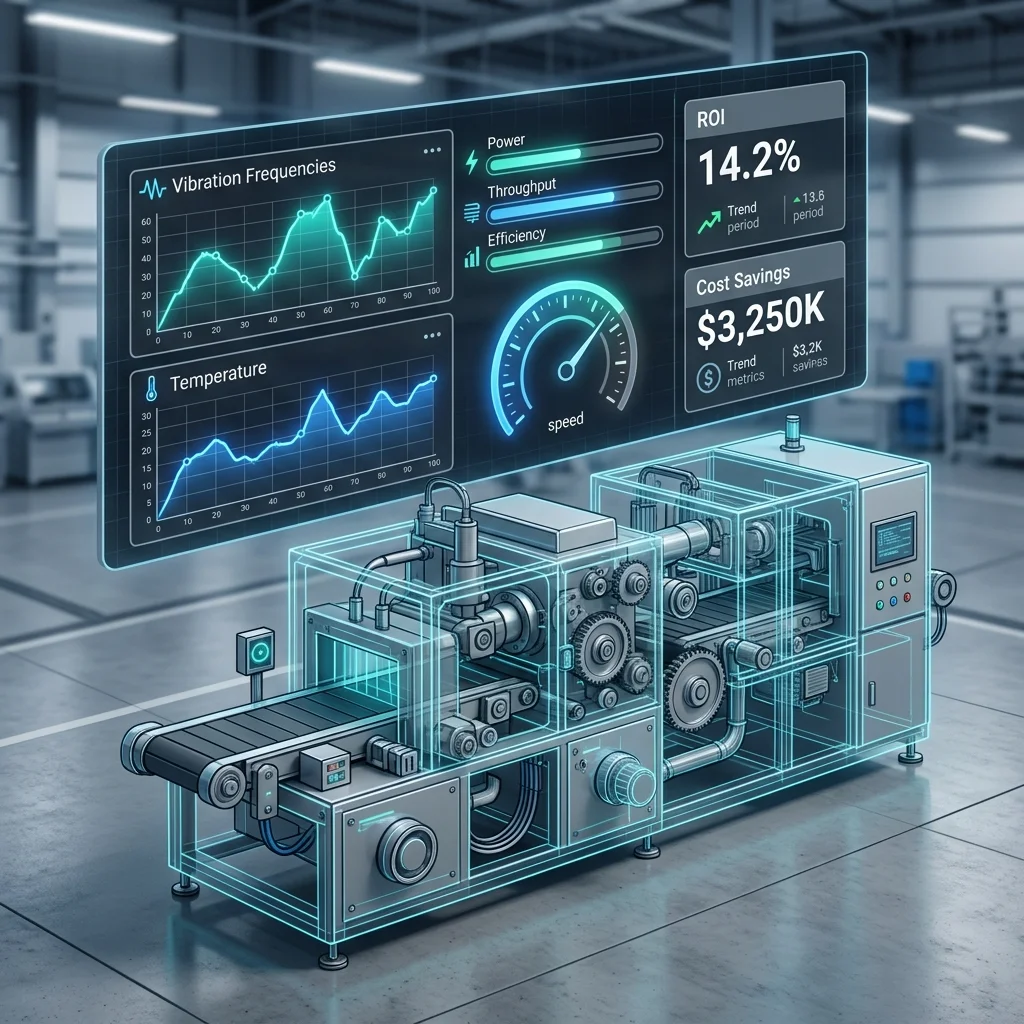
A digital twin powered by continuous IoT sensor monitoring establishes a baseline of normal operation. It uses machine learning algorithms to continuously compare live telemetry against this historical model. When the vibration frequency shifts by even a fraction of a hertz, or the motor temp rises by 2 degrees relative to the production load, the digital twin flags the anomaly.
Instead of a sudden, catastrophic failure on a Tuesday afternoon during peak production, you get a scheduled maintenance window on a Sunday morning. You replace a $500 bearing in 45 minutes, avoiding a $50,000 gearbox replacement and 8 hours of lost line capacity.
2. Diagnosis: Eliminating "Triage Time"
When a complex production line stops unexpectedly, the longest phase of the outage is rarely the physical repair. The bottleneck is the diagnosis. Technicians must trace wires, check PLC code, test components, and debate the root cause. Meanwhile, the clock is ticking at $4,000 a minute.
A digital twin acts as a flight data recorder for your industrial machinery. Because it has captured all sensor values leading up to the failure, maintenance teams can replay the event in the virtual model. The digital twin can isolate the exact sensor that faulted, show the pressure drop sequence, and pinpoint the root cause in minutes. It eliminates the guesswork and gets technicians straight to the repair phase.
3. Optimization: Preventing Future Faults via Simulation
Sometimes, machines break not because of wear, but because they are being run outside their designed parameters. A digital twin allows engineers to run "what-if" simulations. They can test a faster cycle speed in the digital environment, analyzing whether the increased mechanical stress will trigger a thermal spike or cause premature bearing wear. By optimizing the process digitally, they prevent the physical wear that leads to future downtime.
A Room-Ready ROI Calculation Framework
Let's walk through a realistic, mid-sized manufacturing scenario to see how the math works out. We will use standard industry benchmarks to keep the calculation grounded in reality.
The Scenario: Mid-Sized Discrete Manufacturer
- Number of Production Lines: 4
- Average Unplanned Downtime per Line: 80 hours per year (Total = 320 hours/year)
- Calculated Cost of Downtime (Direct + Indirect): $5,000 per hour
- Total Annual Downtime Cost: $1,600,000
The Projected Digital Twin Impact
Based on case studies from similar industrial deployments, a Level 3 Predictive Digital Twin typically reduces unplanned downtime by 35% to 50%. To be conservative for our financial business case, we will model a 30% reduction.
- Reduction in Downtime Hours: 320 hours × 30% = 96 hours saved annually
- Gross Annual Cost Savings: 96 hours × $5,000/hour = $480,000
The Implementation Investment Cost
To implement the digital twin, the manufacturer needs to invest in hardware, data integration, custom modeling, and software licensing. Let's break down the projected pilot cost with AdaptNXT:
| Expense Category | Description | Cost (One-Time) | Cost (Recurring / Year) |
|---|---|---|---|
| IoT Hardware & Sensors | Accelerometers, thermal sensors, and edge gateways to instrument legacy machines. | $25,000 | -- |
| System Integration | Connecting edge gateway data streams, translating Modbus to MQTT, and database setup. | $40,000 | -- |
| Model Development | Building the machine learning baseline, physics simulation, and virtual replica interface. | $75,000 | -- |
| Software & Cloud Licensing | Cloud telemetry ingestion, database storage, and alerting dashboard licenses. | -- | $15,000 |
| Support & Training | Training maintenance technicians and ongoing model monitoring updates. | $10,000 | $8,000 |
| TOTAL COSTS | -- | $150,000 | $23,000 |
The Return on Investment (ROI) Metrics
Using these numbers, we can calculate the core financial metrics for the project over a three-year horizon:
Year 1 Cash Flow:
Gross Savings ($480,000) − One-Time Costs ($150,000) − Recurring Costs ($23,000) = +$307,000
Year 2 & 3 Cash Flow (Per Year):
Gross Savings ($480,000) − Recurring Costs ($23,000) = +$457,000
Three-Year Net Cumulative Savings:
$307,000 + $457,000 + $457,000 = $1,221,000
Payback Period:
The payback period is the time required to recoup the initial investment. With monthly gross savings of $40,000 ($480,000 / 12 months) and a Year 1 cost footprint, the payback is reached in approximately 3.8 months.
This is the kind of math that gets approved. A technology project that pays for itself in less than 4 months and delivers over $1.2 million in bottom-line savings over three years is a strategic priority, not a nice-to-have experiment.
Making the Case to the Board: The 3 Key Pillars of the Pitch
When you present a digital twin proposal to your executive committee, do not lead with the data architecture or the neural network design. Instead, anchor your pitch on three business principles:
1. Risk Mitigation and Insurance
Frame the digital twin as an operational insurance policy. Explain that the project is designed to eliminate the single point of failure that could halt your main revenue-producing line. You are protecting the company's delivery commitments and protecting major customer relationships from the fallout of unplanned outages.
2. Data Capitalization
Remind the board that the company is already paying to generate data. Your PLCs, electricity meters, and QA cameras are throwing off gigabytes of data every day that is simply discarded. The digital twin project is about capitalizing on an asset you have already paid for, translating raw noise into operational savings. (To understand how to prepare your underlying data ecosystem for this, see our step-by-step guide on Preparing Your Factory Data for Digital Twins).
3. Controlled, Incremental Rollout
Lower the perceived risk of the project by presenting a staged implementation. Emphasize that you are not proposing to twin the entire factory on day one. You are proposing a focused, 8-week pilot on a single critical asset (like the primary extruder or assembly bottleneck) to validate the ROI math. The budget for the rest of the project will only be unlocked once the pilot proves the savings.
The Bottom Line
Downtime is a solvable engineering problem, and the digital twin is the most effective tool we have ever had to solve it. But to make it work, you need to bridge the gap between technology and the P&L. By focusing on the true cost of downtime, establishing real-time anomaly detection, and starting with a disciplined pilot, you can build a project that delivers undeniable financial return.
If you are ready to build a business case for a digital twin in your facility, the engineering team at AdaptNXT can help. We specialize in retrofitting legacy lines, building clean data pipelines, and developing predictive models that deliver bottom-line value. Connect with our industrial IoT experts to design your pilot →
Frequently Asked Questions
What is the primary benefit outlined here?
The main benefit is significant operational efficiency and cost reduction through structured implementations.
How long does implementation take?
Implementation timelines vary based on scope, but initial pilots can often show results within a few weeks.
Is this applicable to small businesses?
Yes, the principles and frameworks discussed scale from small businesses to large enterprises.