
By an industry veteran in industrial IoT systems design and enterprise data strategy.
Key Takeaways
- Strategic insights to accelerate enterprise workflows and scaling.
- Technical considerations for resilient architectural deployments.
- Cost-benefit analysis of modern technological frameworks.
When manufacturing leaders decide to invest in a digital twin, they usually start by looking at demo videos. They watch sleek 3D CAD models rotating on screens, glowing heatmaps showing simulated airflows, and predictive dashboards highlighting structural stresses in real-time. It looks elegant, clean, and immediate.
But when the project actually kicks off, many teams hit a wall. They realize their production data is trapped in isolated, legacy PLCs that communicate in obscure serial protocols. They discover their time-series databases are missing massive chunks of data, and their timestamps are misaligned across different production lines. The dream of the real-time digital replica gets bogged down in months of data cleaning and system integration.
Need an Architect's Assessment?
Speak directly with a senior AdaptNXT solutions architect about your system constraints, timeline, and production feasibility.
As a marketer and industrial systems designer who has spent decades helping companies navigate digital transformation, I will give you the single most important rule of industrial AI and IoT:
"Your digital twin is only as good as the data pipeline feeding it. If you feed a state-of-the-art virtual replica with delayed, noisy, or misaligned data, all you have built is an expensive way to make incorrect operational decisions."
If you want to achieve the 30% reduction in unplanned downtime and the process optimization benefits we discussed in our guide on the ROI of Digital Twins, you must start by preparing your industrial data ecosystem. This guide outlines the pragmatic, step-by-step framework to audit, clean, and structure your factory data for a successful digital twin implementation.
Step 1: The Industrial Data Audit — Cataloging What You Have
Before you buy a single new sensor or write a line of code, you must map your existing data landscape. You need to know what systems are already generating data, where that data is stored, and who owns it.
In a typical manufacturing environment, your data is distributed across three distinct layers:
1. The Control Layer (OT Hardware)
This includes Programmable Logic Controllers (PLCs), Human-Machine Interfaces (HMIs), and Distributed Control Systems (DCS). These units interact directly with the machinery. They hold the real-time values of motor speeds, valve states, temperature limits, and safety tripwires. The challenge here is that this data is designed for control, not analysis. It is volatile and usually gets overwritten rapidly.
2. The Supervisory Layer (SCADA & Historians)
Supervisory Control and Data Acquisition (SCADA) systems aggregate data from multiple PLCs to give operators a control room view. Process Historians (like OSIsoft PI or Rockwell FactoryTalk) are specialized databases that log this data over time, compressing it to store years of operational history. This is the goldmine for your digital twin, as it provides the historical baseline your machine learning models need to learn what "normal" looks like.
3. The Business Layer (IT Systems)
Enterprise Resource Planning (ERP) and Manufacturing Execution Systems (MES) hold business context. They know what SKU is being run, which operator is logged in, what batch of raw materials is in the hopper, and what the quality yield was for today's shift. Your digital twin must integrate this data to understand the operational context behind the physical telemetry.
The Audit Action Plan: Create a spreadsheet detailing every critical asset. For each machine, document: What controller manages it? Is it networked? What data is currently logged in the historian? What is the sample frequency (e.g., once per second, once per minute)?
Step 2: Addressing the Three V’s of Industrial Telemetry
Once you know where your data resides, you must evaluate its quality against three critical dimensions: Volume, Velocity, and Veracity.
1. Data Velocity: Finding the Right Sampling Rate
A common mistake is assuming you need to transmit every piece of data at millisecond speeds. Uploading vibration data at 20 kHz directly to the cloud will clog your network and result in astronomical storage bills. Conversely, logging furnace temperature only once an hour is useless for detecting process drift.
You must align telemetry frequency with physical cycle times. For motor vibration, you might run local high-speed edge analysis (e.g., using TinyML on Jetson Orin Nano) and only transmit the compressed frequency features once every 10 seconds. For thermal processes, a 1-second interval is usually more than sufficient. Establish a tiered sampling strategy based on the dynamics of the physical asset.
2. Data Volume: Establishing the Historical Baseline
To train predictive models, you need historical context. If you want to predict a machine failure, your model needs to have seen that failure occur in the historical data at least a few times. Ideally, you want at least 6 to 12 months of continuous historian records before launching predictive capabilities. If you don't have this, your first step isn't modeling — it's simply logging data to build that historical capital.
3. Data Veracity: The Timestamp Alignment Problem
This is the silent killer of digital twin projects. Imagine you are trying to diagnose why a product defect occurred on Line 3. Your PLC logs a pressure drop at 10:14:02. Your SCADA logs a motor temperature spike at 10:14:15. Your MES logs the defect reject at 10:15:00.
If these systems do not share a synchronized clock, it is impossible to establish cause-and-effect relationships. Before implementing your twin, configure all controllers, historians, and enterprise servers to sync to a single, local NTP (Network Time Protocol) server to guarantee timestamp integrity across the entire facility.
Step 3: Standardizing Communication Protocols — Translating the Babel
Factories are rarely built all at once. They are built incrementally over decades, resulting in a mix of machinery from different manufacturers, eras, and countries. Your Siemens PLC speaks Profinet. Your Allen-Bradley PLC speaks EtherNet/IP. Your legacy Modicon PLC speaks Modbus serial. Your CNC machine uses MTConnect.
To build a digital twin, you need a universal translator. You cannot build custom integrations for 50 different proprietary protocols.
| Protocol / Standard | Primary Use Case | Why It Matters for Digital Twins |
|---|---|---|
| OPC UA | Industrial interoperability standard. Platform-independent. | Acts as the secure, semantic data model on the factory floor, unifying various PLC brands. |
| MQTT / Sparkplug B | Lightweight, publish-subscribe IoT communication protocol. | Optimizes bandwidth by sending data only on change. Sparkplug B defines a structured payload for industrial assets. |
| Modbus | Legacy industrial protocol. Common in older sensors and energy meters. | Requires translation at the edge (Modbus RTU/TCP to MQTT) to join the modern cloud telemetry loop. |
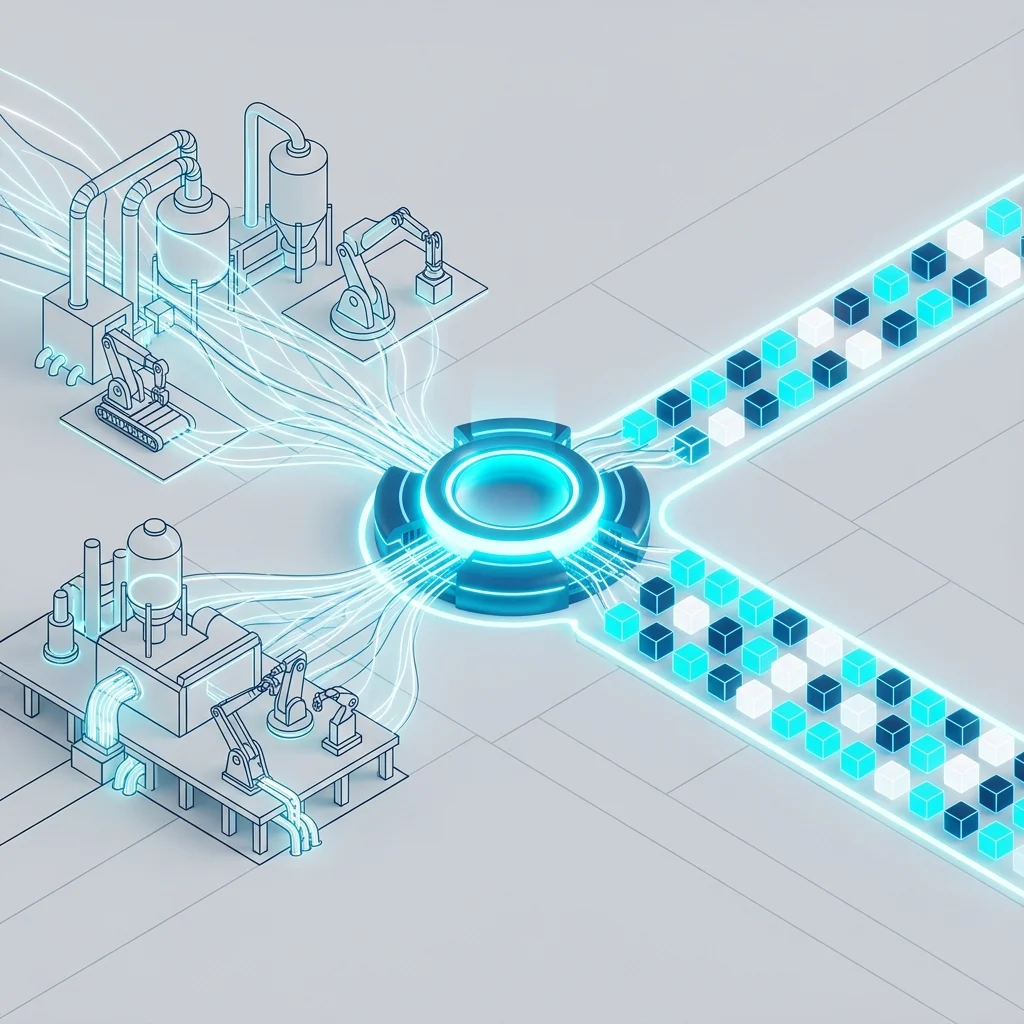
The modern consensus for industrial data architecture is the Unified Namespace (UNS). In this architecture, all data from the factory floor is translated into a standardized topic structure (e.g., `Site/Area/Line/Machine/Tag`) and published to a central MQTT broker. The digital twin simply subscribes to the UNS to get the real-time data it needs, decoupling the data producers from the data consumers. For a deeper look at translating legacy telemetry, read our guide on Modbus to MQTT retrofitting.
Step 4: Designing a Secure OT/IT Architecture
Connecting your factory floor controllers to a digital twin database introduces cybersecurity risks. A compromised PLC can lead to physical safety hazards or catastrophic production disruptions. You must design a secure architecture that protects your Operational Technology (OT) from the outside world.
Adhere to the standard Purdue Model for Industrial Control Systems:
- Air-Gapping the Control Loop: PLCs and safety systems (Levels 1 and 2) must reside on isolated local networks with no direct internet access.
- The Industrial DMZ (IDMZ): Place a secure Demilitarized Zone between your OT network and your IT enterprise network. No traffic should flow directly from the factory floor to the cloud.
- Edge Gateways as Gatekeepers: Deploy rugged edge gateways in the DMZ. These gateways pull data from local SCADA or historians via OPC UA, encrypt it, and push it out to the cloud MQTT broker via outbound-only HTTPS or MQTTS connections (Port 8883). This ensures the factory firewall blocks all incoming connections, eliminating external entry points for attackers. Check out our guide on designing resilient gateway buffering to ensure data security during network dropouts.
Your Pre-Implementation Checklist
Before you reach out to a digital twin implementation partner, ensure you can tick these boxes. This will compress your implementation timeline by months and save substantial integration costs:
- PLC Connectivity: Are your critical machines networked, or do they require hardware/sensor retrofitting?
- Data Historian: Do you have a centralized repository storing historical time-series data?
- Time Synchronization: Have all controllers and servers been synced to a central NTP server?
- Contextual Data: Can your MES or ERP associate telemetry data with specific SKUs, batches, and shifts?
- Security Alignment: Has your IT/OT security team approved outbound edge gateway connections to the cloud?
The Bottom Line
A digital twin is a powerful asset, but it is only the reflection of your physical reality. If your data foundation is fractured, your virtual replica will be distorted. By taking a structured approach to auditing your assets, standardizing communication protocols, ensuring timestamp alignment, and locking down security, you lay the groundwork for an implementation that delivers immediate, measurable value. (Once your data is prepared, see our deployment roadmap to learn How to Launch Your First Digital Twin with AdaptNXT).
At AdaptNXT, we help manufacturers bridge the gap between legacy shop floors and cloud analytics. We don't just build dashboards — we design the edge gateways, write the protocol translators, and build the secure data pipelines that make digital twins work in the real world. If you are ready to prepare your factory floor data for transformation, contact our team to start your audit.
Frequently Asked Questions (FAQ)
How does this technology improve ROI?
By automating repetitive tasks and ensuring high availability, operational costs are minimized while output increases.
Is it suitable for legacy systems?
Yes, modular architectures allow incremental upgrades without replacing the entire legacy infrastructure.
What are the main security considerations?
End-to-end encryption, strict access controls, and regular compliance audits are essential to mitigate risks.