
By an industry veteran in technology delivery, industrial systems integration, and partner strategies.
You have done the preliminary research. You understand the core concept of the virtual replica from our Beginner's Guide to Digital Twins. You have run the financial models and realized that reducing unplanned downtime by even 30% yields a massive return, as detailed in our guide on Digital Twin ROI. And you have begun auditing your factory controllers using our framework on Preparing Your Factory Data.
Now, you face the most critical phase of the journey: Execution.
Need an Architect's Assessment?
Speak directly with a senior AdaptNXT solutions architect about your system constraints, timeline, and production feasibility.
This is where the rubber meets the road. In industrial technology, execution is notoriously challenging. Many digital twin initiatives stall because they are treated either as pure IT software projects that ignore the messy realities of factory floor hardware, or as isolated OT (Operational Technology) projects that fail to scale beyond a single PLC.
To successfully deploy a digital twin, you need a partner who speaks both languages fluently — who can wire a vibration sensor to a legacy lathe in the morning, and write a serverless cloud ingestion function in the afternoon. That is the exact space AdaptNXT occupies.
This guide outlines our proven, four-phase deployment roadmap. It is designed to mitigate operational risk, secure quick wins to prove value to your board, and establish a scalable, secure architecture that grows with your business.
The AdaptNXT Philosophy: Bridging the IT/OT Divide
Before looking at the timeline, it is important to understand how we approach these deployments. The industrial world is divided into two distinct domains:
- Operational Technology (OT): The world of physical assets, PLCs, safety-critical loops, and milli-second controls where reliability and safety are paramount.
- Information Technology (IT): The world of cloud databases, API integrations, machine learning models, and security protocols where scalability and data flow are key.
Most system integrators only understand one side. They are either automation houses that struggle with cloud scale, or software agencies that don't know how to interface with a Modbus register without breaking the control loop. At AdaptNXT, we bring cross-functional teams that combine hardware architects, embedded firmware developers, data engineers, and ML specialists to bridge this divide seamlessly.
"A digital twin is not a software package you buy off the shelf. It is a bridge between the physical and digital worlds. To build a strong bridge, you must anchor it firmly on both sides — the shop floor and the cloud."
Phase 1: Discovery, Scoping, & Feasibility (Weeks 1–2)
We do not start by purchasing hardware or writing code. We start with a highly structured, collaborative discovery phase to align the project with your business goals.
1. Identifying the "Bottleneck Asset"
We work with your operations and maintenance teams to identify the single asset or production line where unplanned downtime hurts the most. This could be the main extruder in a plastics plant, the primary compressor in a chemical facility, or the bottleneck packaging line in a food plant. By focusing on a high-value, high-pain asset, we ensure the pilot project delivers undeniable business value.
2. The IT/OT Data & Security Audit
Our engineers perform a hands-on audit of the selected asset's data infrastructure. We determine:
- What PLCs or controllers are currently managing the asset?
- Is there an existing process historian, or are we extracting data directly from controllers?
- What are the network limitations and security protocols (firewalls, DMZs) in place?
By the end of Week 2, we deliver a comprehensive Feasibility Report and Integration Map detailing exactly how data will flow from the machine to the digital model without compromising your network security.
Phase 2: Data Engineering & Pipeline Design (Weeks 3–5)
With the integration map approved, we begin building the nervous system of the digital twin: the data pipeline.
1. Retrofitting & Edge Gateway Deployment
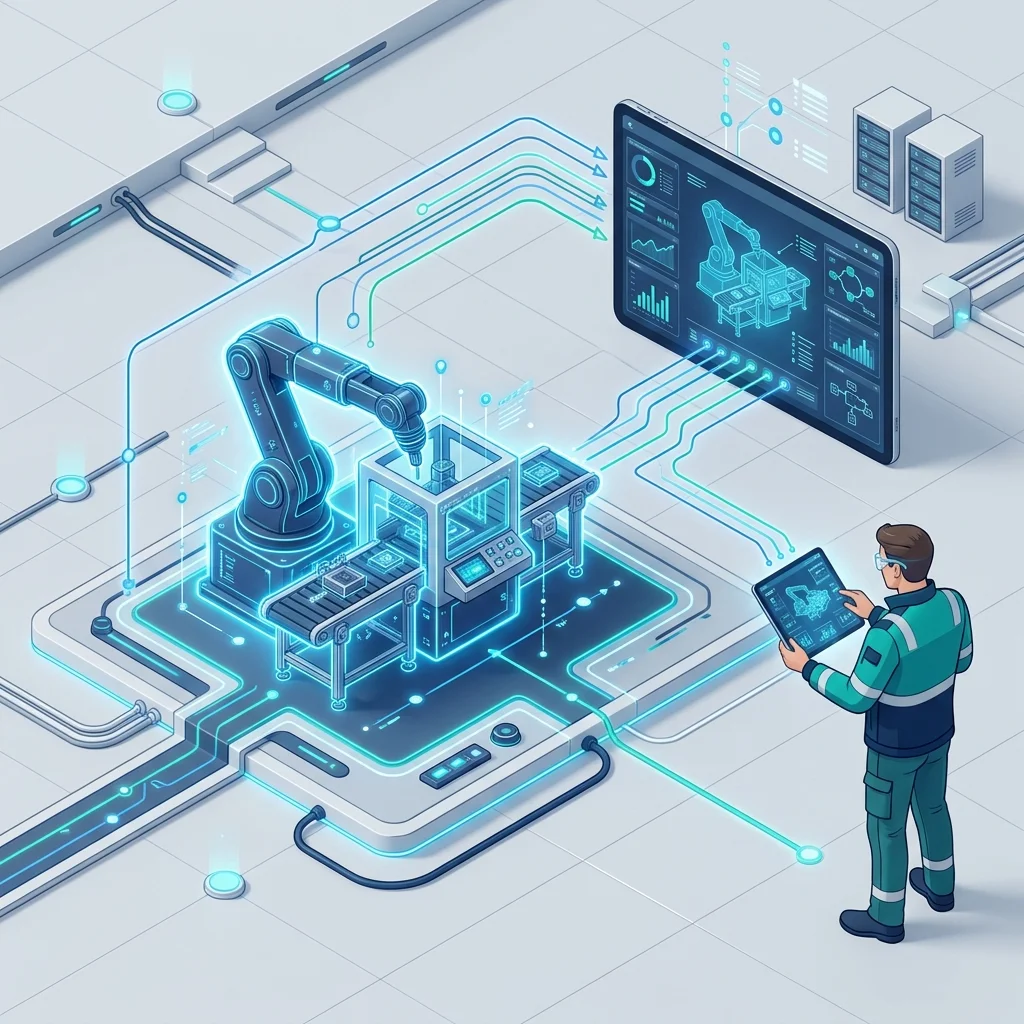
If the asset lacks native connectivity, we deploy non-invasive sensors (such as accelerometers for vibration or clip-on current transducers) and wire them to a ruggedized edge gateway installed locally on the shop floor. We configure the gateway to poll data from local PLCs using industrial protocols like Modbus or OPC UA, translate that data into lightweight JSON streams, and push it out securely via MQTT.
2. Designing the Unified Namespace (UNS)
We structure your data using the Unified Namespace framework. Instead of creating messy, point-to-point connections between machines and databases, we organize all telemetry into a logical, hierarchical topic structure (e.g., `Factory/Line1/Extruder3/MotorTemp`). This makes the data instantly discoverable and usable by the digital twin model and any future enterprise applications.
3. Implementing Resilient Buffering
Industrial networks are notoriously unstable. A forklift hitting a wireless access point can temporarily disrupt connectivity. To prevent data loss, we implement our Store-and-Forward edge buffering database on the gateway. If the connection drops, data is safely cached locally and automatically backfilled once connectivity is restored, ensuring zero data gaps for your analytical models.
Phase 3: Model Development & The 8-Week Pilot (Weeks 6–10)
This is where we build the virtual replica itself. To minimize risk, we execute this as a focused, 8-week pilot, creating a functional prototype of the twin for the selected asset.
1. Building the Analytical Twin
We ingest the historical and real-time data streams into our cloud database. Our machine learning engineers train anomaly detection models based on the asset's normal operating parameters. For example, if we are twinning a pump, we build a multi-variable model that analyzes the relationship between motor current, flow rate, and housing vibration to predict efficiency degradation.
2. Creating the Operator Dashboard
A digital twin is useless if your operators cannot understand it. We design a clean, intuitive, mobile-responsive dashboard tailored for your maintenance and operations teams. The dashboard displays:
- Real-time asset health scores (0–100%)
- Predictive maintenance alerts with estimated failure windows
- Vibration frequency spectrums and thermal trend lines
- Anomalous event logs with automated diagnostic recommendations
3. Validation and Handover
During the final weeks of the pilot, we run the digital twin parallel to your manual operations. We validate that the anomaly detection models are firing correctly without generating false positives. We then train your maintenance team on how to interpret dashboard metrics and respond to alerts.
Phase 4: Scaling & Continuous Optimization (Week 11 & Beyond)
Once the pilot has proved its value (typically by catching its first unplanned anomaly and preventing downtime), we begin scaling the solution across your facility.
1. Horizontal Rollout
We replicate the data pipeline and model templates across identical assets or other production lines. Because we build using modular, template-based architectures, scaling the digital twin to additional lines is significantly faster and more cost-effective than the initial pilot.
2. Model Drift Monitoring & Retraining
Industrial assets change over time. A machine that has undergone a major rebuild will behave differently than it did when it was brand new. This behavior change can lead to "model drift," causing the AI to flag normal operations as anomalies.
AdaptNXT implements automated model drift monitoring. Our pipelines continuously track model performance and flag when accuracy begins to degrade. The system then automatically triggers a retraining run using the latest historical dataset, ensuring the digital twin remains accurate over the entire lifecycle of the physical asset.
How AdaptNXT Minimizes Implementation Risk
We understand that investing in emerging technology can feel risky. To protect your investment and guarantee project success, we adhere to three strict principles:
| Risk Factor | Typical Vendor Approach | The AdaptNXT Approach |
|---|---|---|
| Scope Creep & Cost Overruns | Open-ended T&M contracts with undefined deliverables. | Fixed-scope, fixed-budget 8-week pilot with concrete OEE success metrics. |
| Operational Disruption | Modifying legacy PLC code, risking safety loops. | Non-invasive sensor retrofitting and read-only edge gateway configurations. Zero risk to existing control loops. |
| Vendor Lock-In | Proprietary platforms that trap your data in their cloud. | Built using open-standard industrial protocols (OPC UA, MQTT) and standard cloud databases (AWS/Azure). You own the data and code. |
The Next Step: Let's Map Your Pilot
The transition from a reactive, fire-fighting maintenance culture to a proactive, data-driven operation does not happen overnight. But it does start with a single, structured step.
At AdaptNXT, we don't expect you to sign a multi-million-dollar contract on day one. We believe in earning your trust on the shop floor. We start with a focused Digital Twin Feasibility Workshop to audit your selected asset, outline the integration path, and present a fixed-budget pilot proposal.
If you are ready to stop reacting to breakdowns and start optimizing your production lines in the digital world, let's have a conversation. Our engineering team will help you cut through the marketing noise and build a system that delivers measurable bottom-line value.
Book a Digital Twin Feasibility Call with Our Team → For more details, contact our team.