
By an industry veteran in inbound marketing and industrial technology.
Let me ask you a question that every plant manager, operations director, and CTO I have ever met would answer the same way.
When was the last time you made a significant change on the factory floor — a new machine layout, a production line reconfiguration, a new shift schedule — and it worked exactly as planned, on the very first attempt, with zero disruption?
Need an Architect's Assessment?
Speak directly with a senior AdaptNXT solutions architect about your system constraints, timeline, and production feasibility.
If you are being honest, the answer is almost never.
The reality of manufacturing is that the physical world is expensive to experiment with. Every test costs materials. Every change risks downtime. Every unplanned failure is a fire drill that pulls your best engineers away from their actual jobs. For decades, manufacturers have had to make high-stakes decisions based on incomplete information, gut instinct, and hard-earned experience.
The Digital Twin is the technology that is, quietly and definitively, changing that reality. It is the single most important concept in modern industrial operations that many manufacturing leaders have heard of but very few truly understand.
This guide is your definitive, no-jargon introduction to what a digital twin is, how it works, why it is different from anything you have used before, and what it can realistically do for your operation. Let's get into it.
Key Takeaways
- Understand the core principles and semantic structure for better SEO.
- Implement real-time monitoring and scalable frameworks to drive ROI.
- Adopt a robust governance and compliance strategy.
Summary Overview
| Concept | Impact |
|---|---|
| Efficiency | Reduces manual effort and accelerates processing times. |
| Quality | Minimizes errors and ensures consistent output. |
| Scalability | Enables seamless growth without proportional cost increases. |
What is a Digital Twin? A Simple, Precise Definition
A digital twin is a living, dynamic virtual replica of a physical object, process, or system — one that is continuously updated with real-world data from sensors and operational sources so that it mirrors the actual state of its physical counterpart at every moment in time.
The key word in that definition is living. This is the crucial distinction.
Your engineering team almost certainly has 3D CAD models of your machines. You probably have schematics, P&ID diagrams, and detailed technical drawings. But those are static documents. They describe how the machine was designed. They tell you nothing about how it is performing right now, at this specific moment, under today's operating conditions, having run for 14,000 hours since its last major service.
A digital twin is not a static model. It is a dynamic system that receives a continuous, real-time feed of data — temperature readings, vibration signatures, pressure values, energy consumption, production throughput — and uses that data to model the current physical and operational state of the asset. The physical and the digital exist in a continuous feedback loop, each reflecting the other.
"The value of a digital twin is not that it can show you what a machine looks like. Any 3D renderer can do that. The value is that it can tell you what a machine is thinking — and more importantly, what it is about to do."
A Short History: Where Did Digital Twins Come From?
The concept is older than the name. In the early days of NASA's Apollo program, engineers built physical replicas of spacecraft systems in Houston — called "simulators" — that they used to train astronauts and troubleshoot problems in real-time. When the Apollo 13 oxygen tank ruptured in 1970, NASA engineers ran emergency simulations on the Earth-based replicas to figure out how to bring the crew home safely. They were, in essence, using an analogue twin.
The formal concept of the "Digital Twin" was first articulated by Dr. Michael Grieves at the University of Michigan in 2002, initially applied to Product Lifecycle Management (PLM). The idea was simple and powerful: pair every physical product with a digital information counterpart.
For two decades, the concept remained largely academic. The technology required to make it practical — cheap, reliable IoT sensors; high-bandwidth wireless networks; affordable cloud computing; and powerful machine learning — simply did not exist at scale.
Today, it does. And that is why Digital Twins are no longer a research paper. They are a production-floor reality for manufacturers from automobile makers in Stuttgart to pharmaceutical plants in Pune.
The Three Non-Negotiable Components of a Digital Twin
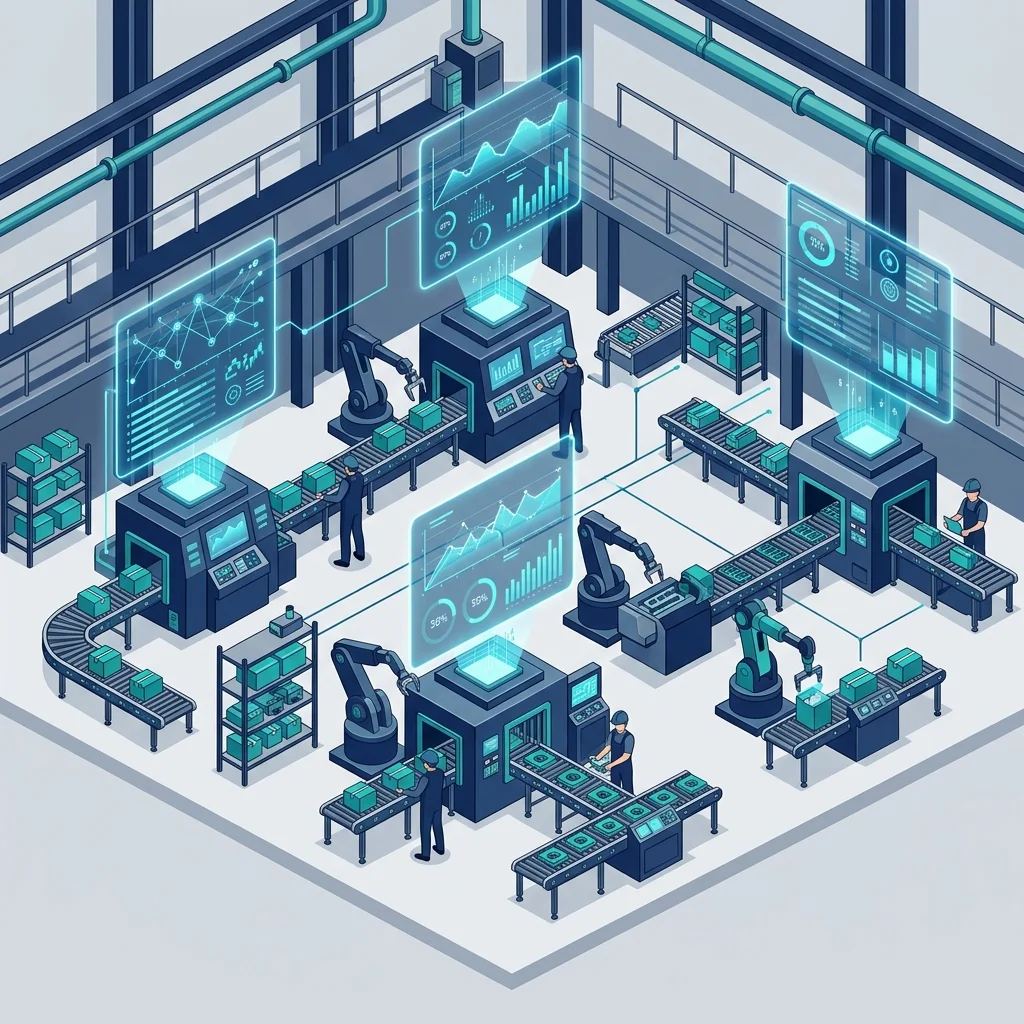
A true, functional digital twin is not a single piece of software. It is an ecosystem built from three core components that work in concert. Remove any one of them and what you have is merely an impressive dashboard — not a twin.
1. The Physical Asset and Its Sensor Layer
The foundation is the real-world object being twinned — a CNC machining center, an entire assembly line, a compressed air system, or even a full facility. Attached to this physical asset is a network of IoT sensors that continuously monitor its operational parameters.
Depending on the asset and the use case, these sensors may measure:
- Vibration & Acoustic Signatures — Detected by accelerometers to identify bearing wear, imbalance, or structural fatigue long before they cause a failure.
- Thermal Data — Infrared sensors and thermocouples tracking temperature across motors, gearboxes, and electrical panels to identify dangerous hot spots.
- Pressure & Flow Rates — Critical for hydraulic systems, pneumatics, and chemical processing to ensure safe and optimal operation.
- Energy Consumption — Smart meters measuring the power draw of individual machines, which often changes as a leading indicator of mechanical degradation.
- Process Quality Data — Camera systems performing automated visual inspection of output to close the quality loop in real-time.
The sensor layer is the nervous system of the digital twin. Without it, the digital replica is deaf and blind to reality.
2. The Data Pipeline and Connectivity Layer
Raw sensor data is meaningless unless it can be reliably transported, processed, and ingested into the digital model. This is the job of the connectivity and data pipeline layer.
In a modern IIoT architecture, sensor data flows from the factory floor through an edge gateway, which performs initial filtering and compression. Protocols like MQTT are used to transmit this data efficiently over the network to a cloud or on-premise data platform. The key engineering challenges at this layer are ensuring low latency, high reliability (including handling network interruptions via store-and-forward buffering), and the security of data in transit.
For legacy factories with older equipment that predate IIoT, retrofitting this layer is often the first major project — translating older industrial protocols like Modbus into modern MQTT streams that cloud platforms can consume.
3. The Digital Model and Analytics Layer
This is what most people picture when they imagine a digital twin: the software model itself. This can range from a physics-based simulation engine that models the mechanical behaviour of an asset, to a sophisticated machine learning model trained on historical operational data, to a 3D visual representation overlaid with live data. In mature implementations, it is all three.
This layer is where the real value is created. The model doesn't just display data — it processes it, contextualises it against historical baselines, runs what-if simulations, and surfaces actionable insights to the engineers and operators who need them.
Digital Twin vs. Other Technologies: Clearing Up the Confusion
One of the most common sources of confusion I encounter when speaking with manufacturing leaders is the conflation of digital twins with other technology concepts. Let's put this to rest.
| Technology | What It Is | Key Limitation vs. Digital Twin |
|---|---|---|
| 3D CAD Model | A static geometric representation of an asset as designed. | No live data. Cannot reflect the current operating state or predict future behaviour. |
| SCADA / HMI Dashboard | A real-time monitoring dashboard for operational data. | Shows current state only. Cannot simulate outcomes of potential changes or predict failures. |
| Process Simulation Software | A modelling tool for simulating manufacturing processes using theoretical inputs. | Runs on assumed parameters, not real-world data. Simulations drift from reality quickly. |
| Predictive Maintenance System | An AI tool that analyses sensor data to predict equipment failures. | A component of a digital twin, but not the full picture. Typically limited to single asset health, not system-wide simulation. |
| Digital Twin | A living, real-time virtual replica synchronized with the physical asset via IoT sensor data. | Integrates all of the above. Provides current state, historical context, and future simulation capability in one connected model. |
The Four Core Use Cases That Deliver Real ROI in Manufacturing
Theory is cheap. Let us talk about the specific, measurable business outcomes that digital twins are delivering on production floors today.
1. Predictive Maintenance: From Reactive Chaos to Controlled Precision
This is the most mature and widely deployed use case, and for good reason — the ROI is often immediate and dramatic.
The traditional approach to maintenance is binary: either you replace parts on a calendar schedule whether they need it or not (costly and wasteful), or you wait for a machine to fail (catastrophically expensive and disruptive). Both approaches are fundamentally inefficient because they ignore the actual condition of the asset.
A digital twin changes the entire model. By continuously monitoring the vibration signature of a gearbox, for example, the system's machine learning algorithms can detect the microscopic frequency shifts that indicate a bearing is beginning to wear — weeks or even months before a human inspector would notice any problem, and long before the bearing actually fails. The system generates a maintenance alert with a predicted failure window, giving your team time to schedule the repair during a planned downtime slot.
The typical industry outcomes are compelling:
- Unplanned downtime reduced by 30-50%
- Maintenance labour costs reduced by 10-25%
- Machine lifespan extended by 20-40% due to optimised intervention timing
- Spare parts inventory reduced significantly by moving from "just in case" to "just in time" stocking
2. Process Optimisation: Finding the Bottlenecks You Cannot See
Every manufacturing process has a theoretical throughput and an actual throughput. The gap between those two numbers represents waste — lost capacity that shows up on the P&L as unsatisfied demand, higher unit costs, or missed delivery commitments.
A digital twin of an entire production line allows engineers to identify where that gap is hiding. By visualising material flow, machine cycle times, operator movement, and queue lengths in the digital model, they can run simulated experiments. "What happens to overall equipment effectiveness (OEE) if we adjust the buffer between station 3 and station 4?" "If we add a second quality inspection camera here, does the downstream bottleneck move or resolve?" These are questions that previously required expensive, disruptive physical trials. A digital twin answers them virtually, in hours rather than weeks.
3. New Product and Process Introduction: De-risking the Launch
Introducing a new product variant, or significantly changing a production process, is one of the highest-risk activities in manufacturing. Retooling a line for a new SKU, for example, often involves weeks of validation runs, scrap materials, and engineering time — all before the first saleable unit rolls off the line.
With a digital twin of the production system, manufacturers can simulate the new product introduction entirely in the virtual environment. They can model how the existing machines will interact with the new materials or tolerances, identify potential failure points in the new workflow, and validate the process parameters before a single physical changeover is made. This can compress product launch timelines by weeks and dramatically reduce validation scrap costs.
4. Energy and Sustainability Management: The Increasingly Urgent Business Case
With energy costs at historically high levels and increasing pressure from regulators, investors, and customers around ESG performance, the energy use of a factory floor is no longer simply an operational cost — it is a strategic and reputational concern.
A digital twin that models the full energy consumption profile of a facility — mapping the relationship between production output, machine states, ambient temperature, and kilowatt-hour consumption — becomes a powerful tool for energy optimisation. The system can identify machines that are consuming disproportionate amounts of power relative to their output (often a sign of mechanical inefficiency), recommend optimal production scheduling to reduce peak demand charges, and validate the projected energy savings of capital investments in more efficient equipment before those investments are approved.
What Level of Digital Twin Do You Actually Need?
Not all digital twins are created equal, and the right level of sophistication depends entirely on the maturity of your data infrastructure and the specific problem you are trying to solve. It is a spectrum:
Level 1 — The Descriptive Twin (Monitor)
The digital model reflects the current real-time state of the asset using live sensor data. This is the foundation — a sophisticated monitoring layer that tells you exactly what is happening, right now. Think of it as a highly contextualised, data-rich operations dashboard. This is where most manufacturers begin their journey, and it delivers immediate value on its own.
Level 2 — The Diagnostic Twin (Understand)
Building on the descriptive layer, the diagnostic twin integrates historical data and analytical models to explain why things are happening. When a metric moves outside its normal range, the system can surface the likely root cause, correlating the anomaly with other operational variables to provide context that helps engineers act quickly and correctly.
Level 3 — The Predictive Twin (Anticipate)
This level uses machine learning models trained on historical operational data to forecast future states. This is the home of predictive maintenance — the ability to anticipate failures before they occur and give operations teams a window to act. It is also where energy consumption forecasting, quality yield prediction, and production scheduling optimisation live.
Level 4 — The Prescriptive Twin (Optimise)
The most advanced level. The prescriptive twin not only tells you what will happen — it tells you what to do about it, and in some cases, takes action autonomously. Prescriptive twins integrate with OT control systems to automatically adjust machine parameters in response to changing conditions, closing the loop between digital insight and physical action without human intervention.
The Most Common Objections — And the Honest Answers
I have heard every objection to digital twin adoption, and I respect every single one of them. Here are the three I encounter most often, with the frank, experience-informed answers they deserve.
"Our machines are too old. We can't instrument legacy equipment."
This is the most common concern, and it is largely a myth. The modern IIoT ecosystem has been specifically designed to solve this exact problem. Non-invasive sensors can be clamped onto a piece of equipment built in 1987 without any modification to the machine itself. Edge gateways can translate the proprietary Modbus or OPC-DA protocols that legacy PLCs speak into the modern cloud-compatible data streams that twin platforms consume. The path from legacy to connected is well-trodden and considerably less expensive than most manufacturers expect.
"We don't have the data or the data science expertise."
You almost certainly have more relevant data than you think. Maintenance logs, downtime records, quality inspection reports, and energy bills are all data sources that can inform initial twin models. The right implementation partner — one with industrial domain expertise — can help you identify which data assets you already have, which gaps need to be filled, and how to build a pragmatic roadmap. You do not need a team of PhD data scientists. You need a structured implementation approach and the right technology partner. If you are unsure whether your data is sufficient, our guide on AI and data readiness is a good starting point for self-assessment.
"What is the actual ROI? We've been burned by technology promises before."
The honest answer is: it depends on the use case, the quality of implementation, and how committed your organisation is to acting on the insights the twin surfaces. However, the business case for predictive maintenance alone — the most straightforward and well-validated use case — typically delivers a 3x to 5x return on implementation cost within the first 18 to 24 months for mid-sized manufacturers. (For a complete breakdown of the financial math and formulas, see our guide on The ROI of Digital Twins). The key is to start with a well-defined, measurable pilot project rather than attempting a full-facility transformation from day one.
How to Get Started: A Pragmatic 4-Step Approach
If you are convinced that a digital twin programme is the right next step for your organisation, here is the approach I recommend to every manufacturer I work with. It is deliberately incremental, designed to deliver measurable value at each stage rather than betting the entire investment on a single big-bang project.
Step 1: Identify Your Most Painful Problem
Do not start with technology. Start with your highest-cost operational problem. Is it a specific critical machine that fails unexpectedly and brings a production line to a halt? Is it a persistent quality yield issue on a particular product? Is it an energy bill that has spiralled out of control? The most successful digital twin programmes start with a specific, measurable problem that everyone in the organisation is already motivated to solve. This creates the internal alignment and sense of urgency that any transformational project requires.
Step 2: Audit Your Existing Data and Sensor Infrastructure
Before deploying anything new, inventory what you already have. What data is your existing SCADA or PLC system collecting? What maintenance records exist? Where are the sensor gaps? A detailed audit prevents duplication of effort, surfaces unexpected data assets, and creates the basis for an accurate and realistic implementation cost estimate. This is where many manufacturers are pleasantly surprised — they often have far more usable data than they assumed.
Step 3: Run a Focused Pilot on a Single Asset or Line
Choose a contained, representative asset or production cell for your first digital twin deployment. This limits the initial investment and complexity, allows your team to build capability and confidence, and creates a working proof of concept with measurable outcomes that can be used to justify broader rollout. A well-executed pilot on a single critical asset can deliver value within weeks, not months or years.
Step 4: Measure, Learn, and Scale
Define your success metrics before the pilot begins — OEE improvement, mean time between failures (MTBF) increase, maintenance cost reduction, energy consumption reduction. Measure them rigorously. Use the results to build a quantified business case, refine your implementation approach, and plan the rollout to additional assets or facilities. Every factory is different, and the lessons learned in a disciplined pilot are worth more than any vendor's benchmark.
The Bottom Line
The Digital Twin is not a futuristic concept reserved for the R&D labs of automotive giants. It is a practical, proven technology that is delivering measurable operational improvements for manufacturers of every size and sector, right now.
At its core, it is a profoundly simple idea: stop making expensive decisions in the dark. Give yourself a perfect, real-time mirror of your physical operation in the digital world, and use that mirror to test, simulate, predict, and optimise before you touch a single piece of physical equipment.
After decades of watching technology promises come and go, I can tell you with conviction that the digital twin is not hype. The underlying technologies — cheap sensors, reliable edge networks, scalable cloud compute, and powerful machine learning — have finally matured to the point where the value proposition is not theoretical. It is measurable. And for the manufacturers who act on it first, the competitive advantage will compound, year after year, in ways that those who wait will find very difficult to close.
If you are ready to explore what a digital twin programme would look like for your specific operation, the team at AdaptNXT specialises in designing and deploying Industrial IoT solutions that are grounded in operational reality, not technology theatre. A practical starting point for most manufacturers is establishing real-time machine telemetry and OEE tracking first — our OEE & Machine Monitoring System provides the live data layer that every digital twin depends on. Start with a conversation →
Looking to accelerate your digital transformation? Try our ROI calculator to estimate the impact, or contact our team to discuss your specific needs.
Frequently Asked Questions
What is the primary benefit outlined here?
The main benefit is significant operational efficiency and cost reduction through structured implementations.
How long does implementation take?
Implementation timelines vary based on scope, but initial pilots can often show results within a few weeks.
Is this applicable to small businesses?
Yes, the principles and frameworks discussed scale from small businesses to large enterprises.