
The Challenge
Modern retail floor management often relies on intuition or outdated manual metrics, leaving significant "blind spots" in understanding customer behavior. Floor managers struggle to answer critical questions: Which aisles see high footfall but low engagement? Where do customers lose interest? Are high-margin end-cap displays actually catching the eye?
The client, a leading multi-format retailer, faced a common challenge: their massive investments in store layouts and product placements were not yielding data-driven insights. Traditional methods like manual traffic counts or exit surveys were inaccurate, expensive to scale, and failed to capture the nuances of the "shopper journey."
The lack of real-time visibility into customer paths meant that shelf space was often sub-optimally allocated, leading to "dead zones" in prime locations and missed cross-selling opportunities across their 50+ hypermarket locations.
Our Solution
AdaptNXT developed a non-intrusive Computer Vision in Retail ecosystem that turns existing security infrastructure into a sophisticated behavioral analytics engine:
- Leveraging Existing Infrastructure: Designed the system to integrate directly with existing RTSP/ONVIF security camera feeds, eliminating the need for expensive new hardware deployments across 500+ store cameras.
- Edge-Based AI Processing: Implemented a high-performance edge processing layer using NVIDIA Jetson modules. This allows for real-time person detection and tracking locally at each store, significantly reducing cloud bandwidth costs and latency.
- Multi-Camera Journey Handover: Engineered a custom re-identification (Re-ID) algorithm that tracks unique customer paths across multiple overlapping camera views without the need for facial recognition, ensuring a complete aisle-to-aisle journey map.
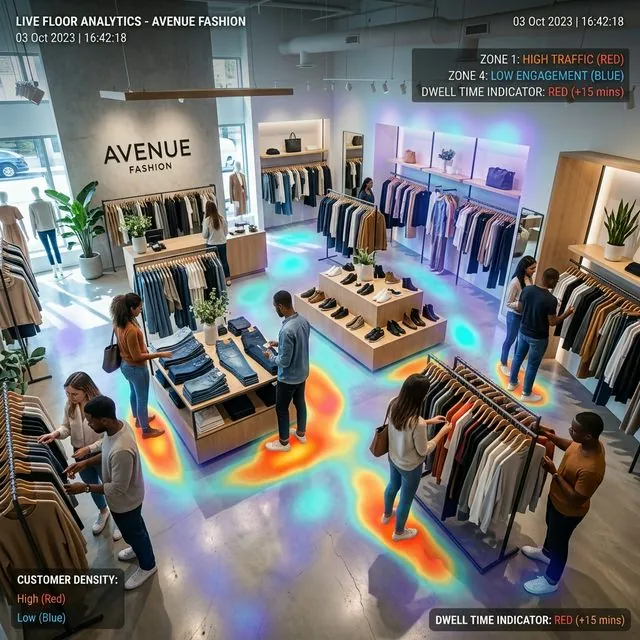
- Automated Heatmap Generation: Developed a visualization engine that overlays movement density and dwell-time data onto a 2D digital twin of the store floor plan. This provides an immediate visual representation of high-traffic vs. low-engagement areas.
- Privacy-First Architecture: Built a system that processes all video at the edge and only transmits anonymized coordinate data to the central dashboard. No person-identifiable information (PII) is ever stored or transmitted, ensuring 100% compliance with privacy regulations.
- Business Intelligence Integration: Correlated heatmaps with POS (Point of Sale) data to calculate the "Conversion Velocity" of different store sections, helping category managers understand the relationship between footfall and actual purchases.
Technical Architecture
| Component | Technology / Role |
|---|---|
| Input Data | Existing RTSP/ONVIF Security Camera Feeds |
| Edge Processing | NVIDIA Jetson Modules for Real-Time Person Detection |
| AI Algorithms | Custom Re-Identification (Re-ID) tracking, Privacy-Preserving analytics |
| Visualization & Integration | Automated 2D Digital Twin Heatmaps, POS Data Correlation Engine |
The Impact
The implementation of the AI movement analytics platform has transformed store operations into a data-driven laboratory for retail optimization:
- 15% Increase in Sales Conversion in previously underperforming "dead zones" by reconfiguring shelf heights and product adjacencies based on tracked customer flow.
- 25% Reduction in Checkout Wait Times through real-time density alerts that notify store managers to open additional billing counters when footfall in the checkout zones exceeds pre-defined thresholds.
- Saved 40+ Hours/Month of manual auditing per store manager by replacing physical floor inspections with automated weekly dwell-time and traffic reports.
- Optimized Product Placement: Identified that 60% of customers were bypassing a high-margin seasonal display, leading to a successful rebranding of the section that boosted category sales by 9% within 30 days.