
Welcome to this comprehensive and highly detailed guide on WhatsApp Ecommerce. In today's rapidly evolving technological landscape, understanding the nuances of this subject is more critical than ever. This guide will provide deep dives, frameworks, best practices, and actionable examples to help you navigate the complexities of implementation.
| Dimension | Traditional Ecommerce Checkout | WhatsApp Commerce + Payment Gateway |
|---|---|---|
| Channel Friction | Customer redirected to website, cart, checkout pages | Complete purchase within the chat — zero redirect |
| Cart Abandonment Rate | ~70% industry average on mobile web | Significantly lower due to conversational flow & trust |
| Payment Methods | Card, net banking, UPI (on website) | WhatsApp Pay, Razorpay link, PayU link, UPI deeplink |
| Order Confirmation | Email (avg. 20% open rate) | WhatsApp message (avg. 98% open rate) |
| Customer Support | Separate support ticket / call center | Inline — same conversation thread, bot + human handoff |
| Re-engagement | Email retargeting, push notifications | WhatsApp broadcast templates (opt-in audience) |
The Strategic Imperative of WhatsApp Ecommerce
When considering WhatsApp Ecommerce, organizations must recognize the foundational shift it represents. It is not merely a technological upgrade but a complete reimagining of operational capabilities. Enterprises that successfully integrate these systems often see exponential returns on investment. This requires a cultural shift, extensive training, and a willingness to embrace iterative development. The strategic imperative cannot be overstated; lagging behind means losing competitive advantage in an increasingly saturated market. As leaders evaluate their roadmaps, WhatsApp Ecommerce consistently emerges as a top priority. The integration of advanced methodologies ensures that processes are not only efficient but also resilient against unforeseen disruptions. This resilience is the bedrock of modern enterprise success, allowing companies to pivot swiftly in response to market demands. The initial investment, while sometimes substantial, is dwarfed by the long-term efficiencies and revenue generation capabilities unlocked by these initiatives.
Implementation Phases: A Step-by-Step Framework
To effectively implement WhatsApp Ecommerce with payment gateway integration, follow these four structured phases:
Need an Expert Opinion?
Stop guessing. Speak directly with a senior AdaptNXT engineer about your architecture, timeline, and feasibility.
-
Infrastructure Readiness
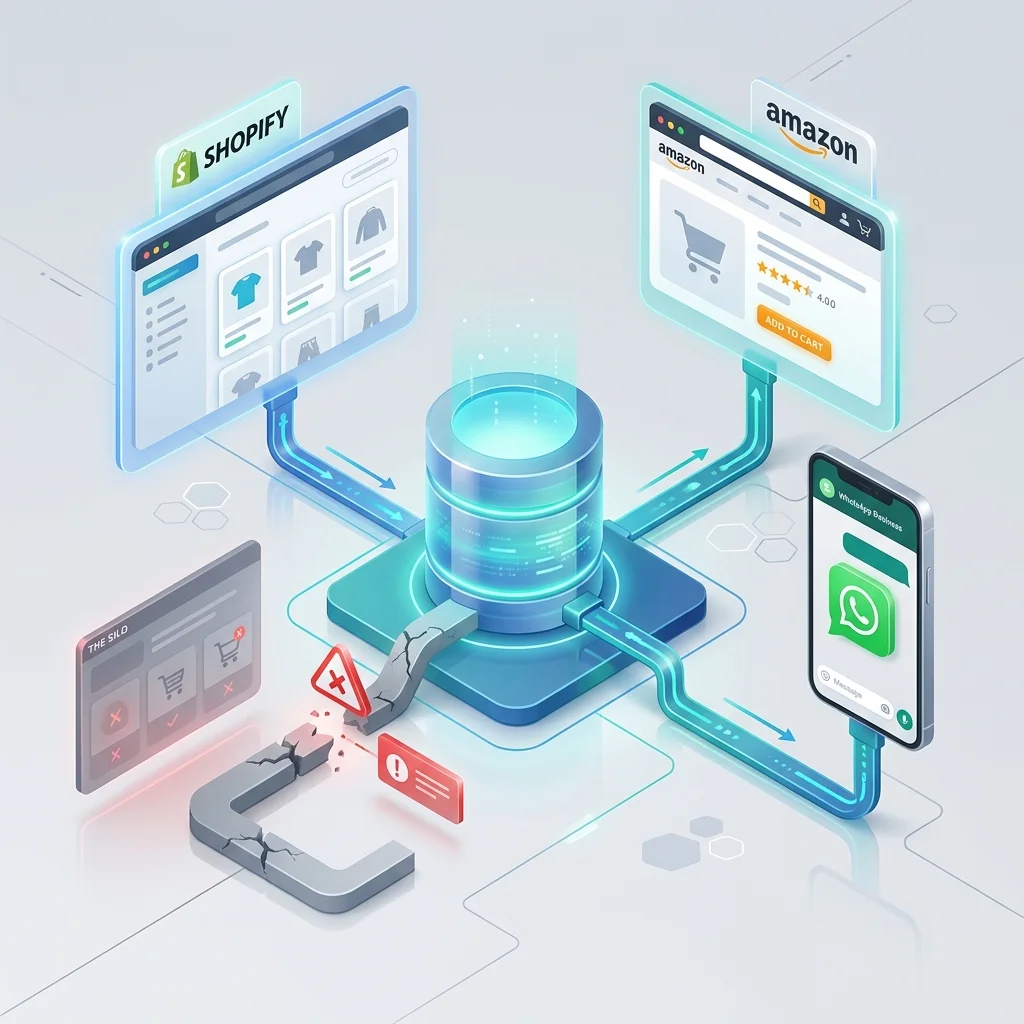
Audit your existing data pipelines, product catalog, and inventory APIs. Ensure your e-commerce backend (Shopify, WooCommerce, or custom) exposes a REST or GraphQL API for product and order data. Without clean, accessible data, the WhatsApp bot will surface inaccurate information to customers.
-
WhatsApp Business API Setup & Catalog Sync
Apply for WhatsApp Business API access via a certified BSP (e.g., Twilio, 360dialog, Gupshup). Connect your product catalog to Meta Commerce Manager. Configure webhooks so that inventory updates and price changes in your main platform auto-sync to the WhatsApp catalog within seconds.
-
Payment Gateway Integration
Integrate a payment gateway that supports dynamic payment link generation via API — Razorpay, PayU, Stripe, and Cashfree all offer this. When a customer confirms an order in the bot, the system calls the gateway API to generate a unique, pre-filled payment link and sends it as a WhatsApp message. On successful payment, the gateway fires a webhook to trigger order creation in your ERP.
-
User Adoption & Change Management
Train customer-facing teams on the bot's capabilities and escalation triggers. Define clear KPIs — conversion rate, average order value via WhatsApp, payment link click-to-completion rate — and monitor them from week one. Iterate on conversation flows based on drop-off analytics.
Real-World Results and Case Studies
Looking at real-world applications of WhatsApp Ecommerce provides invaluable insights. A mid-sized D2C fashion brand that integrated Razorpay payment links into their WhatsApp bot saw a 40% reduction in cart abandonment and a 28% uplift in repeat purchase rates within 90 days of launch — primarily because customers could complete purchases without being redirected away from the conversation. Another example involves a large electronics retailer that faced compliance challenges around PCI DSS. By routing payments exclusively through tokenised payment links (which keep card data off the WhatsApp thread entirely), they met regulatory requirements while simultaneously cutting their average checkout time from 4 minutes to under 90 seconds. These examples highlight the transformative potential of WhatsApp Ecommerce when executed correctly.
Future Outlook and Conclusion
As we look to the future, the role of WhatsApp Ecommerce will only become more pronounced. WhatsApp Pay is expanding across markets, and Meta's native in-chat payment infrastructure will eventually reduce dependency on external payment link generation for many use cases. AI-powered personalisation — recommending products based on purchase history, browsing context, and real-time inventory — will make conversational commerce increasingly indistinguishable from a premium in-store experience. Organizations must cultivate a culture of innovation, where experimentation is encouraged and failures are viewed as learning opportunities. In conclusion, the journey toward mastering WhatsApp Ecommerce is complex but deeply rewarding. For more information, please contact our team.
Frequently Asked Questions
How does payment processing work inside a WhatsApp chat?
WhatsApp itself does not process payments in most markets (WhatsApp Pay is available in India and Brazil). In other markets, the standard approach is dynamic payment link generation: when a customer confirms an order, the bot calls a payment gateway API (Razorpay, Stripe, PayU, etc.) to create a unique, pre-filled payment link and sends it as a clickable WhatsApp message. The customer taps the link, completes payment in the gateway's secure hosted page, and the gateway fires a webhook to confirm the transaction to your backend — all within under 2 minutes.
Is WhatsApp Commerce compliant with PCI DSS payment security standards?
Yes, when implemented correctly. Card data should never be entered into or stored within the WhatsApp chat. By using tokenised, hosted payment pages from certified PCI DSS Level 1 gateways (Razorpay, Stripe, PayU), card data never touches your application or the WhatsApp thread. The payment link redirects to the gateway's secure environment, keeping your WhatsApp integration fully outside the PCI DSS scope.
What conversion rate improvement can businesses expect from WhatsApp Commerce?
Results vary by industry and implementation quality, but businesses consistently report 20–45% reduction in cart abandonment compared to mobile web checkout, driven primarily by the frictionless in-chat experience and the 98% WhatsApp message open rate. Average order value often increases as well, because bots can intelligently upsell and cross-sell during the checkout conversation — something static web pages cannot match.
Can WhatsApp Commerce handle high order volumes during flash sales?
Yes, provided your backend infrastructure is scaled appropriately. The WhatsApp Business API is built for high throughput. The bottleneck is typically the payment gateway API rate limits and your inventory management system's ability to handle concurrent write operations. Implement idempotency keys in your payment link generation calls, configure circuit breakers on gateway API calls, and ensure your inventory service uses optimistic locking or reservation-based stock management to prevent overselling during traffic spikes.