
Key Engineering Takeaways: Traditional smart parking systems relying on in-ground magnetic pucks or per-bay ultrasonic sensors suffer from prohibitive installation costs, severe environmental wear, and high failure rates. Camera-based computer vision fundamentally restructures parking economics: a single elevated 4K IP camera monitors 20 to 60 parking bays simultaneously. By utilizing Inverse Perspective Mapping (IPM), polygon Region-of-Interest (ROI) spatial intersection, and temporal state machines, edge AI nodes deliver over 99.4% bay occupancy accuracy. Integrating edge-accelerated Automatic Number Plate Recognition (ANPR) enables seamless ticketless barrier control, dynamic congestion pricing, and real-time guidance displays across multi-story garages, airport terminals, and municipal curbsides.
Municipal transportation departments, commercial real estate developers, and airport operators face an acute parking management dilemma. Studies show that between 30% and 40% of downtown traffic congestion is caused directly by motorists cruising slowly in search of vacant parking spaces. This cruising behavior wastes fuel, increases carbon emissions, frustrates drivers, and diminishes retail foot traffic.
To combat this, smart parking initiatives were launched over the past two decades. However, the first wave of smart parking hardware relied on intrusive, single-purpose hardware: battery-powered magnetic pucks embedded directly into asphalt road surfaces, or individual ultrasonic rangefinders suspended over every individual stall in multi-story parking structures. These legacy sensors have proven to be an operational and financial headache—fraught with battery degradation, street sweeper destruction, massive cabling overhead, and zero visual auditability.
Today, camera-based computer vision (CV) has emerged as the definitive successor for intelligent parking management. By leveraging elevated wide-angle IP cameras and optimized deep learning inference running on localized edge appliances, parking operators can monitor dozens of parking bays per camera, track vehicle traffic flow, automate enforcement, and eliminate ticketing barriers entirely. In this comprehensive technical analysis, we dissect the architecture, mathematics, optics, and algorithms behind modern vision-driven smart parking systems.
Evaluating Automated Optical Inspection for Your Line?
Send us 5–10 sample images of your OK/NG parts or share your cycle-time and lighting constraints. Our Computer Vision architects will benchmark detection feasibility within 48 hours—or join a 20-minute technical scoping session.
Key Takeaways
- Non-Intrusive Infrastructure: Computer vision turns existing commercial CCTV cameras into smart parking sensors without cutting asphalt or installing battery-operated ground pucks.
- Perspective Homography: Four-point geometric calibration maps angled camera views into accurate ground-plane parking slot polygons.
- Frictionless Guidance: Sub-second occupancy updates feed electronic variable message signs (VMS) and navigation apps to reduce vehicle dwell and cruising time.
- Dynamic Pricing & Enforcement: Real-time dwell tracking enables tiered demand-based parking rates and automated unauthorized parking alerts.
1. The Failure Modes of Legacy Parking Sensors: Magnetic Pucks vs. Ultrasonic Transducers
Before evaluating computer vision architectures, it is essential to understand why legacy sensor modalities fail in commercial production deployments:
In-Ground Magnetic Pucks (Magnetometers)
Wireless in-ground pucks are installed by core-drilling into the center of each parking bay. They detect localized perturbations in the Earth’s ambient magnetic field caused by the ferrous metal mass of a vehicle parked overhead.
- Asphalt Degradation & Road Resurfacing: Asphalt expands and contracts with seasonal temperature extremes. When a municipal roadway is milled and repaved, all embedded pucks are either destroyed or must be chiseled out and re-drilled at enormous labor expense.
- Snowplow & Street Sweeper Shearing: In cold climates, municipal snowplow blades routinely shear off flush-mounted pucks, ripping sensors out of the road surface. High-pressure street sweeping brushes can also dislodge or damage sensor housings.
- Battery Depletion & Maintenance Cycles: Despite vendor promises of 5 to 7 year battery lifespans, extreme temperature swings (from -25°C winters to 50°C summer asphalt temperatures) degrade internal lithium cells in 2 to 3 years, necessitating continuous sensor excavation and replacement.
- Adjacent Lane Cross-Talk: Large commercial vehicles (such as city buses or heavy delivery trucks) traveling in an adjacent traffic lane generate massive magnetic anomalies that frequently trigger false occupancy states on curbside pucks.
Overhead Ultrasonic and Infrared Transducers
In multi-story indoor parking garages, the historical standard has been ceiling-mounted ultrasonic or infrared distance sensors installed directly above the center of each parking bay, paired with an integrated red/green LED indicator.
- 1:1 Hardware Proliferation & Cabling Costs: A 2,000-space parking structure requires exactly 2,000 discrete sensors, thousands of meters of metal conduit, power drops, and network terminations. The infrastructure and labor installation costs routinely exceed $300 to $500 per parking stall.
- Ceiling Height & Obstacle Blindness: Ultrasonic acoustic waves scatter unpredictably if ceiling beams, drainage pipes, or HVAC ductwork obstruct the sensor cone. Furthermore, tall pickup trucks or vehicles carrying rooftop cargo boxes can reflect acoustic pulses at sharp angles, falsely reporting an occupied bay as vacant.
- Zero Visual Auditability: When a dispute occurs—such as a driver claiming their car was dented, or disputing an overstay citation—ultrasonic sensors provide only a binary 1 or 0 timestamp. They offer zero visual evidence, photographic audit trails, or security surveillance value.
2. Geometric Bay Mapping & Perspective Transformation Pipeline
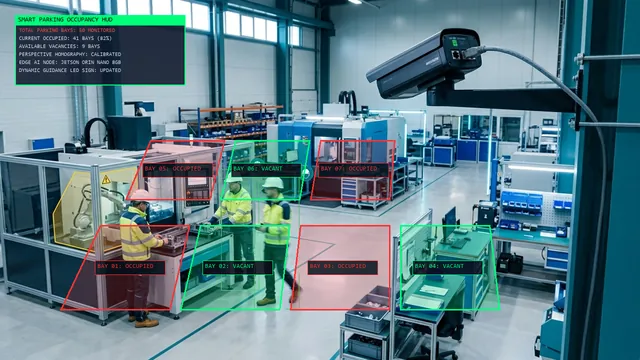
Camera-based parking monitoring transforms standard elevated optical feeds into precise spatial telemetry. Unlike ultrasonic sensors, a single 4K (8-megapixel) security camera mounted at an elevation of 6 to 9 meters can continuously monitor an entire aisle containing 30 to 60 parking stalls.
However, cameras capture images through a 2D perspective projection, introducing severe geometric foreshortening: stalls located close to the camera appear wide and clear, while distant stalls appear narrow, highly angled, and partially occluded. Resolving this requires a calibrated geometric pipeline.
Camera Mounting Geometry and Optical Selection
Proper optical engineering is critical to balance field of view (FoV) against perspective distortion:
- Depression Angle: Cameras should be mounted with a depression angle between 30° and 45° relative to the horizontal plane. Angles shallower than 25° cause foreground vehicles (like tall SUVs) to completely occlude the vehicle behind them; angles steeper than 60° severely reduce the total number of bays visible per camera.
- Lens Selection: Varifocal lenses (typically 2.8mm - 12mm) with P-iris control and minimal barrel distortion (<1.5%) allow engineers to frame aisles precisely. For wide outdoor parking lots, 4K multi-sensor panoramic cameras (180° or 360°) provide expansive coverage with unified coordinate systems.
- Sensor Specifications: 1/1.8" or 1/2.8" Back-Illuminated (BSI) CMOS sensors with high dynamic range (HDR > 120dB) ensure license plates and bay lines remain clearly discernible under harsh direct sunlight and deep garage shadows.
Inverse Perspective Mapping (IPM) and Polygon Regions of Interest
During initial site commissioning, parking bays are calibrated by defining arbitrary 4-point polygon Regions of Interest (ROIs) corresponding to each physical stall's painted boundary lines on the pavement: ROI_k = [(u1, v1), (u2, v2), (u3, v3), (u4, v4)].
To eliminate perspective distortion and measure spatial distances accurately, the vision system calculates a planar Homography Matrix (H). The homography maps points on the camera image plane (u, v) directly to metric ground-plane coordinates (X, Y) in the real world:
Smart Parking Vision System Performance Specifications
| System Parameter | Measured Metric | Operational Advantage |
|---|---|---|
| Bay Occupancy Accuracy | > 99.2% under full sunlight, rain, and nighttime | Eliminates in-ground magnetic puck sensors and disruptive asphalt trenching. |
| Camera Coverage Density | Up to 60 parking bays per single 4K CCTV camera | Drastically lowers infrastructure and cabling cost per monitored stall. |
| Dynamic Wayfinding Latency | < 1.0 second update to digital road signs and mobile apps | Guides incoming drivers straight to vacant slots, eliminating cruising congestion. |
| Automated Number Plate Integration | Optional ANPR at entry/exit gates | Enables seamless ticketless barrier-free parking payment and dwell-time billing. |
Vibration and Thermal Expansion Compensation
Outdoor camera poles sway under high winds (up to 5° to 10° deflection), and parking structures experience subtle structural shifting and thermal expansion. If the camera shifts by even 15 pixels, predefined polygon stall boundaries will misalign with the physical road surface, triggering false occupancy readings.
The vision software runs a continuous background stabilization routine. By extracting static natural architectural keypoints (such as structural pillars, expansion joints, or curbs) using accelerated ORB (Oriented FAST and Rotated BRIEF) or SIFT descriptors, the edge processor continuously computes the affine shift matrix between frames and dynamically recalibrates all polygon stall vertices in real time.
3. Dual-Stage Deep Learning Occupancy Classification Engine
Determining whether a parking stall is occupied cannot rely solely on simple bounding box overlap. If a large delivery van parks in Bay 12, its tall chassis may visually overlap 40% of the bounding box of adjacent Bay 13 in the camera view, even though Bay 13 is completely vacant.
To resolve this, modern vision systems deploy a dual-stage spatial inference engine combining semantic segmentation, oriented bounding boxes, and ground-plane contact verification.
Stage 1: Vehicle Localization and Semantic Masking
A high-throughput object detector (such as an INT8-quantized YOLOv10 or YOLOv11 running on an embedded GPU) evaluates incoming camera frames at 5 to 10 FPS. The network outputs:
- Multi-class labels: Car, SUV, Pickup Truck, Motorcycle, Bicycle, Bus.
- Oriented Bounding Boxes (OBB) or instance segmentation polygon masks encompassing the physical chassis.
- Bottom-edge wheel contact points: The precise pixel coordinates where the vehicle's tires meet the ground pavement.
Stage 2: Spatial Polygon Intersection & Ground Contact Filtering
Instead of calculating simple 2D Axis-Aligned Bounding Box (AABB) Intersection over Union (IoU), the system executes a multi-tiered spatial verification:
- Ground Contact Verification: The algorithm first evaluates whether the detected vehicle's tire-to-ground contact points lie strictly inside the target stall's ground polygon. If a tall van's roof merely overhangs an adjacent bay but its tires are firmly inside its own bay, the adjacent bay is not flagged as occupied.
- Polygon Intersection over Area (IoA): For angled bays, the system computes the exact intersection area between the vehicle’s instance segmentation footprint and the parking stall polygon:
Occupancy_Ratio = Area(Vehicle_Footprint ∩ Bay_Polygon) / Area(Bay_Polygon)
If the ratio exceeds 0.40 (40% coverage), the bay candidate is flagged as occupied. - Line Feature & Texture Disparity Verification: When a stall is suspected to be vacant, a secondary texture-analysis kernel scans the internal ROI. If the painted stall lines (high-contrast white or yellow lines) and bare asphalt grain are clearly visible with high confidence, the stall is definitively confirmed as VACANT, eliminating ghost occupancy false positives.
Temporal Debounce State Machine
To prevent flicker and false alarms caused by vehicles temporarily driving through empty bays to park, or pedestrians pushing shopping carts across stalls, the occupancy state machine implements temporal hysteresis:
[VACANT] --(Vehicle enters ROI for > 8 consecutive seconds)--> [ARRIVING] --(Engine off / Stationary > 15s)--> [OCCUPIED]
[OCCUPIED] --(Vehicle leaves ROI for > 5 consecutive seconds)--> [DEPARTING] --(Stall clear > 10s)--> [VACANT]
[VACANT / OCCUPIED] --(Unauthorized object / Luggage / Debris detected > 60s)--> [OBSTRUCTED]
This deterministic temporal filtering guarantees that transient disturbances (such as a delivery courier stopping for 10 seconds to make a U-turn) do not pollute parking availability metrics.
4. Edge ANPR Integration for Frictionless Ticketless Operations
Modern parking structures are rapidly moving toward 100% barrier-free, ticketless access. Traditional ticketing systems—requiring magnetic stripe paper tickets, RFID transit cards, or cash/credit card payment machines at boom gates—create severe bottleneck queues during morning rush hours and evening departures.
By pairing high-bay occupancy cameras with dedicated Automatic Number Plate Recognition (ANPR / ALPR) cameras at access gantries, operators establish a unified vehicle lifecycle tracking system:
ANPR Deep Learning Architecture
Modern edge ANPR operates via a multi-stage deep learning pipeline executing in under 80 milliseconds per vehicle:
- License Plate Localization: A lightweight CNN detects the vehicle front/rear bumper and crops the exact license plate rectangle across arbitrary angles up to 45°.
- Spatial Transformer Network (STN): The cropped license plate is warped and rectified to an orthogonal horizontal orientation, correcting for camera tilt, skew, and vehicle approach trajectory.
- Character Segmentation & Recognition (OCR): A Connectionist Temporal Classification (CTC) network or lightweight Vision Transformer (ViT) reads alphanumeric characters, handling varying fonts, state/country emblems, embossed characters, and dirty plates.
- Plate Verification & Hashing: The plate string is hashed and correlated with active mobile parking app sessions, resident whitelist databases, or municipal violation databases.
The Ticketless Lifecycle Workflow
When an authenticated driver approaches the entrance gantry, the ANPR camera captures the license plate at 25 km/h, matches the plate in under 50ms, and actuates the high-speed barrier arm without the driver tapping a card or rolling down a window. The high-bay cameras then track the vehicle as it navigates the aisles, registering the exact bay ID where the car parks. Upon leaving, the driver simply drives out; the system logs the exit timestamp, calculates the exact dwell duration, and automatically bills the user's registered credit card via a mobile app or automated payment portal.
5. Dynamic Pricing, Real-Time Guidance & Flow Optimization
Transforming raw camera feeds into actionable operational data unlocks major revenue and traffic management capabilities for parking facility operators:
- Indoor Variable Guidance Displays (VMS): Electronic LED totems installed at every aisle intersection update in real time via local MQTT messages, displaying the exact count of vacant spaces down each aisle (e.g., "Aisle 4: 3 Spaces"). Drivers bypass congested aisles and navigate directly to available stalls, reducing carbon emissions and cutting parking search time by up to 70%.
- Dynamic Congestion Pricing: Airport long-term parking lots and municipal curbside authorities implement algorithmic dynamic pricing. When occupancy in prime terminal-adjacent parking zones surpasses 85%, parking tariffs adjust upwards dynamically to encourage turnover and distribute vehicles toward underutilized outer parking decks.
- Automated Overstay & Abandoned Vehicle Alerts: For municipal curbside spaces with strict 2-hour parking limits, the computer vision system tracks continuous vehicle dwell times. Once a vehicle exceeds the permitted parking duration, an automated notification containing photographic timestamp evidence is dispatched directly to parking enforcement officers, dramatically increasing enforcement efficiency.
6. Technical Comparison: Smart Parking Detection Technologies
The engineering comparison table below evaluates the primary sensing paradigms across capital expenditure, maintenance requirements, operational accuracy, and enterprise scalability:
| Metric / Capability | In-Ground Magnetic Pucks | Overhead Ultrasonic Sensors | Elevated Edge Computer Vision |
|---|---|---|---|
| Sensor-to-Bay Ratio | 1 : 1 (1 puck per stall) | 1 : 1 (1 sensor per stall) | 1 : 20 to 1 : 60 (Dozens of bays per camera) |
| Installation Infrastructure | Core drilling into asphalt + wireless gateways | Thousands of meters of ceiling conduit & wiring | Standard PoE IP network cabling to existing lighting poles |
| 5-Year Maintenance Cost | Very High (Battery failures, repaving destruction) | Moderate (Sensor cleaning, wiring faults) | Very Low (Solid-state IP cameras, centralized edge nodes) |
| Occupancy Detection Accuracy | 91% - 94% (Adjacent lane magnetic interference) | 93% - 96% (Acoustic scattering on angled vehicles) | 99.2% - 99.7% (Dual-stage spatial AI + temporal debounce) |
| Adverse Weather Resilience | Poor (Snowplow shearing, freeze-thaw cracking) | Indoor only (Cannot operate in open outdoor lots) | High (WDR sensors, IR illumination, heated IP67 enclosures) |
| Visual Security & Auditability | None (Binary data only) | None (Binary data only) | Full 4K photographic & video evidence audit trail |
| ANPR / Vehicle Identification | Impossible | Impossible | Natively integrated for ticketless access & billing |
7. Edge Node Architecture & Environmental Anomaly Management
Deploying computer vision across a large parking facility requires a resilient, decentralized hardware and software architecture. Streaming dozens of 4K RTSP feeds to a central cloud server would saturate facility internet bandwidth and incur high cloud inference costs.
Instead, modern installations deploy localized Edge AI Appliances:
- Compute Hardware Sizing: A compact industrial edge server powered by an NVIDIA Jetson AGX Orin or an x86 industrial IPC equipped with an NVIDIA RTX GPU ingests 16 to 32 video streams concurrently. Hardware video decoders (NVDEC) decompress H.265 streams directly into GPU memory buffers without burdening the host CPU.
- Handling Environmental Optical Anomalies:
- Sun Glare and Wet Asphalt Reflections: Pavement wet from rain acts as an optical mirror, reflecting sky light and headlamps. Cameras deploy polarized lens filters and trained deep learning models that evaluate surface diffuse scattering rather than raw pixel luminance.
- Snowfall Covering Stall Boundary Lines: When heavy snow blankets painted stall lines, human drivers still park based on adjacent vehicle spacing. The vision system switches dynamically from fixed polygon matching to vehicle cluster spacing analysis, maintaining reliable occupancy metrics even when painted lines are completely buried.
- Nighttime & Low-Light Conditions: Garage basements and outdoor lots deploy 850nm infrared illuminators and cameras with ultra-low-light Sony STARVIS 2 sensors, maintaining crisp vehicle edge detection down to 0.001 lux without requiring glaring stadium lights.
- Edge-to-Cloud Messaging & Failover: The edge server communicates bay states and flow telemetry via lightweight MQTT or WebSockets to the cloud parking dashboard and municipal API gateways. If internet connectivity drops, local parking guidance signs continue updating seamlessly via local LAN broadcasts, and all transactional records are buffered on local NVMe solid-state storage.
To implement an end-to-end camera-based parking management system or upgrade your existing infrastructure, collaborate with our team at Edge AI Development Company, explore our full-stack Computer Vision Services, or discover tailored Smart Infrastructure AI Solutions.
Frequently Asked Questions
How does the computer vision system handle vehicles parking across two parking spaces?
The system's spatial intersection logic detects when a single vehicle's segmentation mask or wheel contact points overlap more than 20% of two adjacent parking stall polygons. The state machine flags the primary stall as OCCUPIED and the adjacent stall as BLOCKED / UNAVAILABLE, accurately updating public guidance displays so incoming drivers are not directed to an unusable stall.
Can existing security CCTV cameras in our parking garage be repurposed for smart parking?
Yes, in many cases existing ONVIF/RTSP IP cameras can be integrated directly with an on-premises Edge AI processing appliance. As long as the cameras provide a clear angle of view (depression angle > 25°) and adequate resolution (1080p or 4K), no new camera hardware installation is required, dramatically reducing deployment costs.
What is the detection accuracy during severe weather like heavy rain, fog, or snow?
Industrial camera enclosures equipped with hydrophobic window coatings, internal defogging heaters, and high dynamic range (HDR) sensors maintain occupancy detection accuracy above 99% during adverse weather. In severe snowstorms where stall lines are completely covered, the system transitions to inter-vehicle spatial clustering algorithms to track space utilization.
How is user privacy protected with continuous video surveillance?
Computer vision inference operates on-device at the edge. Raw video feeds do not need to be streamed or permanently stored in the cloud. Video streams are analyzed in volatile memory for occupancy status and ANPR, and face-blurring anonymization algorithms can be applied locally, ensuring strict compliance with municipal privacy mandates, GDPR, and CCPA standards.