
Key Engineering Takeaways: Modern fulfillment centers and 3PL warehouses are transitioning from manual handheld scanners and isolated safety beacons to unified spatial computer vision. Deploying active stereo depth sensors and calibrated Time-of-Flight (ToF) cameras achieves sub-5mm volumetric parcel dimensioning on in-motion conveyors moving up to 3.5 m/s. Meanwhile, hybrid forklift collision avoidance systems—combining fixed infrastructure CCTV with on-vehicle Jetson edge nodes—deliver sub-30ms time-to-collision (TTC) warnings to mitigate the logistics sector’s highest fatality risk. Successful implementation requires global shutter industrial sensors, polarized strobe illumination, TensorRT INT8 optimization, and fault-tolerant edge-to-WMS integration.
High-velocity distribution centers, third-party logistics (3PL) hubs, and e-commerce fulfillment networks operate under relentless operational pressures: razor-thin shipping margins, volatile peak volumes, strict Service Level Agreements (SLAs), and severe labor shortages. Historically, warehouse automation relied heavily on isolated, legacy hardware: stationary laser barcode scanners, manual tape measures for dimensional weight (DIM weight) compliance, and simple proximity radar or RFID tags for vehicle safety. These fragmented technologies suffer from high mechanical wear, blind spots, rigid operational tolerances, and zero visual auditability.
Today, enterprise logistics operators are replacing brittle single-purpose sensors with end-to-end Computer Vision (CV) architectures. By transforming standard and specialized optical feeds into real-time spatial intelligence, warehouses can automate complex visual tasks across the entire facility lifecycle. From microsecond parcel dimensioning on sortation lines to dynamic dock door turnaround tracking and autonomous forklift safety zones, computer vision provides the sensory backbone for Industry 4.0 logistics. In this technical deep dive, we examine the system architectures, sensor optics, neural pipelines, and hardware deployments powering modern automated warehousing.
Evaluating Automated Optical Inspection for Your Line?
Send us 5–10 sample images of your OK/NG parts or share your cycle-time and lighting constraints. Our Computer Vision architects will benchmark detection feasibility within 48 hours—or join a 20-minute technical scoping session.
Key Takeaways
- Active Collision Prevention: Computer vision eliminates forklift-pedestrian blind spots by calculating velocity-scaled dynamic safety zones on the facility floor.
- Tag-Free Deployment: Unlike UWB or RFID wearables that workers frequently forget, overhead edge vision tracks 100% of personnel and equipment passively.
- Spatial Homography Accuracy: Inverse perspective mapping translates 2D camera pixels into true metric floor distances with sub-10cm precision.
- Low-Latency Edge Alerts: Sub-50ms inference on industrial edge servers enables real-time acoustic alarms and automated vehicle speed governor interlocks.
1. Automated 3D Parcel Dimensioning: Cubing and In-Motion Volumetrics
In logistics shipping economics, carriers charge freight based on either actual weight or dimensional weight—whichever is greater. Inaccurate dimensional calculation results in massive revenue leakage for fulfillment providers or punitive carrier chargebacks. Manual dimensioning with handheld tape measures is slow, prone to human bias, and impossible to scale across hundreds of thousands of packages per shift.
Automated parcel dimensioners (cubers) utilize advanced 3D machine vision to capture the precise length, width, height, and bounding volume of irregular packages, cuboidal boxes, polybags, and palletized loads on moving belts in under 200 milliseconds.
3D Sensing Modalities: Active Stereo vs. Time-of-Flight (ToF) vs. Structured Light
Selecting the right 3D imaging physics is paramount for high-accuracy parcel volumetrics:
- Time-of-Flight (ToF) Sensors: Modulated continuous-wave or pulsed near-infrared (NIR) light signals are emitted, and the phase shift or photon round-trip time is recorded at each pixel detector. ToF sensors excel at high capture rates (up to 60 FPS) and compact integration over fast conveyor belts. However, they can exhibit multi-path interference on reflective polybags and ambient NIR noise near open dock bays.
- Active Stereo Vision: Employs dual CMOS image sensors augmented by an infrared pattern projector. The projector overlays a pseudo-random texture onto featureless cardboard boxes or monochromatic parcel plastic, allowing high-density disparity matching algorithms (such as Semi-Global Matching, SGM) to reconstruct robust 3D point clouds without suffering from laser multi-path scattering.
- Structured Light Triangulation: Projects calibrated sinusoidal or binary fringe patterns onto stationary or slow-moving pallets. While delivering sub-millimeter precision, structured light is vulnerable to motion blur, making it better suited for static high-bay pallet inspection stations than high-speed dynamic sortation.
Point Cloud Processing Pipeline & OBB Extraction
Once raw spatial data is acquired, the software pipeline must extract legal-for-trade certified dimensions (complying with OIML R129 or NTEP Class III/IIII standards) with typical tolerances under ±5mm. The algorithmic pipeline operates as follows:
- Pass-Through Filtering & Crop Box: The raw 3D point cloud from the overhead depth camera is filtered to isolate the conveyor belt inspection envelope, eliminating surrounding frame rails and idle mechanical components.
- RANSAC Ground Plane Segmentation: Random Sample Consensus (RANSAC) mathematically identifies the conveyor belt surface equation:
Ax + By + Cz + D = 0
Points within a 3mm tolerance of this fitted plane are designated as the reference datum and removed, leaving only the elevated parcel point cloud. - Statistical Outlier Removal (SOR): Filters noise caused by airborne dust particles, vibrating conveyor seams, or stray ambient light reflections.
- Oriented Bounding Box (OBB) Calculation: Standard Axis-Aligned Bounding Boxes (AABB) fail when a package travels skewed across the belt. Instead, the pipeline performs Principal Component Analysis (PCA) or Minimum Area Bounding Rectangle (via Rotating Calipers algorithm on the 2D projected convex hull) to determine the true orientation matrix, yielding true orthogonal Length, Width, and Height dimensions regardless of orientation.
- Integration with Dynamic Checkweighers: The computed spatial volume is time-synced with an inline load cell checkweigher via an industrial fieldbus (EtherCAT or PROFINET), packaging volumetric dimensions, density metrics, and mass into a consolidated payload transmitted to the Warehouse Management System (WMS).
2. High-Speed Conveyor Barcode Scanning & Sortation
Automated parcel hubs route parcels at line velocities exceeding 2.5 to 3.5 meters per second using cross-belt and tilt-tray sorters. Traditional single-line oscillating laser scanners struggle when barcodes are crinkled, poorly printed, partially torn, or presented across varying elevations and orientations on multi-sided cartons.
Modern fulfillment operations deploy 6-sided camera tunnels (Omni-Directional Vision Tunnels) powered by multi-camera industrial vision systems capable of continuous 1D (Code 128, UPC, Code 39) and 2D (Data Matrix, QR code) localization and decoding at microsecond exposure speeds.
Camera, Optics, and Illumination Specifications
Deploying vision tunnels over high-speed conveyors imposes rigorous optical constraints:
- Global Shutter CMOS Image Sensors: Rolling shutter sensors induce geometric distortion and scanline tearing on packages moving at high velocity. Industrial global shutter sensors (ranging from 5MP to 12MP resolution) expose all pixels simultaneously, freezing motion completely.
- Lens Selection & Telecentricity: C-mount or M42-mount industrial lenses with low optical distortion (<0.5%) and high depth-of-field (DoF) are utilized. To resolve fine 10-mil barcode modules across varying parcel heights (from 25mm flats to 750mm cartons), liquid-lens autofocus systems or multi-plane fixed focal arrays are deployed.
- High-Frequency Pulsed Strobe Illumination: Continuous high-power illumination creates excessive heat, degrades LED lifespan, and blinds workers. Strobe controllers fire ultra-bright 630nm red or 850nm NIR LED bars synchronized with the camera trigger signal via TTL pulses. Exposure times are locked under 80 to 120 microseconds, eliminating motion blur.
- Polarizing Optical Filters: Glossy polybags and cellophane-wrapped pallets cause specular glare that blinds barcode decoders. Linear or circular polarizing filters installed over both the illuminator and the camera lens block cross-polarized glare, revealing clear barcode edges beneath reflective plastic.
Neural Barcode Localization & Error Recovery
When labels are damaged, distorted by cardboard creasing, or printed with degraded ink thermal heads, standard morphological decoders fail. Next-generation computer vision pipelines integrate a lightweight convolutional neural network (e.g., a streamlined YOLO or MobileNet-SSD backbone) running on a local industrial IPC. The network predicts bounding boxes around potential label areas, crops the region of interest (ROI), applies adaptive binarization (Sauvola or Niblack thresholding), and passes the rectified image to an edge-accelerated deep-learning OCR/decoder, recovering over 99.85% of previously unreadable parcels and preventing costly manual exception sorting.
3. Dock Door Trailer Loading, Unloading & Turnaround Tracking
The inbound/outbound cross-dock terminal is frequently the primary operational bottleneck in logistics. Inefficient trailer loading leads to "shipping air," extended dwell times trigger steep detention fees from trucking carriers, and manual paper check-ins introduce pervasive data entry errors.
Strategically installed wide-angle IP cameras over dock doors provide continuous telemetry on dock door states, trailer turnaround velocity, and volumetric load utilization:
Voxel-Based Trailer Volumetric Fill Estimation
By mounting dual 3D depth sensors or wide-angle stereo cameras directly above the interior threshold of the loading dock, the vision system continuously constructs a 3D voxel grid (volumetric pixels) of the trailer interior. As forklifts and autonomous mobile robots (AMRs) deposit pallets or loose-load cartons:
- Volumetric Fill Percentage: The pipeline compares the occupied voxel volume against the theoretical interior volume of standard 53-foot dry vans or 40-foot high-cube containers. Managers receive real-time alerts if freight is being stacked below target cubic utilization thresholds.
- Cargo Stability & Shifting Alerts: Asymmetrical weight distributions and precarious, leaning pallet stacks are flagged instantly before the trailer door is rolled down, preventing catastrophic freight shifts and transit collapses.
- Automated Turnaround & Dwell Timers: Video analytics detect trailer backing, door opening, dock leveler deployment, pallet transfer cycles, and door closure. Dwell times are logged with tamper-evident video verification, automatically validating or disputing carrier detention invoices.
4. Forklift-Pedestrian Collision Warning Systems (Fixed vs. On-Vehicle)
According to OSHA statistics, forklift accidents account for roughly 35,000 serious injuries and nearly 100 fatalities annually in the United States alone. The intersection of pedestrian traffic with 4-ton forklifts navigating tight aisles, blind intersections, and noisy loading docks presents an acute safety challenge. Traditional physical solutions—convex mirrors, blue warning spotlights, and wearable RF tags—rely heavily on human alertness or 100% worker tag compliance.
Computer vision delivers proactive, deterministic collision avoidance through two complementary paradigms: Fixed Infrastructure CCTV and On-Vehicle Edge Vision.
Fixed Infrastructure Vision vs. On-Vehicle Edge Systems
While facility-wide CCTV provides a global macroscopic view of intersection congestion and unauthorized pedestrian incursions, on-vehicle edge vision is critical for localized, real-time life safety:
- Fixed Overhead Cameras: Mounted at aisle intersections, blind corners, and charging stations. They stream RTSP video to an on-premise edge appliance running multi-object tracking. When a pedestrian and a moving forklift approach a blind corner simultaneously, the edge node triggers physical amber LED flashers and audible alarms overhead.
- On-Vehicle Ruggedized Edge Nodes: Heavy industrial forklifts are outfitted with 3 to 4 ruggedized IP67/IP69K automotive cameras (front mast, rear counterweight, left/right chassis) wired directly to an in-cab edge AI computer (such as the NVIDIA Jetson Orin Nano or Orin NX) powered by the forklift's 24V/48V DC battery system via an isolated DC-DC converter.
Pedestrian Pose Estimation & Blind-Spot Occlusion Handling
Relying solely on 2D bounding boxes is insufficient for vehicular safety. A worker stooping down to pick up a dropped parcel or kneeling behind a low pallet will not match standard upright human aspect ratios, leading to missed detections in naive models.
Enterprise safety models utilize Human Pose Estimation (Keypoint Detection) to locate anatomical landmarks (head, shoulders, elbows, hips, knees, ankles). Even if 70% of the worker is occluded by a stacked pallet, identifying the head and shoulder keypoints guarantees detection. The system constructs a dynamic spatial danger zone around the forklift that scales dynamically based on vehicle velocity: when traveling forward at 12 km/h, the forward warning cone extends outward, while the lateral perimeter contracts.
Kinematic Time-to-Collision (TTC) & Vehicle Integration
The on-vehicle edge computer executes an end-to-end inference and kinematic loop every 30 milliseconds:
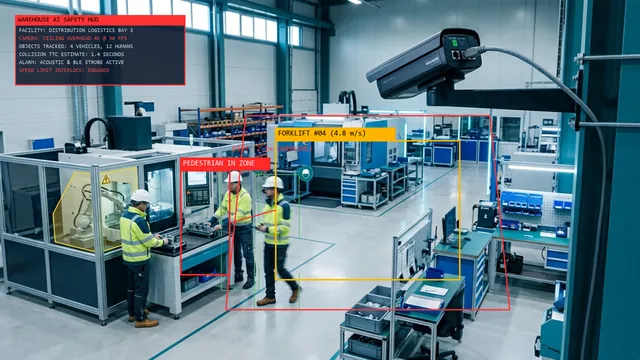
Warehouse Safety System Architecture & Collision Latency
| Safety Layer | Computer Vision Metric | Automated Intervention |
|---|---|---|
| Dynamic Exclusion Zone | Velocity-scaled boundary polygon around forklift | Zone expands proportionally with vehicle speed (2m to 6m buffer). |
| Time-to-Collision (TTC) | Homography ground plane spatial calculation | TTC < 1.5 seconds triggers directional acoustic alarm and strobe beacons. |
| Forklift Telematics Interlock | CAN-bus / Relay slow-down command | Automatically decelerates forklift to crawl speed (2 km/h) in blind intersections. |
| Safety Dashboard Compliance | OSHA incident near-miss logging | Generates facility heatmaps of frequent near-miss conflict corridors. |
Through direct integration with the forklift's electronic control module via J1939 CAN bus, the vision system can enact automated soft speed limiting, restricting the vehicle from accelerating if a human is detected within the hazardous travel envelope.
5. High-Bay Inventory Auditing: Automated Pallet Scanning with AGVs & Drones
In high-bay warehouses where racking extends 10 to 15 meters into the air, manual inventory audits are hazardous, slow, and expensive. Taking an operator up in a scissor lift or turret truck to verify pallet license plate barcodes (LPIDs) exposes workers to fall risks and pulls costly equipment out of active fulfillment rotations.
Computer-vision-equipped Autonomous Guided Vehicles (AGVs), narrow-aisle autonomous mobile robots (AMRs), and indoor inventory drones now perform cycle counting autonomously during off-peak hours:
- Multi-Camera Vertical Arrays: AMRs equipped with vertical mast-mounted cameras navigate aisles using LiDAR SLAM. As the robot glides down the aisle at 1 m/s, high-resolution cameras simultaneously capture images of rack levels 1 through 6.
- Barcode Triangulation & Text OCR: Onboard models detect and decode 1D/2D inventory labels, read human-readable alphanumeric text, and correlate optical readings with the robot's high-precision wheel odometry and LiDAR elevation data.
- Empty Bay and Slot Discrepancy Detection: Beyond reading tags, the vision system assesses spatial occupancy in each racking slot. If the WMS expects a pallet in Bay 14-03-B but the vision system registers empty structural beams (or detects an unrecorded pallet sitting in an assigned empty location), a reconciliation exception ticket is instantly generated.
6. Technical Comparison: Computer Vision Solutions Across Warehouse Domains
The following engineering specification matrix contrasts the architectural, optical, compute, and latency parameters required across diverse warehouse computer vision deployments:
| Subsystem | Camera / Sensor Type | Sensor Shutter | Illumination Architecture | Inference Hardware | Latency SLA | Key Model / Algorithm |
|---|---|---|---|---|---|---|
| 3D Parcel Dimensioning | Active Stereo RGB-D / ToF | Global Shutter | NIR Pattern Projector + 850nm ambient rejection | Industrial x86 IPC + RTX GPU | < 150 ms | RANSAC Plane Fitting + OBB Rotating Calipers |
| Conveyor Sortation Scanning | Multi-head 8K Line-Scan or 12MP Area-Scan | Global Shutter | Pulsed 630nm Red LED Bars w/ Cross-Polarizers | Dedicated FPGA / Edge IPC | < 30 ms | YOLOv10 ROI Locator + Deep OCR / Barcode Decoder |
| Dock Door Turnaround | 4K Ultra-Wide Panoramic IP Camera | Rolling Shutter w/ WDR (>120dB) | High-Bay Industrial LED / Ambient Daylight | Centralized Edge Server (Jetson AGX / T4) | < 500 ms | Voxel Grid Occupancy + Multi-Object Tracking |
| Forklift Collision Avoidance | Quad Automotive IP69K HDR Cameras | Global Shutter | Integrated High-Power 940nm Stealth IR Arrays | Ruggedized In-Cab Jetson Orin NX | < 30 ms | YOLO-Pose Keypoints + Kinematic TTC Tracker |
| High-Bay Racking Audit | Vertical Stereo Rig + 2D LiDAR | Global Shutter | Onboard Diffused LED Spotlights | AGV Mobile Compute (Jetson Orin / x86) | < 100 ms | Visual SLAM + 2D Data Matrix Decoder + Slot Verification |
7. Edge-to-Enterprise Integration & Resilient Architecture
Deploying computer vision models in production warehouses requires seamless integration into existing enterprise resource planning (ERP), Warehouse Management Systems (WMS such as Manhattan Associates, Blue Yonder, SAP EWM), and Programmable Logic Controllers (PLCs).
An enterprise-grade computer vision system incorporates a three-tiered software architecture:
- Physical Edge Layer: High-performance edge gateways—engineered in partnership with our specialized team at Edge AI Development Company—process uncompressed camera frames locally. Hardware decoding via NVDEC, memory-pinned buffers, and TensorRT INT8 optimization ensure real-time performance without taxing CPU resources.
- Fieldbus & Control Integration: For automated machine intervention (such as halting a conveyor upon detecting a jam, actuating a pneumatic diverter arm, or limiting forklift speed), edge nodes interface directly with Siemens, Rockwell, or Beckhoff PLCs via industrial protocols: EtherNet/IP, Modbus TCP, or digital I/O relays with sub-10ms response loops.
- WMS & Cloud Telemetry Layer: Volumetric dimensions, decoded parcel tracking IDs, dock dwell timestamps, and safety incident logs are serialized into JSON or Protobuf payloads and transmitted over secure MQTT or gRPC channels to the warehouse analytics core. If the facility WAN fails, edge gateways utilize local circular disk buffers (RocksDB or embedded SQLite), guaranteeing zero data loss during network dropouts.
For operations looking to design or retrofit automated facilities, exploring custom Computer Vision Services and tailored Manufacturing & Logistics AI Solutions provides the blueprint for sustainable operational ROI.
8. Mitigating Harsh Warehouse Environmental Realities
Real-world logistics facilities present substantial optical and mechanical hurdles that break naive computer vision pilots:
- Vibration and Mechanical Shock: Forklifts traversing floor expansion joints or dock leveler plates experience shocks exceeding 3G to 5G. Camera mounts must incorporate silicone dampening isolators and locking M12 connectors to prevent lens defocusing or cable disconnection.
- Dust, Fibers, and Particulate Accumulation: High-velocity cardboard movement sheds massive volumes of paper dust and micro-fibers, which settle on optical surfaces and degrade contrast. Industrial vision enclosures must be rated IP65/IP67, feature hydrophobic/oleophobic glass coatings, and utilize automated compressed-air purge nozzles to periodically clean lens covers.
- Dynamic Ambient Light Shifts: Open bay doors flood inspection stations with direct sunlight (up to 100,000 lux) during clear afternoons, transitioning to dim sodium vapor lighting (under 150 lux) at night. Image signal processors (ISPs) must feature true Wide Dynamic Range (WDR > 120dB) paired with bandpass optical filters tuned specifically to the wavelength of the artificial strobe system.
Frequently Asked Questions
How accurate is 3D computer vision parcel dimensioning compared to traditional legal-for-trade measuring devices?
Calibrated 3D computer vision dimensioners achieve measurement accuracy within ±5mm (±0.2 inches) for cuboidal packages and irregular shapes on conveyors moving up to 3.5 m/s. When properly calibrated and sealed, these systems meet NTEP (National Type Evaluation Program) and OIML R129 international standards for legal-for-trade commercial billing.
Can warehouse computer vision operate with existing CCTV security cameras?
Yes, for macro-level analytics such as dock door turnaround tracking, congestion heatmaps, and general aisle intrusion monitoring, existing RTSP/ONVIF IP cameras can be integrated directly with an edge AI server. However, high-speed conveyor scanning and sub-millimeter parcel dimensioning require specialized global shutter cameras, telecentric optics, and synchronized strobe lighting.
How does on-vehicle forklift computer vision prevent false alarms from stationary obstacles?
Advanced collision avoidance systems combine human pose estimation with kinematic vector tracking. The model differentiates between static structural columns/pallets and dynamic human workers. Furthermore, warning zones are dynamically shaped based on the forklift's steering angle and velocity, sounding alarms only when a human enters the active trajectory path.
What happens if warehouse Wi-Fi or Internet connectivity drops?
Life-critical applications (such as forklift collision warning systems and conveyor sorting diverters) run 100% locally on edge hardware (like NVIDIA Jetson or industrial IPCs) without relying on external cloud connectivity. Data transactions and dimensioning records are spooled locally and automatically synchronized with the WMS once the network connection is restored.